
The most useful garden trellis is one you can still water, inspect and harvest when the vines are full. Choose it for the crop and the space around it, then use flowers, paths and furniture to finish the setting.
For a small bed, start with an A-frame or a single upright panel. A roomy garden can accommodate an arch, a circular bean feature or a substantial pergola.
These twenty ideas show complete growing areas rather than isolated supports. Match plant spacing to the chosen variety; growing upward does not remove the roots’ need for room.
Plan supports before the plants become tangled. Illinois Extension explains how vertical supports keep vining crops easier to manage.
Find a trellis for your space
- A Bean Arch Between Two Productive Beds
- A Folding Cucumber A-Frame in a Compact Bed
- A Bamboo Bean Tipi in a Round Potager
- A Brushwood Pea Border Beside a Cottage Path
- A Straight Pea Net for a Long Vegetable Plot
- A Ladder Trellis in a Sunny Courtyard
- A Harvestable Cucumber Screen by the Patio
- A Bean Portal for Two Large Patio Planters
- A Bean Obelisk in a Flower-Filled Kitchen Garden
- An Offset Pea Frame Against Warm Brick
- A Purpose-Built Bean Pergola Over a Dining Corner
- Low Pea Hoops Along a Spring Salad Bed
- An Open V-Frame With Two Harvesting Sides
- A T-Frame Bean Row With Replaceable Strings
- A Radial Bean Canopy for a Circular Bed
- A Folding Zigzag Pea Screen for an Awkward Corner
- A Cucumber Column in a Small Front Courtyard
- A Low Squash Ramp With Fruit Kept Close to Ground
- A Pea Backboard for a Raised Working Bed
- A Modular Trellis Court That Can Follow the Rotation
Start with the crop, then choose the support
A tall structure only helps when the variety can use it. These are growing habits to check on the seed packet.
Peas: check mature height
Short and tall varieties need different support heights. Peas fit a cool growing season; use local planting guidance. Pea growth habits.
Beans: climbing or bush?
Choose pole or climbing beans for tall frameworks. Bush beans stay compact and do not fill the same space. Bean growth habits.
Cucumbers: choose a vining type
Trellising can save ground space, but warm-season conditions and the variety still matter. Cucumber growing guidance.
Squash: choose the fruit carefully
Small-fruited trailing types are the practical starting point. Keep large squash and pumpkins on the ground. Trellis and fruit limitations.
1. A Bean Arch Between Two Productive Beds
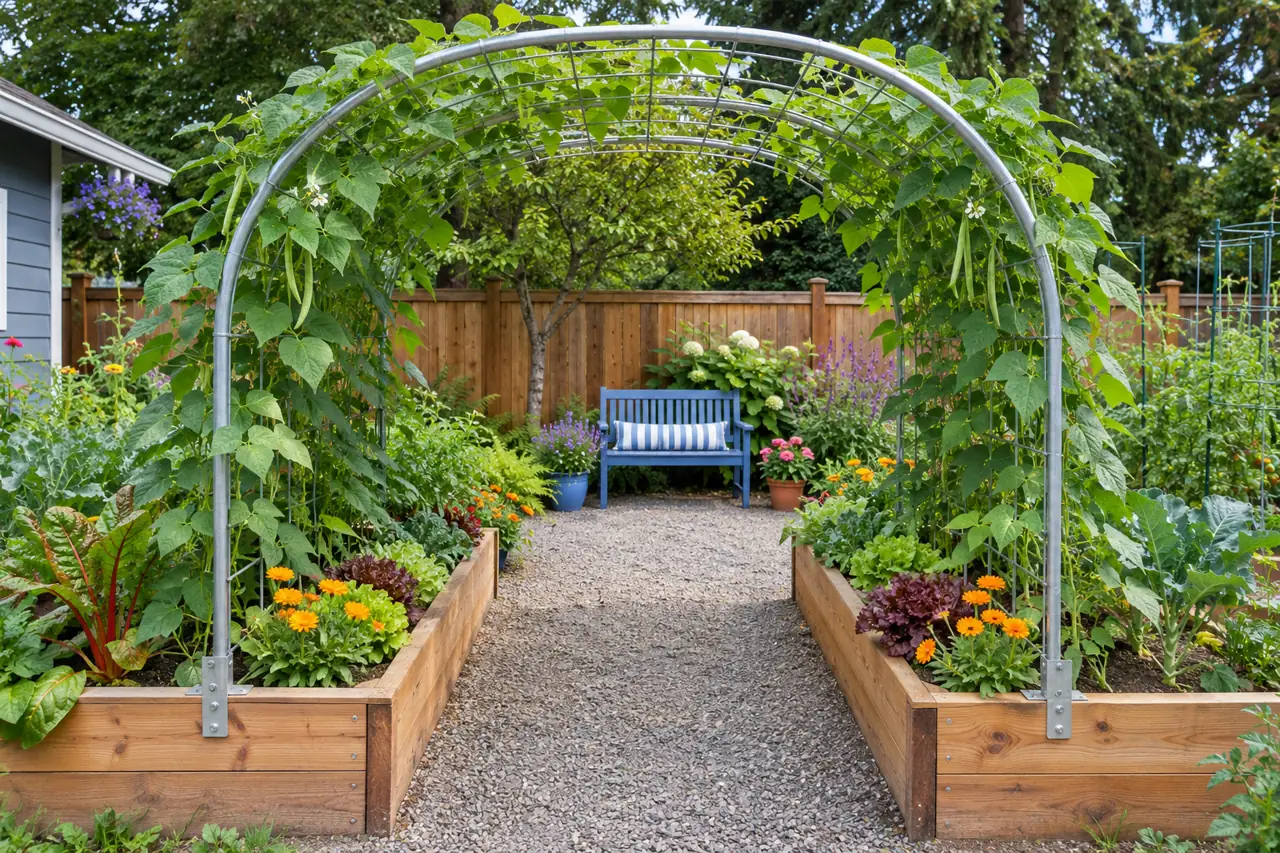
A bean arch turns the route between two beds into a proper garden entrance. Keep the vegetable beds low, then let the curved support provide the height.
Plant climbing beans at the sides and keep the central aisle entirely clear. Lettuce and calendulas can soften the bed ends without swallowing the path.
Galvanized mesh, pale timber edging and a blue bench make the whole corner feel connected.
I love how the arch gives an ordinary harvest walk a destination.
Install a structure suited to mature vines and your wind exposure before planting. Finish exposed wire ends safely, and allow generous clearance for foliage as well as people.
This is a climbing-bean setting, not a place to suspend giant squash above a busy walkway.
2. A Folding Cucumber A-Frame in a Compact Bed
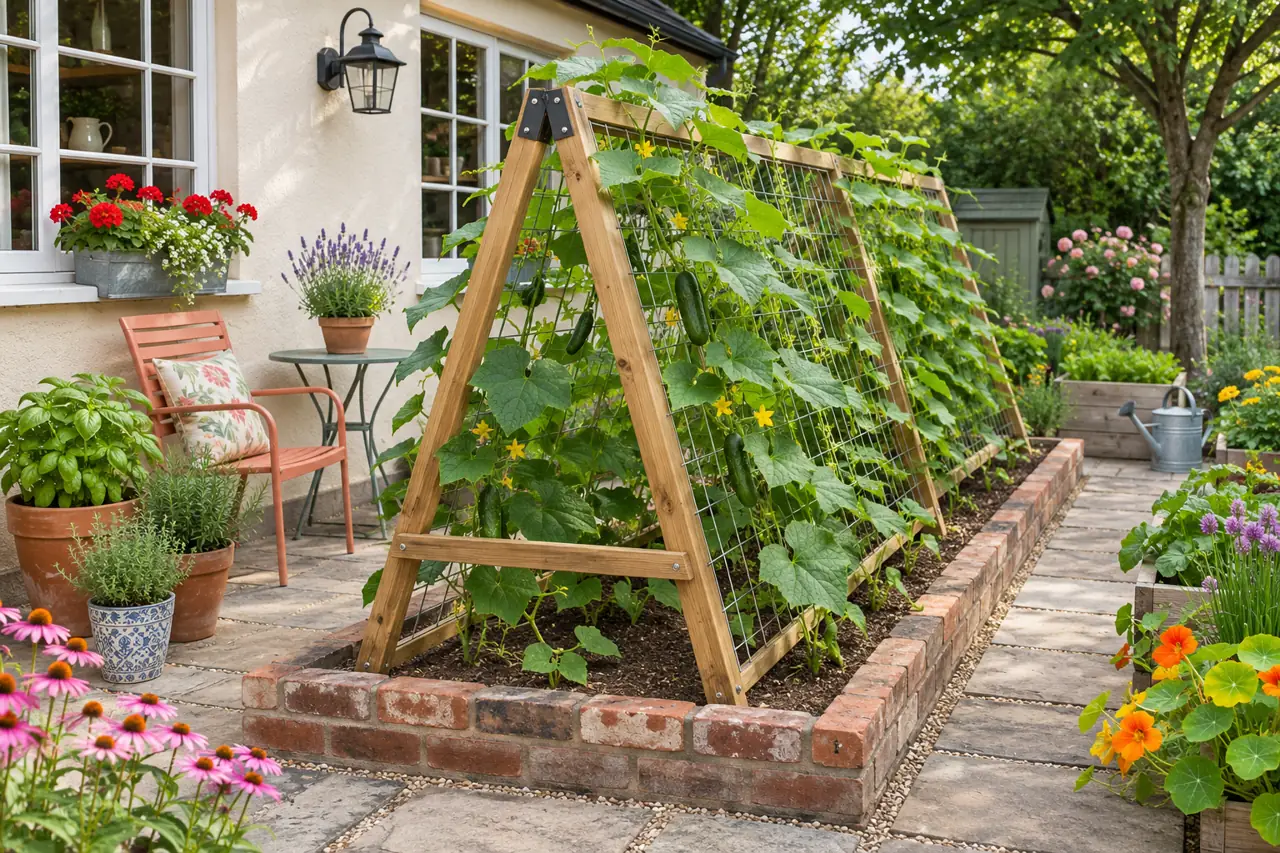
Use a folding A-frame when a small rectangular bed needs a trellis that can leave at the end of the season.
Two mesh faces meet at the ridge, creating a clear triangular shape.
Train vining cucumbers up the outside and leave access along both long edges.
Brick edging and terracotta herb pots give the practical frame a courtyard feel.
A coral chair belongs beyond the working path, where you can sit without blocking the watering can.
Choose sound timber and suitable outdoor hinges, then secure the open frame so it cannot spread or collapse. Folding hardware alone is not an anchor.
Check both faces while harvesting; hidden cucumbers can grow unnoticed behind the leaves.
Keep the space underneath accessible rather than packing it with plants that become difficult to reach.
3. A Bamboo Bean Tipi in a Round Potager
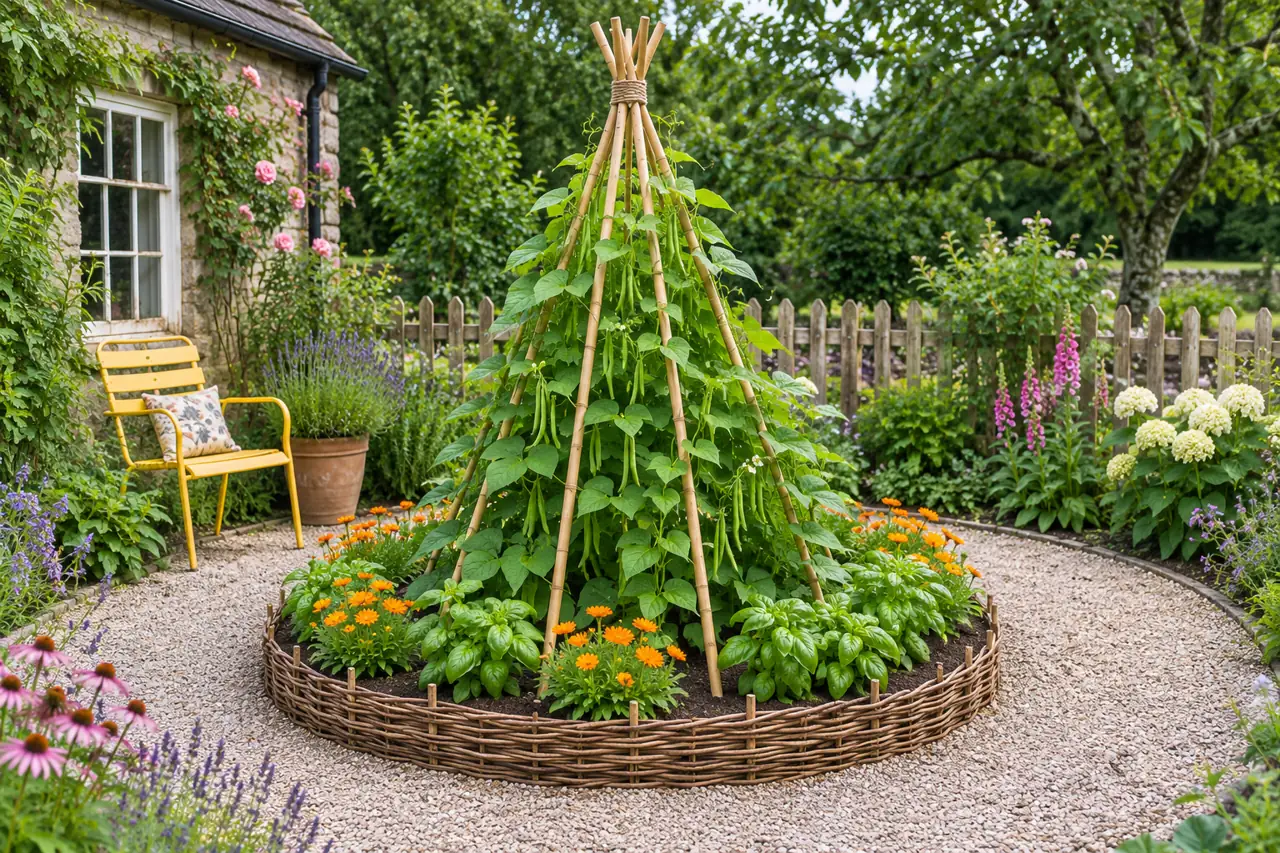
A bamboo bean tipi makes a small circular bed feel like the center of a potager. Arrange the poles around the growing area and join them securely at the top.
Keep the planting ring reachable from a gravel path all the way around.
Low herbs and orange flowers can occupy the sunny outer edge, with a yellow chair outside the bed rather than tucked beneath the vines.
Natural bamboo and woven edging give the garden a soft, handmade character.
Select climbing beans, because bush beans will not fill this tall framework. Check the variety’s eventual height before choosing poles.
The narrow upper section will become crowded first, so leave room for hands around the base and plan how to manage growth within comfortable reach.
RHS guidance distinguishes climbing French beans from dwarf types. Choose the climbing habit for this framework.
4. A Brushwood Pea Border Beside a Cottage Path
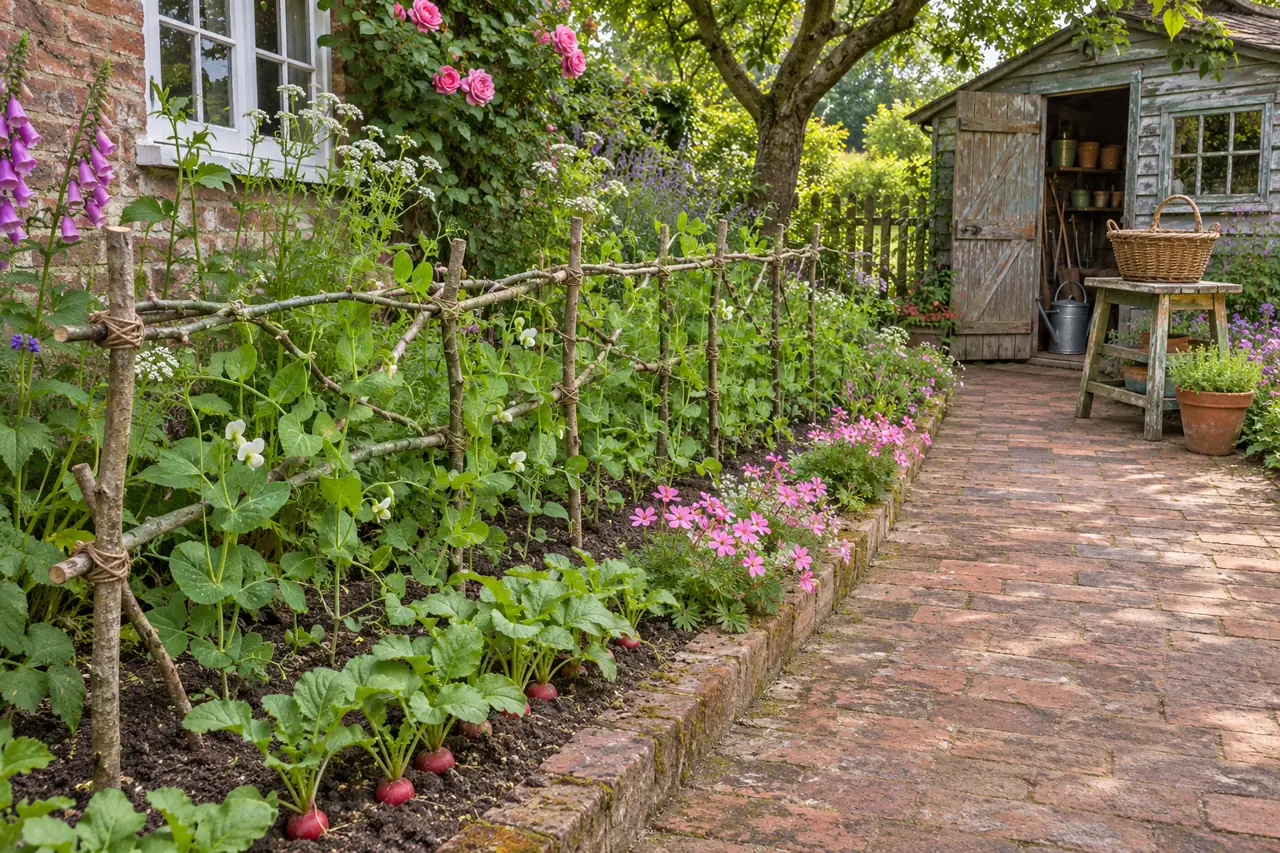
A brushwood border suits a cottage garden where a tall, rigid frame would feel too formal.
Firmly placed twiggy branches create a low network for shorter peas.
Run it beside a broad brick path, with the crop close enough to pick without stepping into the bed.
Radishes can fill a neighboring strip. Keep decorative flowers in their own edging or pots so they do not bury the pea stems.
A weathered shed and an empty harvest basket complete the scene without much extra decoration.
Choose sound branches with useful side twigs, and keep sharp tips away from faces and passing sleeves.
This light support is for modest pea growth. Tall varieties, vigorous beans and heavy fruit call for a stronger, taller structure than a few attractive sticks.
RHS describes twiggy branch supports for shorter peas. This is a light-crop option.
5. A Straight Pea Net for a Long Vegetable Plot
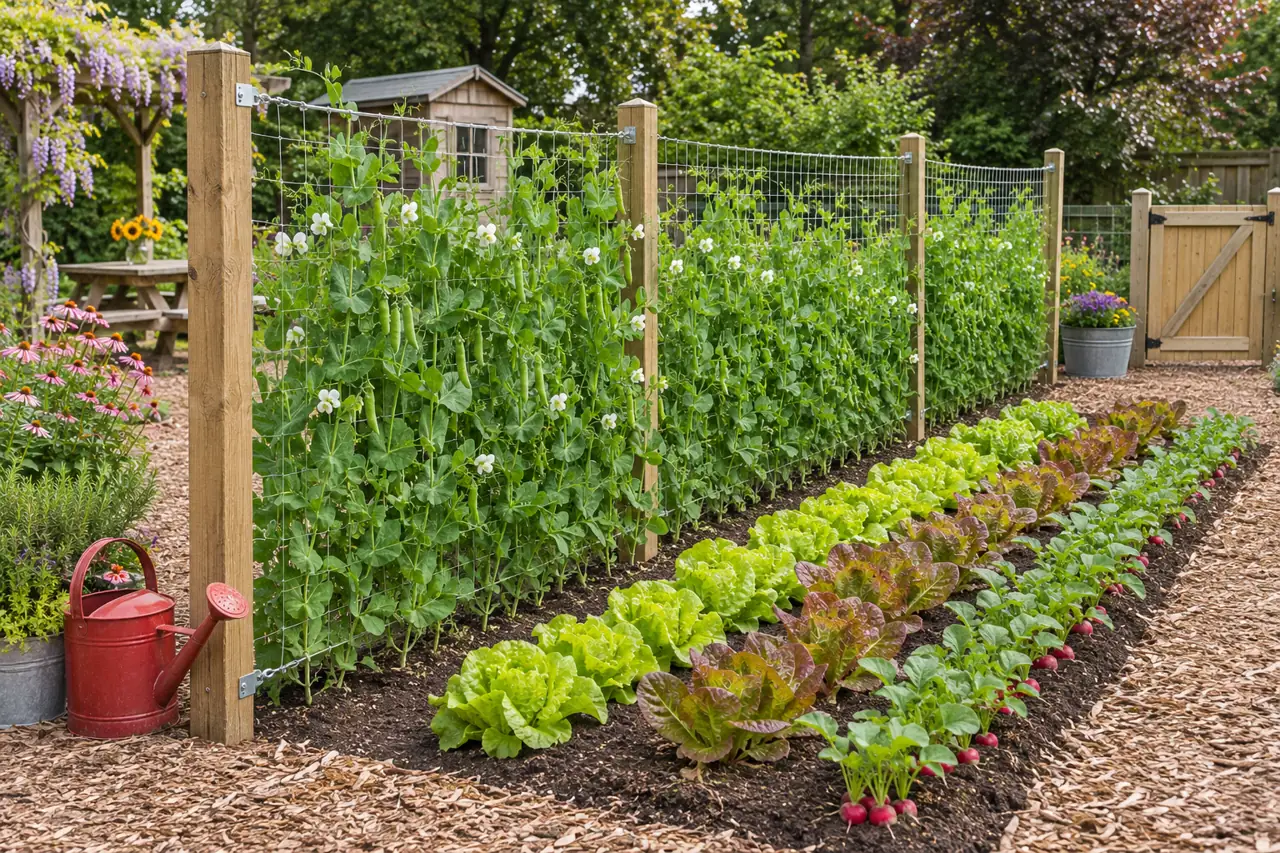
A straight pea net is a useful choice for a long, narrow vegetable plot. The support becomes the back line, while shorter crops stay in orderly rows beside it.
Set the posts and tension the net before the peas need help climbing.
Leave a harvest path on both sides if you can. One-sided access makes it easy to miss pods hidden behind the foliage.
A timber gate, mulched paths and a red watering can give this working garden a simple, cheerful finish.
Match the net height to the chosen pea variety instead of buying the tallest roll available.
Keep netting taut and secured, with no loose lengths trailing across paths.
Inspect it as plants grow, and remove damaged pieces rather than allowing tangled scraps to accumulate around the bed.
Measure the space the whole trellis will occupy
An illustrative width calculation helps reveal space a narrow planting bed can hide. These dimensions are not accessibility standards or construction specifications.
Growing bed
Example bed width: 2 ft. Measure the actual bed rather than using the label on a kit.
Working paths
Example allowance: 2 ft on each side. Your own safe working and mobility needs may require more.
Outward overhang
Example V-frame extension: ½ ft on each side. Include foliage and fittings in the real measurement.
Total example width
2 + 2 + 2 + ½ + ½ = 7 ft.
Measure length, height and access separately before choosing the final design.
6. A Ladder Trellis in a Sunny Courtyard
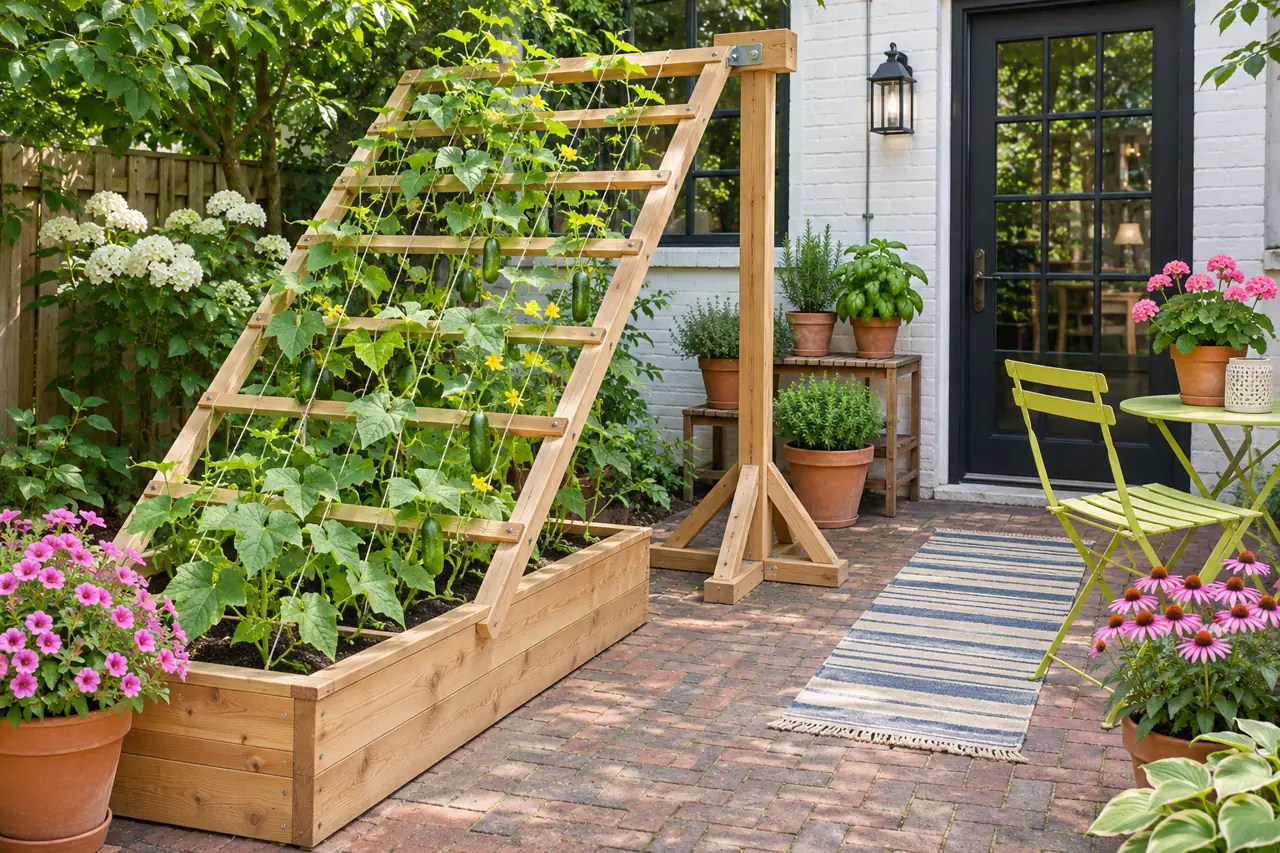
A broad ladder-shaped trellis can make a sunny courtyard feel productive without turning every wall into a vegetable patch.
Place a low cucumber planter below the sloping frame, then keep the door route open beside it.
Add fine vertical cords between widely spaced rungs so young growth has a continuous route upward.
Terracotta herbs, a green bistro chair and a small striped rug bring the planting into the seating area.
Keep the rug out of the wettest watering zone.
Use a purpose-made, sound frame with independent bracing and secure anchoring. An old painted ladder of unknown condition is not automatically suitable for an edible garden.
The slope needs floor space, so measure the frame’s full footprint before arranging the chair and pots around it.
7. A Harvestable Cucumber Screen by the Patio
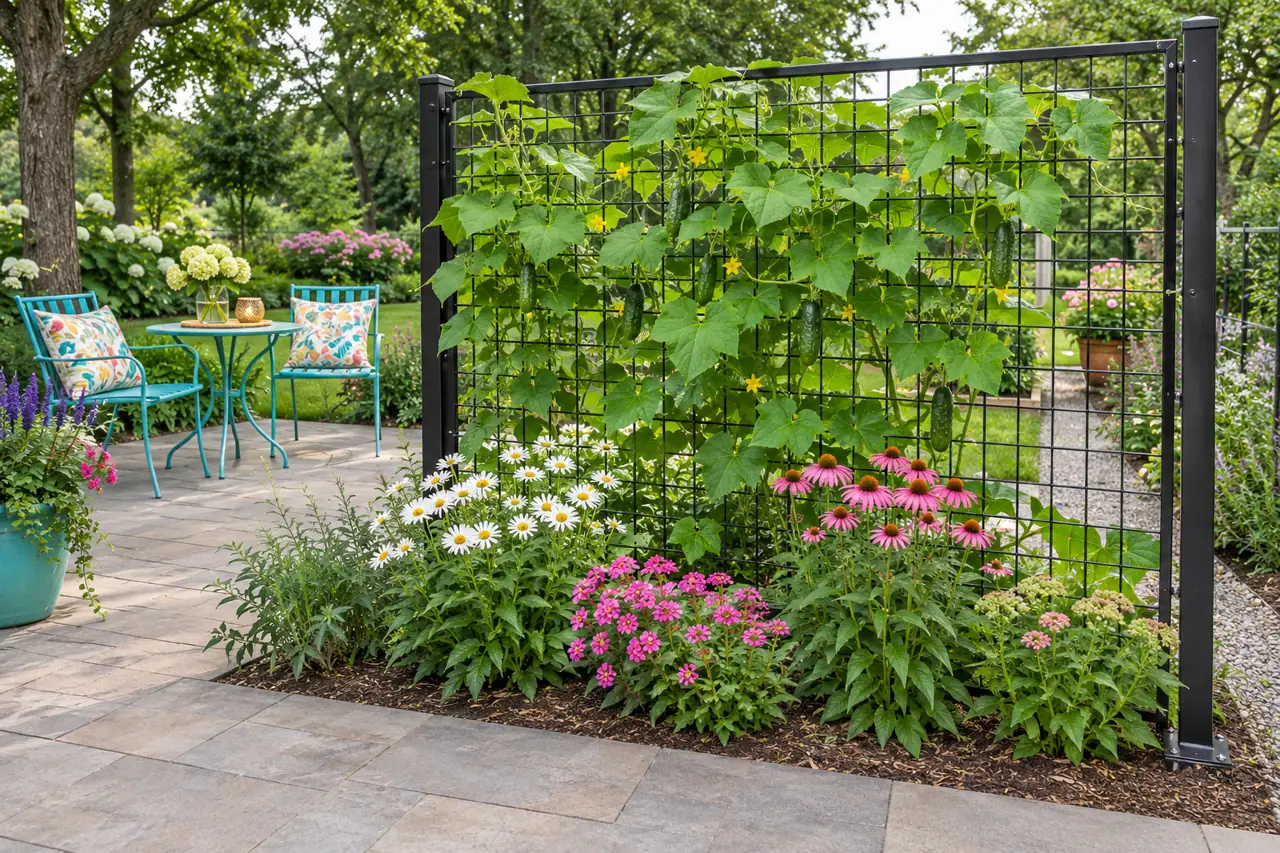
A cucumber screen can separate a patio from the vegetable garden while keeping the harvest close to the table.
Use a freestanding grid in a generous planting border.
Set turquoise chairs and a small table back from the leaves. Separate flower pots can add pink and white color without crowding the crop roots.
The grid should still look good when the vines are young or absent.
Leave a route behind the screen for training, checking ties and picking hidden fruit.
A solid fence pressed directly behind it makes those jobs awkward.
Use a frame and anchoring system suited to the mature plant mass, especially on an exposed patio.
Treat the foliage as seasonal screening; it will not provide year-round privacy after the cucumber season finishes.
8. A Bean Portal for Two Large Patio Planters
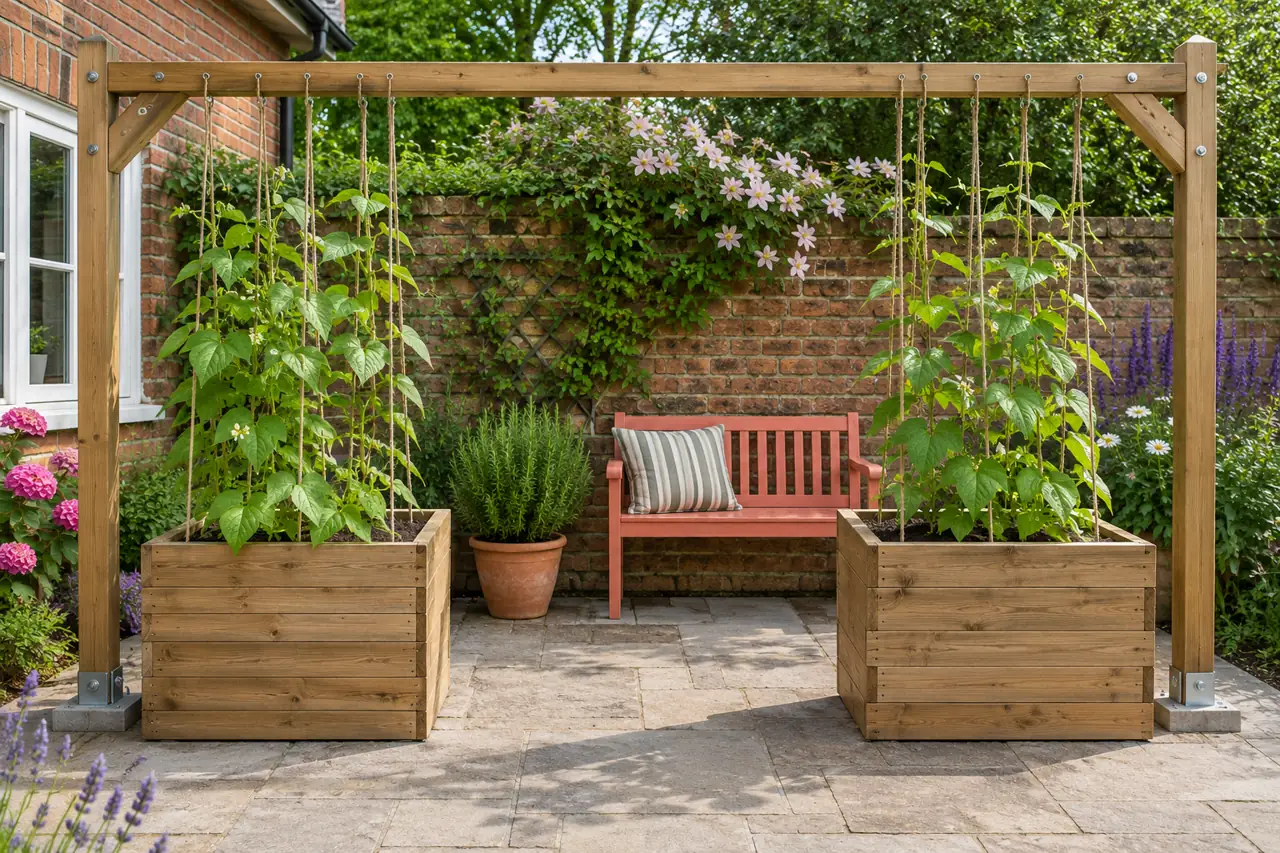
Two large planters can frame an opening on a ground-level terrace, with climbing beans turning the space into a leafy portal.
The support needs its own reliable anchoring. Do not assume the weight of two attractive pots makes a tall connecting frame stable.
Choose containers with drainage and enough rooting volume for the selected crop. Position them where you can reach the soil without leaning across furniture.
A coral bench, striped cushion and rosemary pot make the terrace feel furnished rather than crowded with equipment.
Keep the central opening clear and guide stray growth back to the support.
This design asks for regular moisture checks because container conditions change with sun and wind. Plan easy watering access before the foliage fills the frame.
Maryland Extension covers container choice, watering and early installation of supports.
9. A Bean Obelisk in a Flower-Filled Kitchen Garden

A substantial obelisk brings a little formality to a kitchen garden. Place it in a square bed, with paths around the outside and low planting beneath its vertical lines.
Dark green metal sits comfortably against pale timber fencing.
Chard, calendulas and separate purple flower pots make the whole arrangement colorful before the beans reach the top.
Use climbing beans and a support with enough usable uprights for their growth.
I would keep the tallest flower pots beyond the bed, where they cannot compete for the same small patch of light.
Check that the obelisk is a functional crop support rather than a lightweight ornamental frame.
As foliage fills the center, harvest from every side and guide growth early, while stems can still be moved gently.
10. An Offset Pea Frame Against Warm Brick
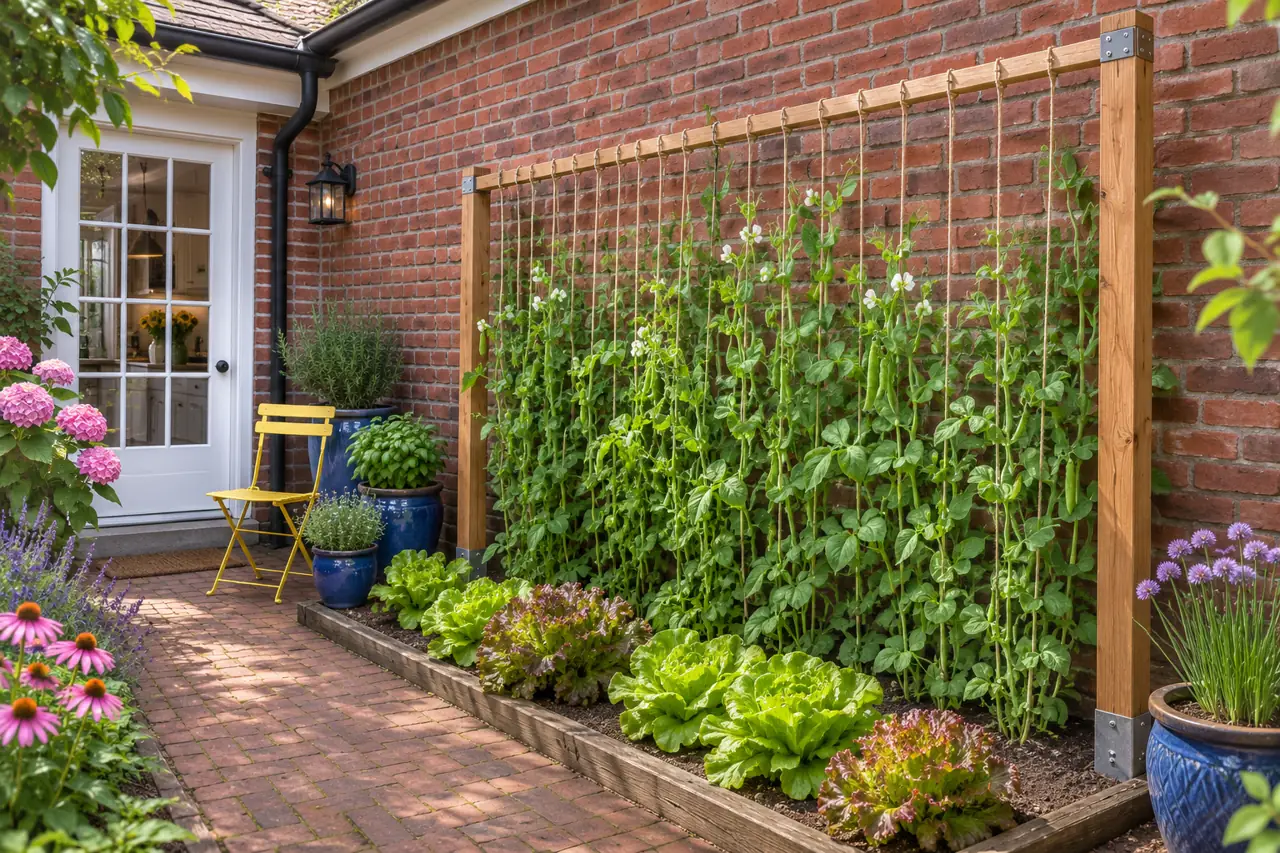
A brick wall makes a handsome backdrop for peas, but the growing frame can stand on its own posts in front of it.
That arrangement keeps the support independent of gutters, window frames and other fittings never intended to carry a crop.
Leave a gap behind the cords for access and air movement. Keep the kitchen-door path clear, with lettuce low in front and blue herb pots beside the entrance.
A small yellow chair can pick up the warmth of the brick without taking over the working area.
Check how much direct sun actually reaches the border; a bright wall does not guarantee a suitable growing position.
Choose peas for the local cool growing season, and plan the bare frame as part of the garden’s appearance after harvest.
11. A Purpose-Built Bean Pergola Over a Dining Corner

A bean pergola creates a garden room rather than another row of vegetables.
Climbing beans grow from borders outside the posts, while the table stays in the open central space.
Yellow chairs and blue patterned cushions make the sheltered corner worth using even before the canopy fills.
Keep flower pots outside the chair-pulling and walking zones.
This is the most substantial project here. Use a purpose-built structure appropriate for mature plant weight and local wind, with qualified advice where the design requires it.
Do not treat a decorative lightweight arbor as equivalent to a sound pergola.
Train growth so it does not hang across faces or trap the furniture.
A seasonal bean canopy can soften the dining area, but it is not a waterproof roof.
Plan for the mature structure. Vines add weight and catch wind. These are design ideas, not verified construction plans.
For an overhead feature, substantial frame or exposed site, use a suitable proven design and qualified advice where needed.
12. Low Pea Hoops Along a Spring Salad Bed
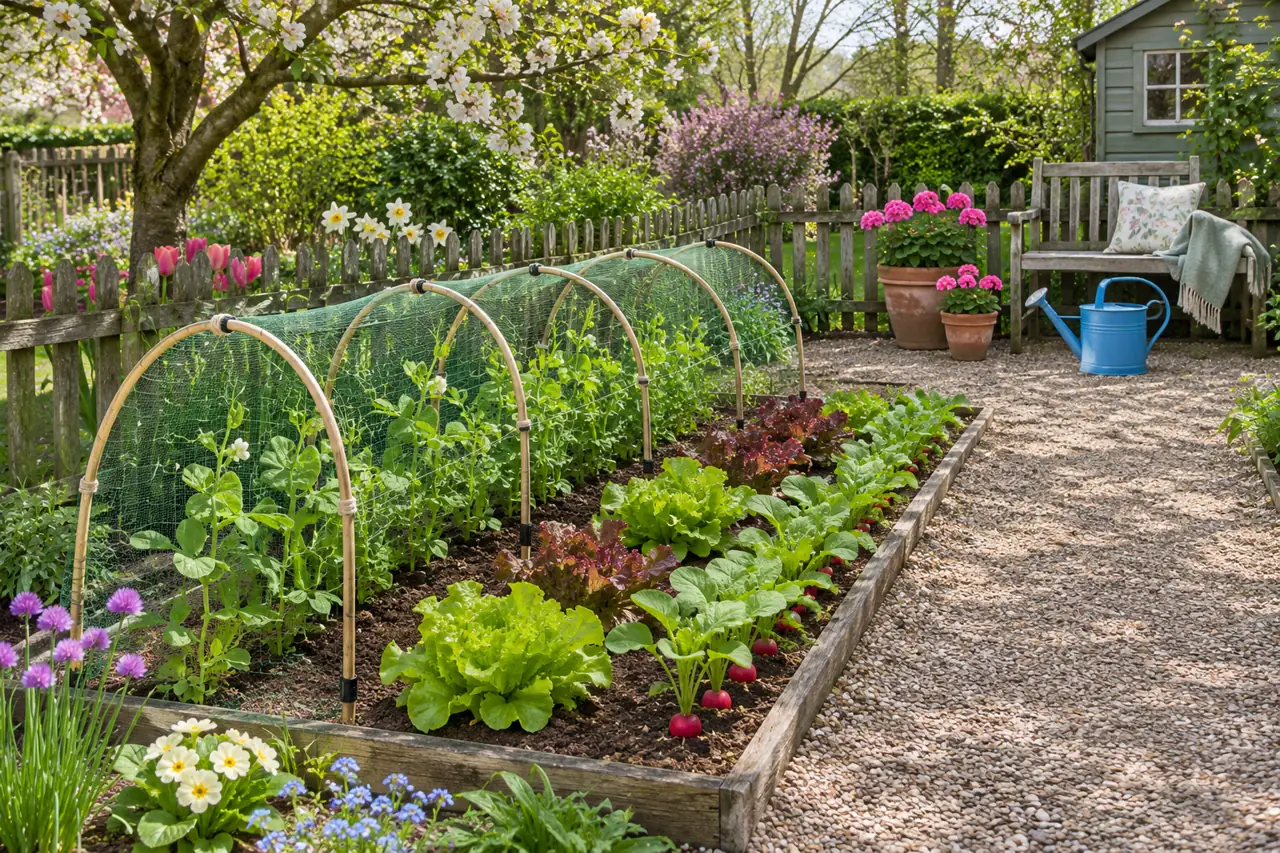
Low hoops give a spring salad garden a softer outline than tall posts.
A fine support mesh follows the curves, with shorter pea varieties growing along one edge.
Put lettuce and radishes alongside, keeping enough separation to see the soil and reach the peas.
A gravel path, picket backdrop and blue watering can give the little bed a complete setting.
This is a support to work beside, not a tunnel to crawl through.
Check the mature pea height before choosing a low framework. A vigorous tall variety will soon overrun it and spill into neighboring crops.
Secure the hoops and netting before growth begins, then inspect for sagging sections. Keep the bed narrow enough for comfortable reach rather than expecting the low shape alone to make maintenance easy.
13. An Open V-Frame With Two Harvesting Sides
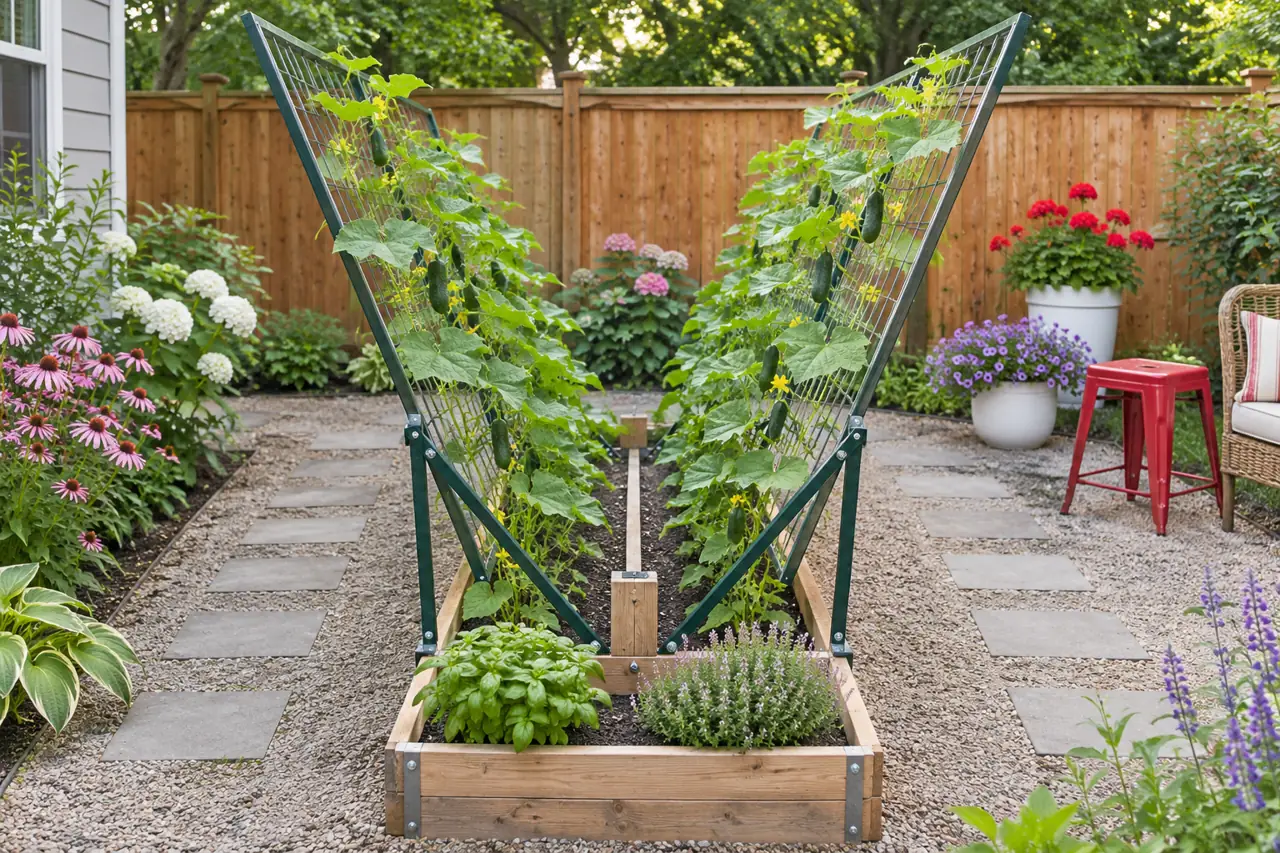
An open V-frame reverses the usual A-frame silhouette: the two faces spread outward at the top. It can present cucumber growth toward two separate harvesting sides.
Place the narrow growing bed between clear paths, then measure the panels’ entire overhang before planting.
Low herbs at the ends, a red stool and white flower pots give the practical structure a tidy garden setting.
Keep the stool outside the working routes.
The outward lean increases the need for appropriate bracing and anchoring.
Choose a proven frame design or obtain help rather than improvising a tall, top-heavy shape.
Train the vines gently onto each face and check fruit near the mesh.
This arrangement needs more width than the soil bed suggests, making it a poor choice for a passage already short of room.
14. A T-Frame Bean Row With Replaceable Strings
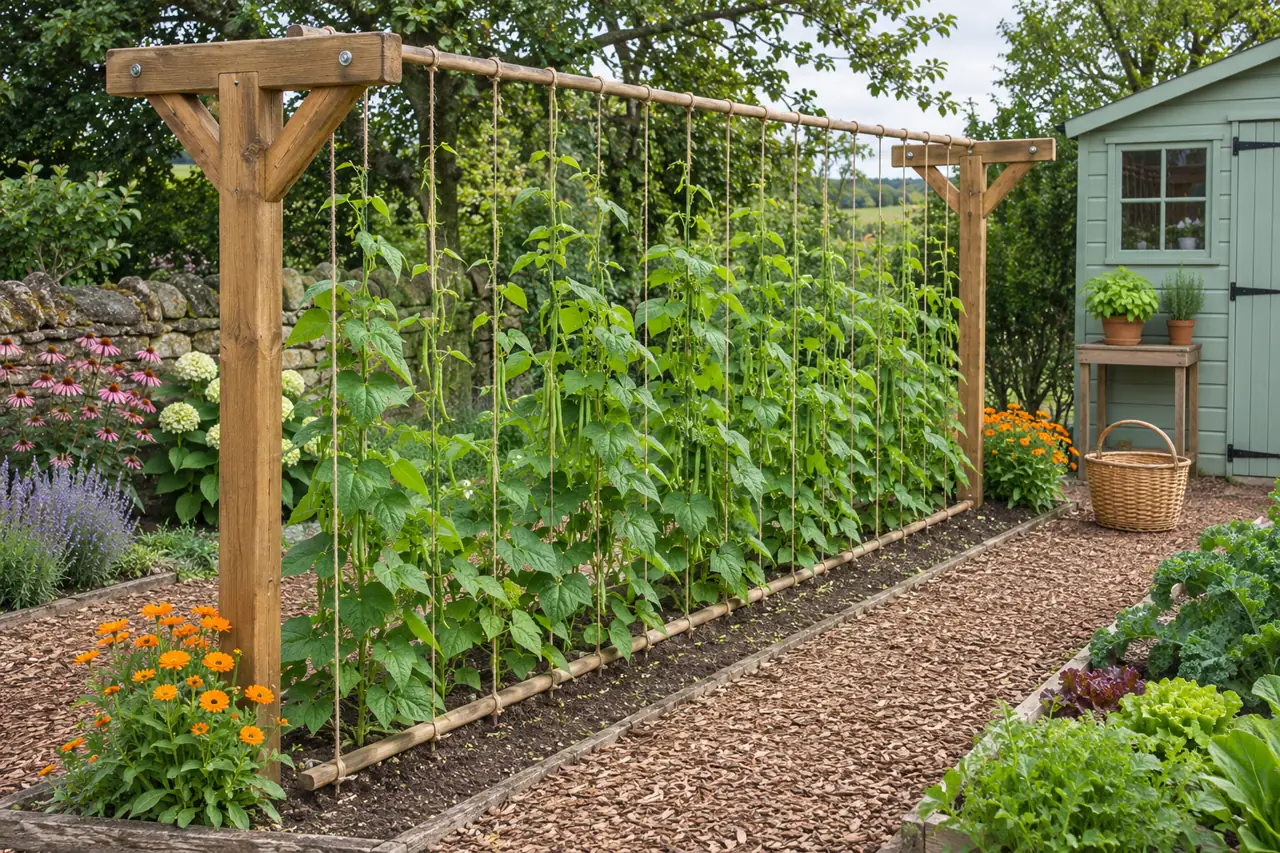
A T-frame with separate strings gives a bean row a clear, uncluttered rhythm. Sturdy end frames carry the upper support, with individual climbing lines descending to the bed.
Keep both sides reachable from bark paths so training and picking do not become one-sided jobs.
Orange calendulas at the ends and a mint-green shed make a productive row feel like part of the backyard.
Natural cord looks light, but its strength and attachment still need to suit the mature crop.
Replace worn lines before planting and keep the ends secured. Never let spare cord cross the paths at ankle height.
Remove the seasonal climbing material while retaining the main frame. Check the frame itself each year rather than treating replacement string as a complete maintenance routine.
15. A Radial Bean Canopy for a Circular Bed
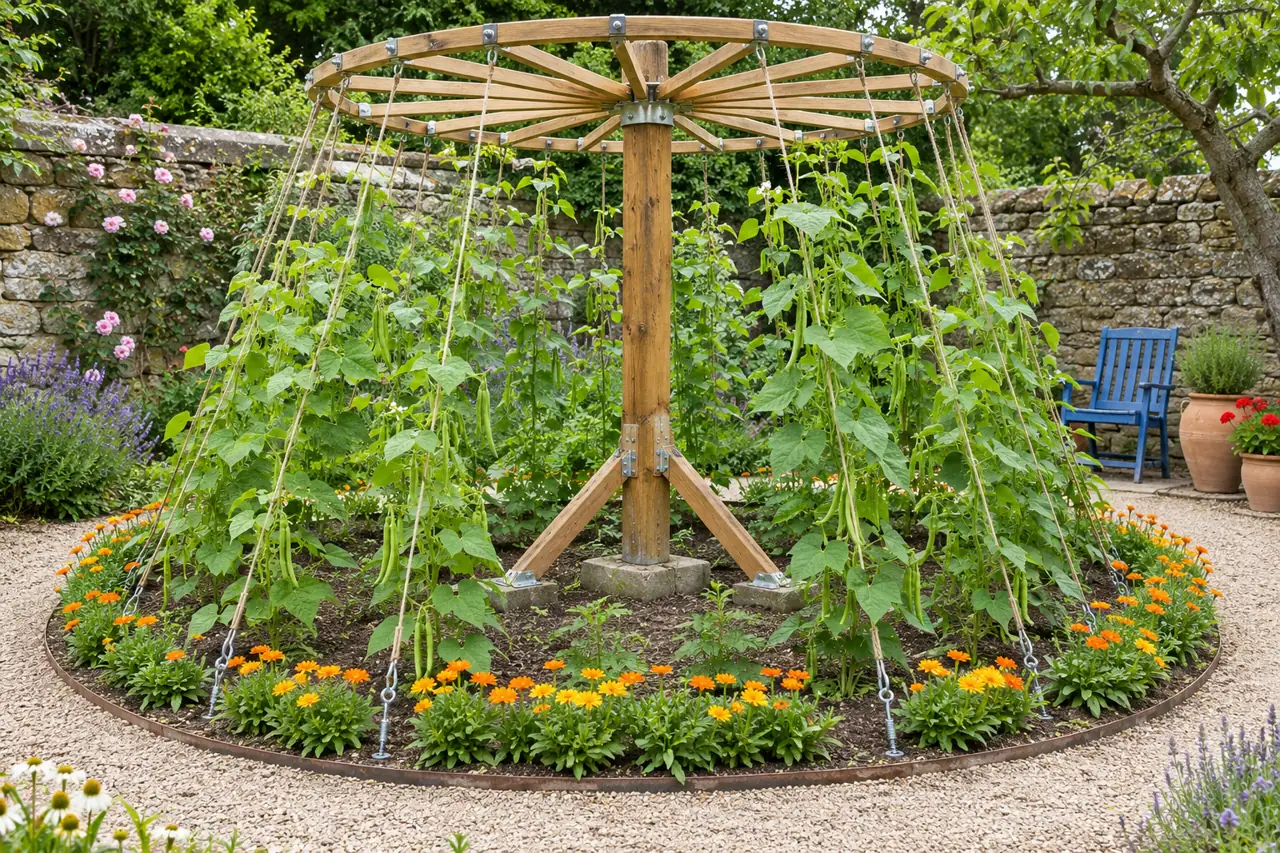
A radial bean canopy gives a circular bed a deliberate design from every direction.
Cords fan from a central upper framework to a ring around the planting area.
The mast and spokes provide the structure; the cords provide routes for climbing growth.
Use a gravel access ring so you can harvest around the outside. A blue chair and terracotta pots belong beyond that ring, against the garden wall.
The shape is striking even with restrained planting below.
It also concentrates the load at the center, so use a properly designed, securely anchored framework rather than a loose pole with decorative strings.
Keep this as a planted feature to work around, not a play shelter.
Plan the final height so routine harvesting does not depend on reaching into an inaccessible summit.
16. A Folding Zigzag Pea Screen for an Awkward Corner
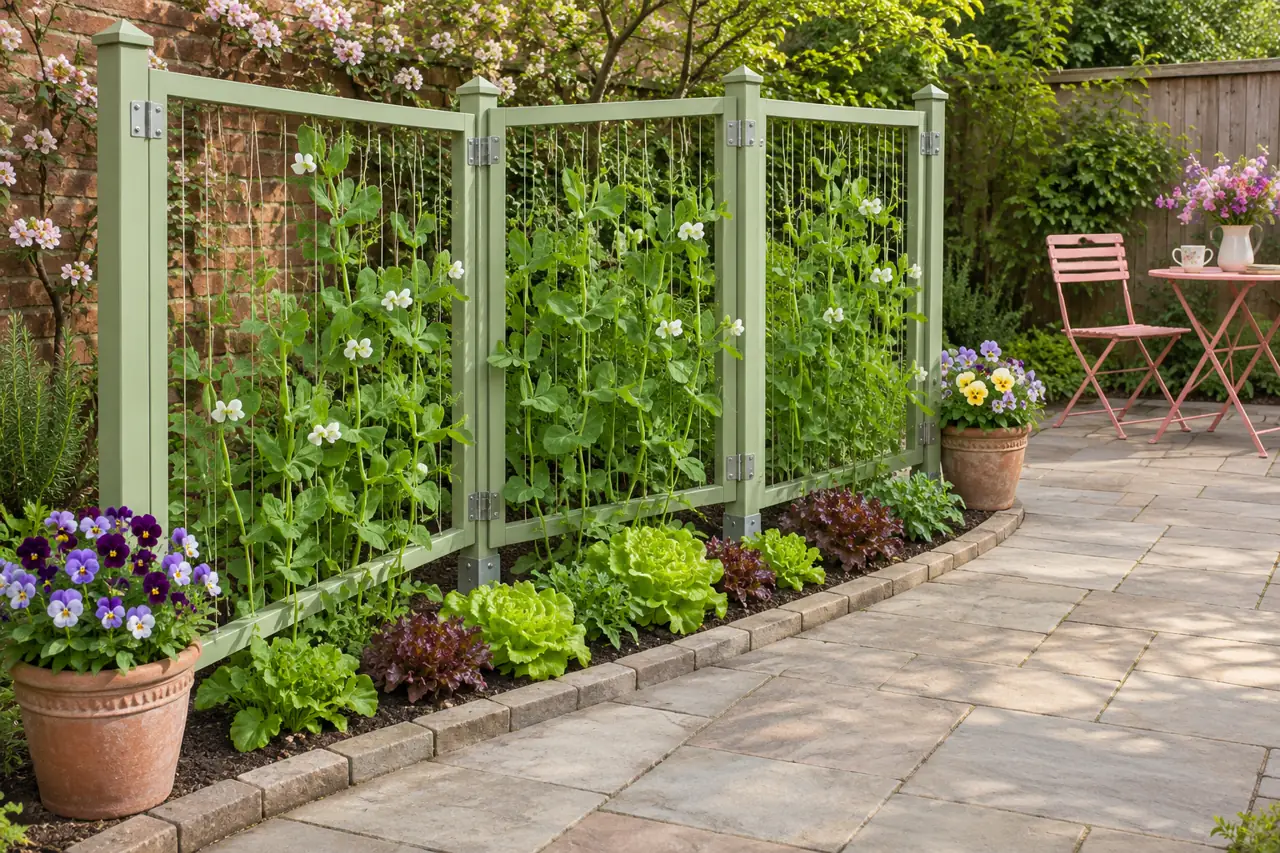
A shallow zigzag of pea panels can follow an awkward corner without creating a solid green wall. Each change of angle makes a small pocket of growing space.
Use a curved paved path alongside, with low lettuces at the front and flower pots beyond the panel ends.
Pale green frames and a pink folding chair keep the corner light and cheerful.
Hinges help the panels fold for storage, but each section still needs secure support in use.
Do not rely on the zigzag shape alone to resist wind.
Leave the panel joints clear enough to inspect and keep netting away from moving hinges.
Choose peas matched to the framework’s height, and check that both angled faces remain reachable. A decorative corner becomes frustrating when the deepest fold hides the harvest.
17. A Cucumber Column in a Small Front Courtyard
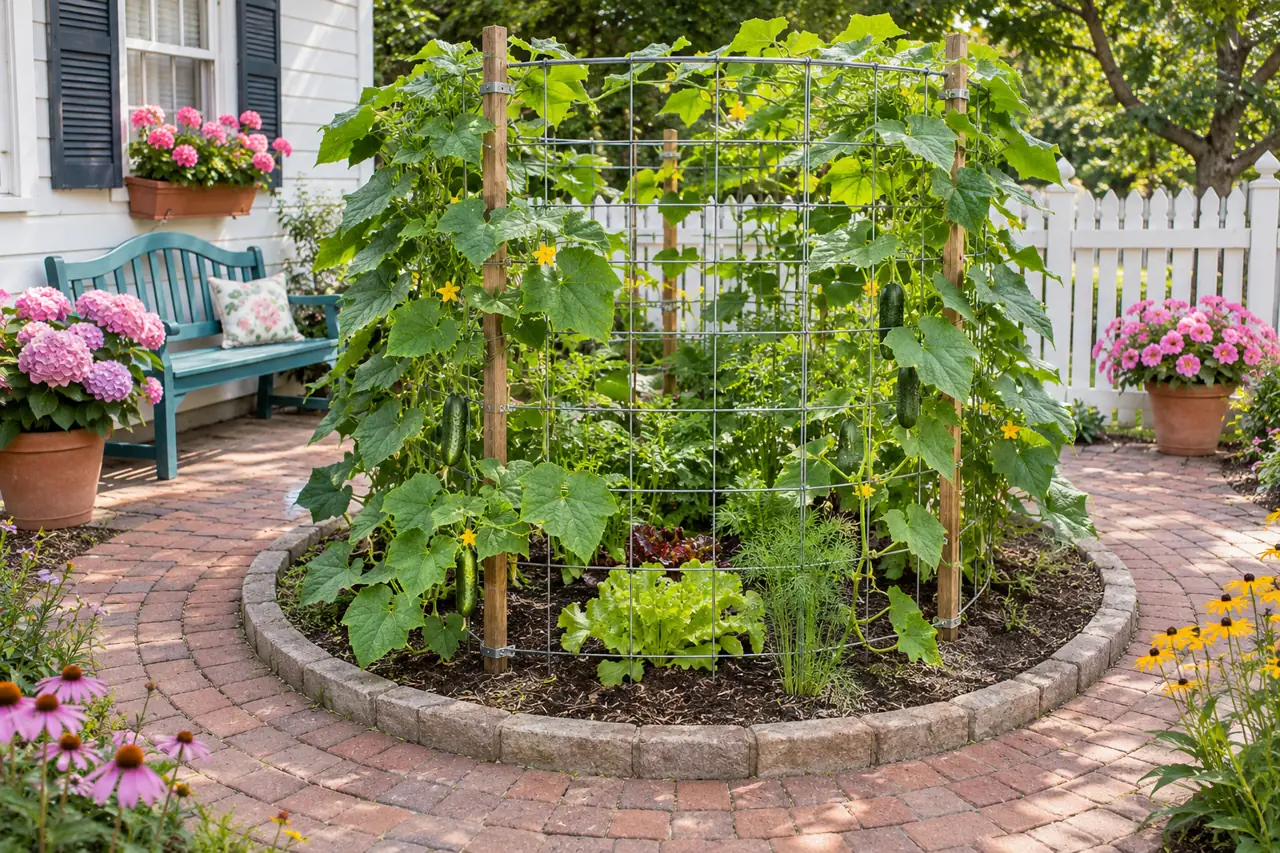
A broad mesh column can give a small front courtyard a productive focal point. Set it in a round bed with a brick path that reaches all sides.
Train cucumber vines around the outside, where leaves and fruit stay visible. Keep surrounding flowers in separate pots, with a teal bench against the picket backdrop.
The column should have useful growing room, not resemble a narrow decorative cage packed with foliage.
Choose mesh openings that allow hands to work comfortably, and check developing fruit before it becomes trapped between wires.
Secure the structure to suitable stakes and finish cut edges safely.
This compact footprint trades floor space for a denser center. Regular inspection matters, and a less vigorous vining variety may fit the setting better than an unchecked mass of stems.
Wisconsin Extension advises checking that fruit does not become embedded in trellis wire.
18. A Low Squash Ramp With Fruit Kept Close to Ground

A low squash ramp brings trailing growth into view without sending heavy fruit above a walkway.
A rigid panel slopes over part of a generous bed, with harvesting access along its outside edge.
Keep neighboring chard in a separate open strip, then repeat warm tones with orange flower pots and a natural timber bench.
Choose a trailing, small-fruited squash suited to your season.
A bush variety will not turn into a climber because a frame is nearby.
Use a structure capable of carrying the mature vine and crop, with appropriate bracing.
Check fruit positions as they develop and keep larger squash on the ground instead.
The shaded space beneath the slope still needs inspection. Resist filling every gap if it makes watering, picking or removing tired foliage difficult.
Four checks before you buy materials
Use this sequence to turn a favorite photograph into a practical shortlist.
1. Record the crop
Variety name • climbing habit • mature size • local sowing window. Match the frame to that crop before choosing a finish.
2. Check the site
Observe sun and wind, confirm permissions and locate buried services before inserting posts. Seek suitable advice for overhead or substantial structures.
3. Mark the full footprint
Include panel lean, mature foliage, doors, chairs and working routes. Keep marking materials out of walking paths.
4. Plan the season’s end
Decide where removable panels will be stored and how joints, cords and fasteners will be inspected. Record which bed carries each crop.
19. A Pea Backboard for a Raised Working Bed
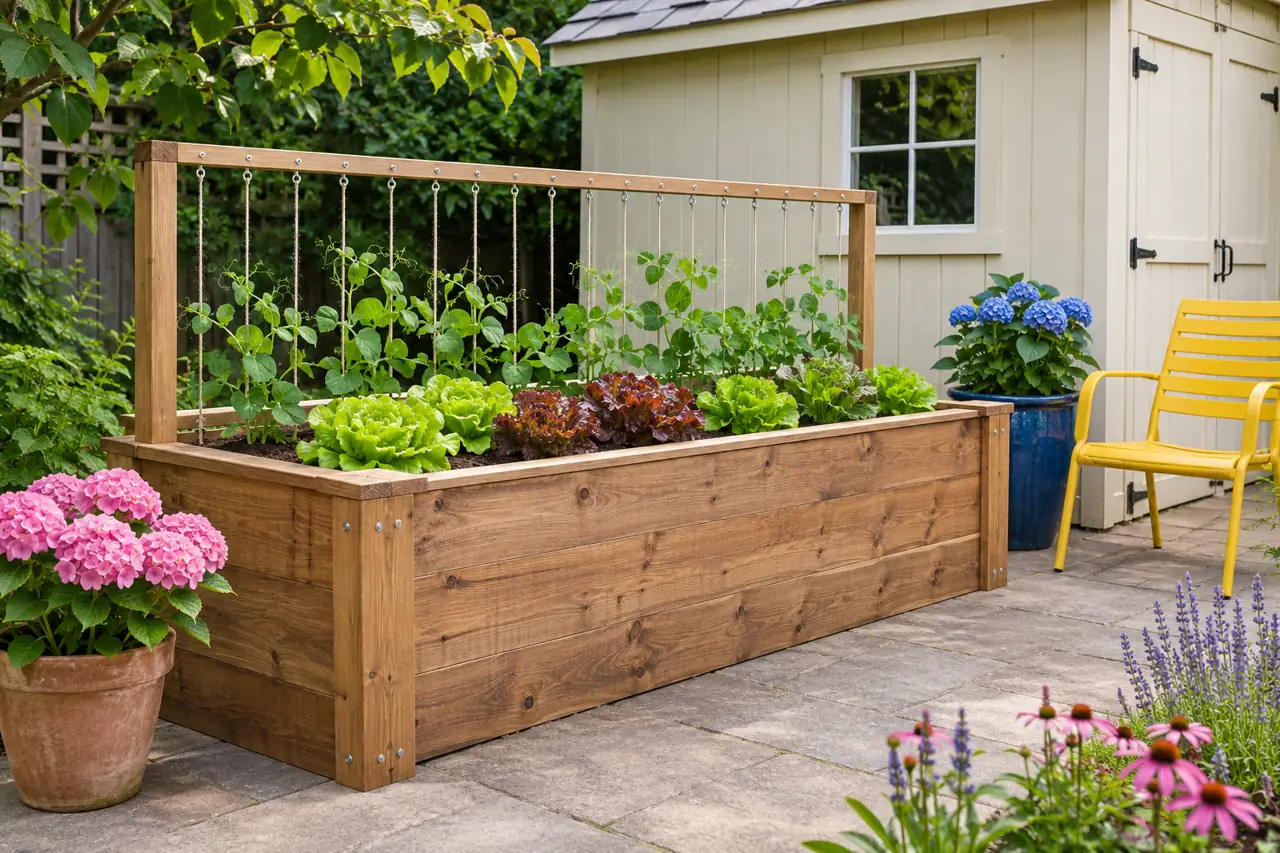
A raised bed with a low pea backboard brings the growing area closer to a comfortable working level.
Keep the trellis at the rear and the harvesting side open.
Shorter peas and low lettuces make a clearer arrangement than a tall canopy leaning over the path.
A firm paved approach, cream shed and separate pink and blue flower pots complete the setting. Leave the yellow chair outside the route needed for tools and watering.
Choose the bed height, depth and reach distance for the person using it.
A photograph cannot establish accessibility or structural adequacy. The bed must safely contain wet soil, and its support and drainage need proper planning.
Check that mature plants remain reachable; raising the soil does not make an excessively tall trellis easier to manage.
20. A Modular Trellis Court That Can Follow the Rotation

A modular trellis court combines a permanent layout with changeable growing surfaces.
Low beds sit around crossing paths, with sturdy frames at the bed ends.
One bay can carry rigid mesh for cucumbers, while another uses cords for climbing beans. Keep a neighboring bay open for low crops rather than covering every frame at once.
Repeat cedar edging, gravel and corner flowers, then finish the far end with a coral bench.
What I like about this plan is the separation between the lasting frame and the seasonal insert.
Use secure connections that suit each panel and crop load.
Changing the insert does not replace crop rotation or soil care.
Keep a bed record so next season’s planting follows a deliberate plan rather than whichever panel happens to be closest.
Wisconsin Extension discusses moving supports and using rotation with permanent systems.
Before you settle on a design
Will a taller trellis give me more vegetables?
A taller frame cannot compensate for an unsuitable variety, poor light or inadequate rooting space. Choose a manageable mature height and keep the harvest within a practical reach.
Can I plant closer because the vines grow upward?
Use the spacing guidance for your crop and variety. Minnesota Extension retains normal seed or transplant spacing for trellised vines; the saving is mainly in vine sprawl.
When should the seeds go in?
Use local guidance for frost risk, soil temperature and the chosen variety. Peas and warm-season beans or cucumbers do not share one universal planting date.
Minnesota’s pea guide and Iowa’s cucumber guide explain their different seasonal needs. Apply the principles to your own region.
Choose the route you want to keep clear
Shortlist two designs, then measure their full footprint where they would stand. Include the working path, the mature crop and the place you will set a watering can.
A trellis that fits those ordinary jobs will be easier to enjoy long after the first photograph.