
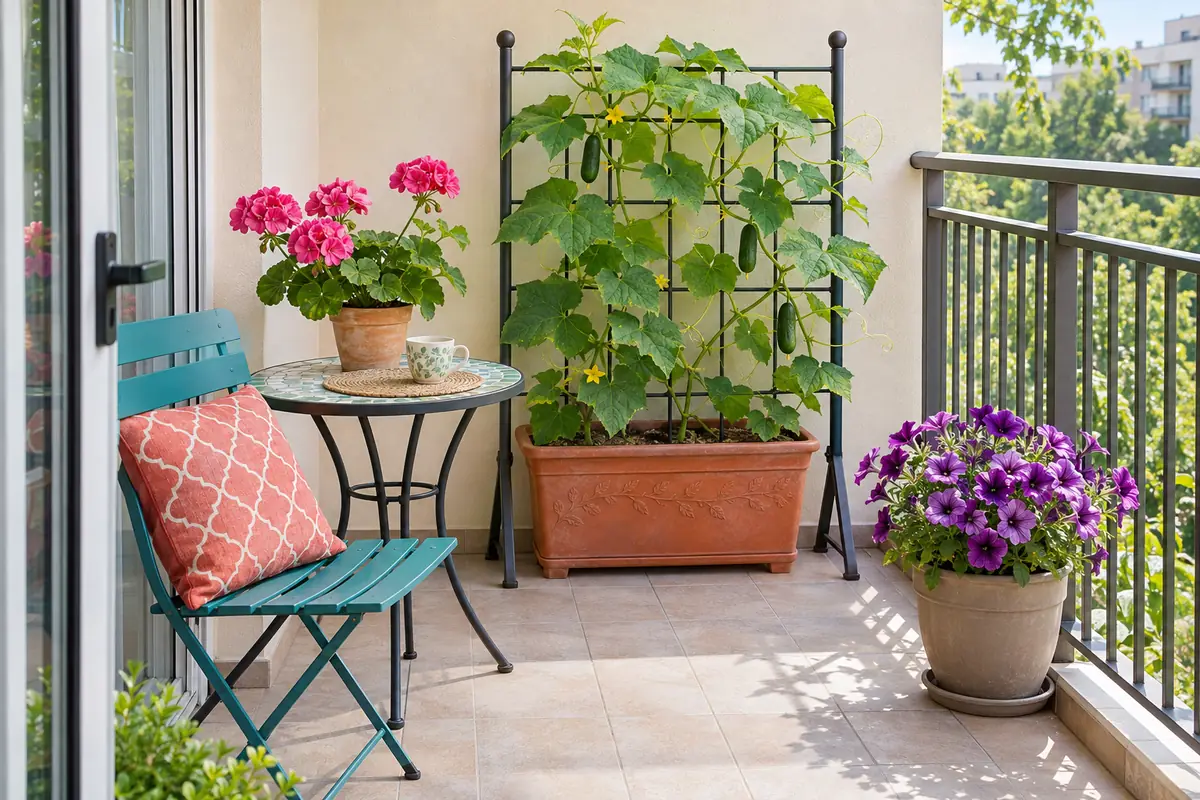
Yes, you can grow cucumbers in pots on a balcony. Start with one compact plant, a generous drainage pot, warm weather and a sunny position.
Then give the vine a stable support and check the potting mix regularly. Choosing a cucumber with suitable pollination needs matters just as much as choosing the pot.
I love how a cucumber vine can bring a leafy backdrop to a small sitting area. Plan the growing corner around everyday access, rather than filling every available inch.
A manageable starting setup: One compact, outdoor-suitable cucumber; a drainage pot of at least five US gallons; container potting mix; and an appropriate stable support.
Add a warm planting window, enough direct sun and a way to check moisture regularly. Confirm the variety’s pollination needs before buying it.
From empty pot to the first harvest
- 1. Check sunlight, shelter and balcony suitability
- 2. Choose the plant habit and pollination type separately
- 3. Prepare a generous pot with a continuous potting mix
- 4. Plant after frost risk and cold potting mix have passed
- 5. Keep the vine supported and the route clear
- 6. Check moisture before watering and feeding
- 7. Match fruit-set care to the seed packet
- 8. Harvest by variety and investigate problems carefully
Check your balcony before buying the plant
Use these decisions to choose the next action. A sunny photograph cannot tell you whether a particular balcony is suitable.
Enough direct sun and a sheltered position
Proceed to variety selection after checking the building rules and load suitability. Mark the pot’s footprint and the route you need to keep clear.
Good light but strong exposure
Resolve the support and wind problem before buying a tall vine. Ask about permitted fixings; do not improvise an anchor on the guardrail.
Drainage would reach a neighbor
Plan how you will collect and empty drainage safely. Keep the building’s drains open and make sure the pot can still drain freely.
Too little direct light for cucumbers
Consider a crop better suited to the site instead of buying extra fertilizer to compensate. Check cucumber light requirements before committing to a plant.
When capacity is uncertain, ask the building manager or a qualified professional. Do not use a generic balcony weight limit from an online garden plan.
1. Check sunlight, shelter and balcony suitability
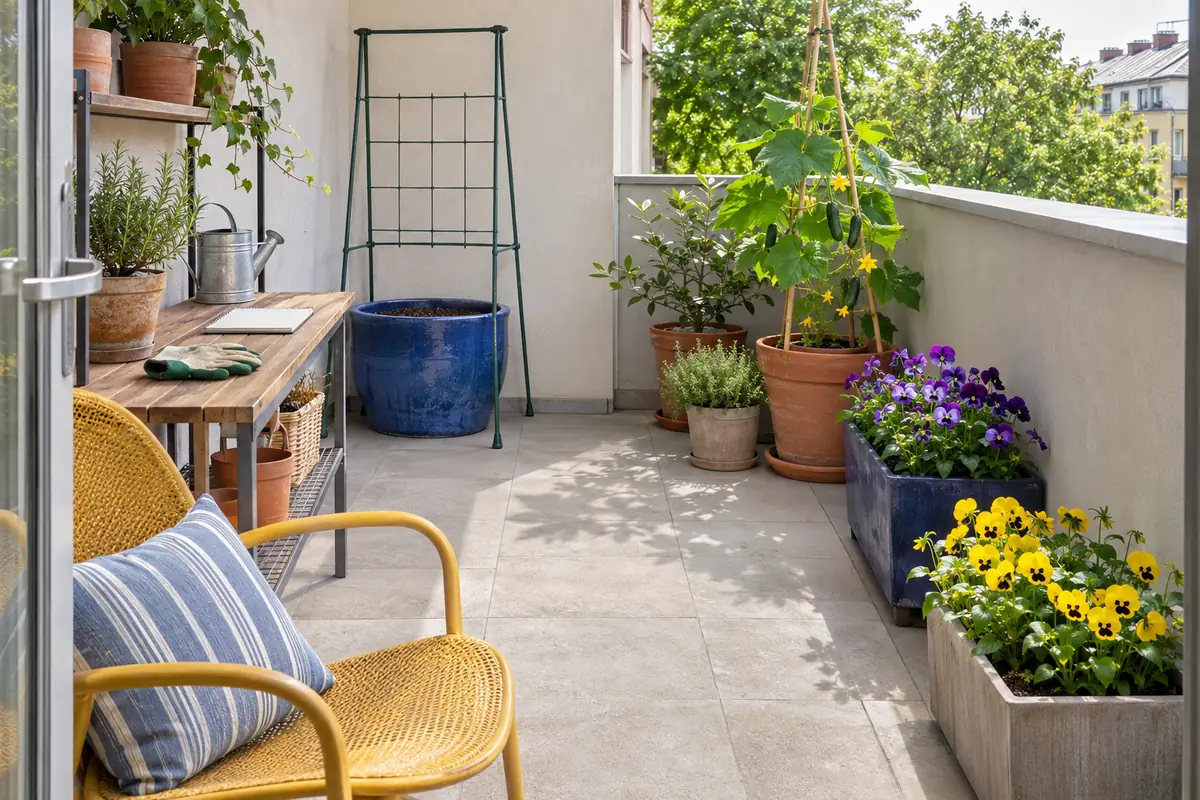
Watch where direct sunlight actually reaches the balcony across a day. An apparently bright space beneath an overhang may receive much less direct light than you expect.
For cucumbers, aim for at least six hours of direct sun, with more where conditions allow. Maryland Extension describes their light requirements in its cucumber guide.
Choose a sheltered growing corner without putting the plant outside the railing. Keep a clear route between the door, seating and the place you will stand to water.
Before buying large pots, confirm building rules and the balcony’s suitability with the building manager. Get qualified advice where load capacity or support fixings are uncertain.
Wet growing mix, containers, furniture and people all contribute to the load. A photo or a pot’s capacity cannot establish what your balcony safely supports.
Set the watering can down beside the planned pot position and open the door fully. This simple rehearsal often reveals an awkward corner before a vine occupies it.
Check where drainage water will go, too. Avoid runoff onto neighbors and keep drains accessible; do not rely on an overflowing saucer to manage excess water.
If strong gusts repeatedly sweep the space, resolve the exposure before adding a tall leafy support. A shorter plant may fit the setting better, but still needs stability.
2. Choose the plant habit and pollination type separately

Look for a cucumber described as bush, compact or suitable for containers. Read its mature spread and support requirements instead of judging the plant by its fruit size.
A miniature cucumber can still grow on a vigorous vine. The word “mini” may describe the fruit you eat, rather than the space the plant needs.
Oregon State’s container guide favors bush cucumbers for small containers and explains how a support helps manage their growth.
Next, check pollination. Parthenocarpic means a variety can produce fruit without pollination; that can be useful where pollinating insects have limited access.
Gynoecious means mostly or entirely female flowers. It does not, by itself, tell you whether the plant needs pollen from another cucumber.
Johnny’s cucumber terminology guide explains this distinction. Some pollination-dependent seed mixtures include a pollen-producing variety, which matters if you intend to keep just one plant.
For an open balcony, also confirm that the chosen variety is suitable outdoors in your climate. A greenhouse recommendation is not automatically a recommendation for an exposed railing-side pot.
What I like to do when planning is write down three details before ordering: mature plant size, outdoor suitability and pollination requirement. Keep the packet for harvest-size guidance later.
3. Prepare a generous pot with a continuous potting mix

For this one-plant setup, begin with a pot holding at least five US gallons, about 19 liters. Check the actual capacity rather than relying on its decorative outside diameter.
Wisconsin Extension recommends a five-gallon minimum and 12–18 inches of depth for larger container vegetables, including cucumbers.
A larger suitable pot can make moisture management easier, if your space and balcony assessment allow it. Follow any more generous container recommendation supplied for your particular variety.
Use a sound container with unobstructed drainage openings. Put it in its final position before filling, and allow access to inspect underneath without moving the growing vine.
Fill with a commercial container potting mix rather than soil dug from the garden. Oregon State recommends this approach for balcony and patio growing.
Read the bag for ingredients and any included fertilizer. A peat-free product intended for vegetable containers is an option where available; follow its preparation directions.
Skip a bottom layer of rocks or broken pots. Wisconsin’s guidance explains that a continuous column of potting mix drains better than deliberately layered materials.
Leave the watering space recommended for your container instead of heaping mix over the rim. Keep flowers in separate pots so the cucumber has its own growing space.
A terracotta pot, simple support and one nearby flowering planter can look finished without crowding the floor. Choose the arrangement for access first, then add the chair cushion.
Compare pot volumes before ordering mix
The gallon sizes here are US liquid gallons. Nursery trade sizes and decorative pot labels may describe containers differently, so check the supplier’s actual capacity.
| Nominal pot size | US gallons | Approx. liters |
|---|---|---|
| Starting comparison | 5 | 19 |
| Larger option | 7 | 26.5 |
| Larger option | 10 | 38 |
Convert the label, then allow for the real fill
Liters = US gallons × 3.7854. A five-gallon capacity is about 18.9 liters; a ten-gallon capacity is about 37.9 liters.
For example, two five-US-gallon pots have a combined nominal capacity of about 37.9 liters. A 40-liter bag is a useful first comparison, not a guaranteed exact fill.
Headspace, root balls and product settling change the amount used. Check the bag’s stated volume and the pots’ actual usable capacity before buying.
Keep plant count separate from volume
This walkthrough uses one cucumber plant in its own pot. A bigger container is not an instruction to crowd several plants together.
The five-gallon starting point follows Wisconsin Extension’s container guidance. Use the variety’s needs and your balcony assessment to decide whether a larger pot is appropriate.
This conversion compares growing volume only. It does not calculate saturated container weight or establish balcony load capacity.
4. Plant after frost risk and cold potting mix have passed
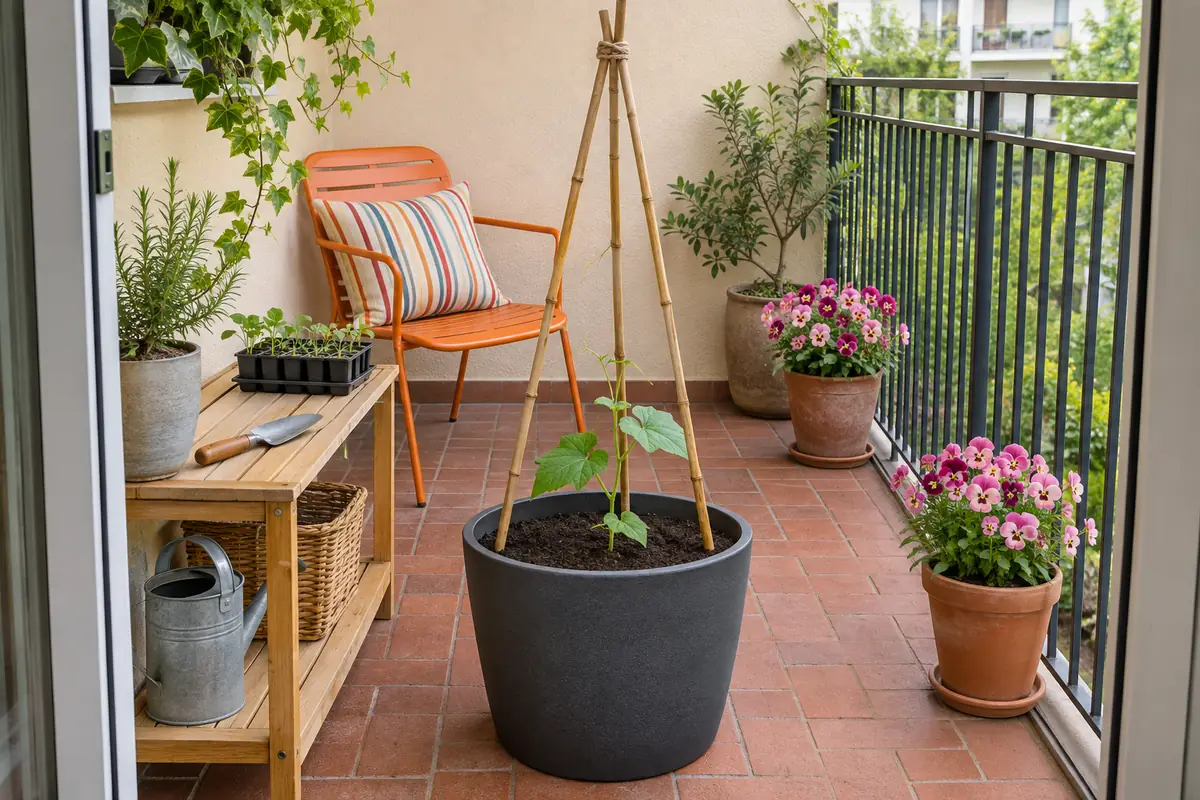
Cucumbers need warmth, so use local conditions rather than a calendar date copied from another region. A sheltered balcony can still have cold nights and cold growing mix.
Iowa State recommends planting after frost danger passes and soil warms to 60–70°F, roughly 16–21°C. Follow your seed supplier’s germination guidance as well.
Choose between direct sowing in the final pot and planting a young transplant. Direct sowing avoids moving the roots; a small healthy transplant offers a convenient starting point.
For seed, follow the packet’s sowing depth and instructions. Keep the sowing area evenly moist while germination takes place, without leaving the whole pot waterlogged.
If you sow spare seeds, thin to the single plant planned here. Snip unwanted seedlings rather than pulling through the retained plant’s roots, as Maryland Extension advises.
Acclimatize an indoor-grown transplant gradually in a protected outdoor spot. Iowa State recommends hardening young plants before they go into their final growing position.
Handle the root ball gently and follow the transplant supplier’s planting-depth instructions. Avoid breaking up its roots or burying a long stem simply because tomatoes tolerate different treatment.
Water the planted mix gently, then check that excess water can escape. Leave the support in place from the beginning so later installation does not disturb established roots.
In a short growing season, compare the variety’s maturity guidance with your remaining warm weather. In a very hot region, ask local extension staff about a suitable planting window.
5. Keep the vine supported and the route clear
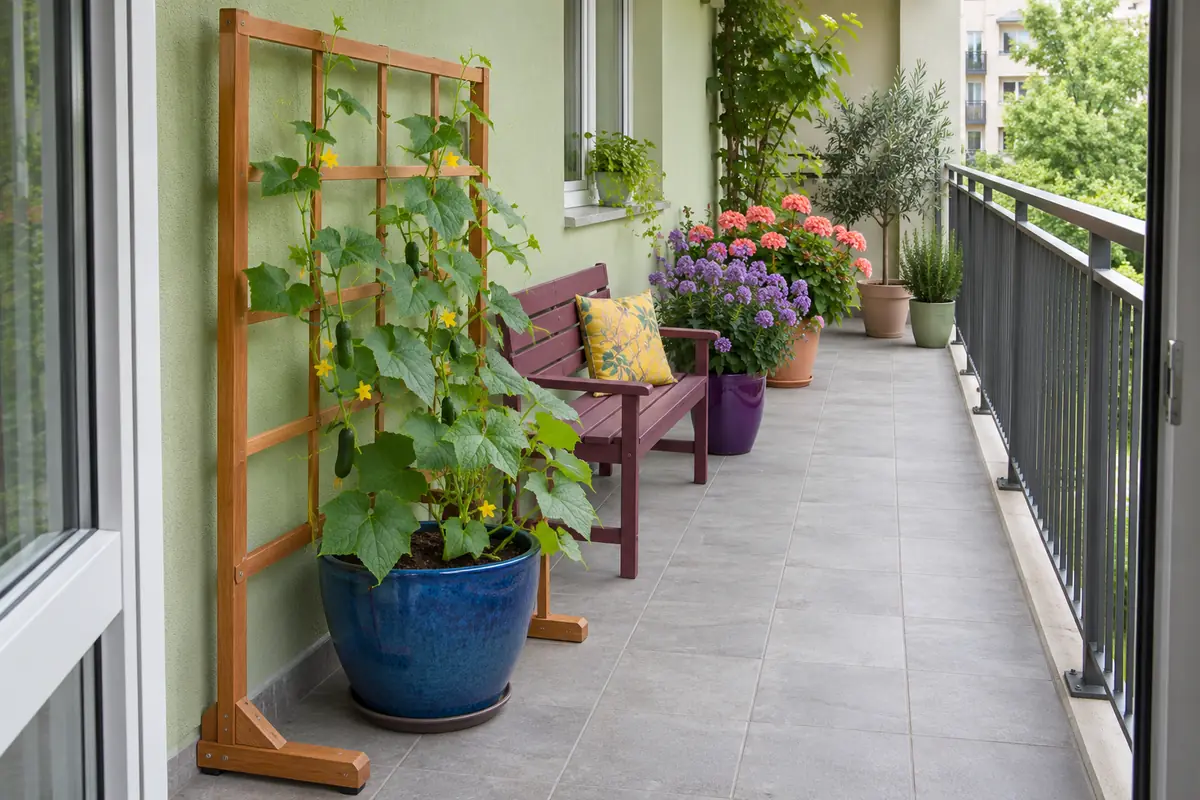
Install the support while the plant is small. Choose a sturdy container-compatible cage, obelisk or freestanding trellis with enough room for the variety’s expected growth.
A broad-based structure beside a wall can keep the growing corner organized. It still needs to be stable under your balcony’s wind conditions, not merely look upright when empty.
Do not use the guardrail as an improvised anchor or train stems outside it. Confirm any building attachment with the property manager before making holes or adding fixings.
Oregon State notes that support helps cucumber foliage stay open to airflow. On a balcony, it also helps you keep the walking surface usable.
Guide flexible young growth toward the support instead of forcing older stems around it. Where a tie is needed, use a soft, loose loop with space for the stem.
Inspect the arrangement as the vine expands. Look for stems caught behind furniture, tight ties and fruit forming where it would be pressed against a support.
Keep the front of the pot reachable for watering and picking. You should be able to see into the foliage without leaning over the balcony edge.
Minnesota Extension distinguishes bush plants from longer-vined cucumbers; let that habit guide the size of your support rather than choosing a tall screen automatically.
6. Check moisture before watering and feeding

Check the potting mix below the surface each day while you learn how quickly this particular pot dries. A crust on top does not describe the whole root zone.
If the mix needs water, apply it gently at the base, wetting the growing medium thoroughly. Let excess drain and empty any collection saucer afterward.
Maryland Extension recommends checking moisture instead of watering on a fixed schedule. Hot weather, wind, plant size and container material all affect the interval.
Check again during unusually hot or windy weather. The useful habit is checking more often, rather than automatically adding another full watering to a pot that remains wet.
Keep the watering can or hose within easy reach, with no trailing line across the doorway. A manageable routine matters more than an elaborate arrangement you cannot reach comfortably.
Read the potting-mix label before starting fertilizer. If nutrients are already included, account for that initial feed rather than adding several products together.
Use a fertilizer suitable for container vegetables at its labeled dilution and frequency. Wisconsin Extension advises following the product directions rather than a universal dose.
Record the date and product used on a simple note. If growth disappoints, review light, moisture and root conditions before assuming the plant needs stronger feeding.
For time away, arrange someone to check the pot or test an appropriate watering system beforehand. A timer setting alone cannot tell you whether the growing mix is wet.
7. Match fruit-set care to the seed packet
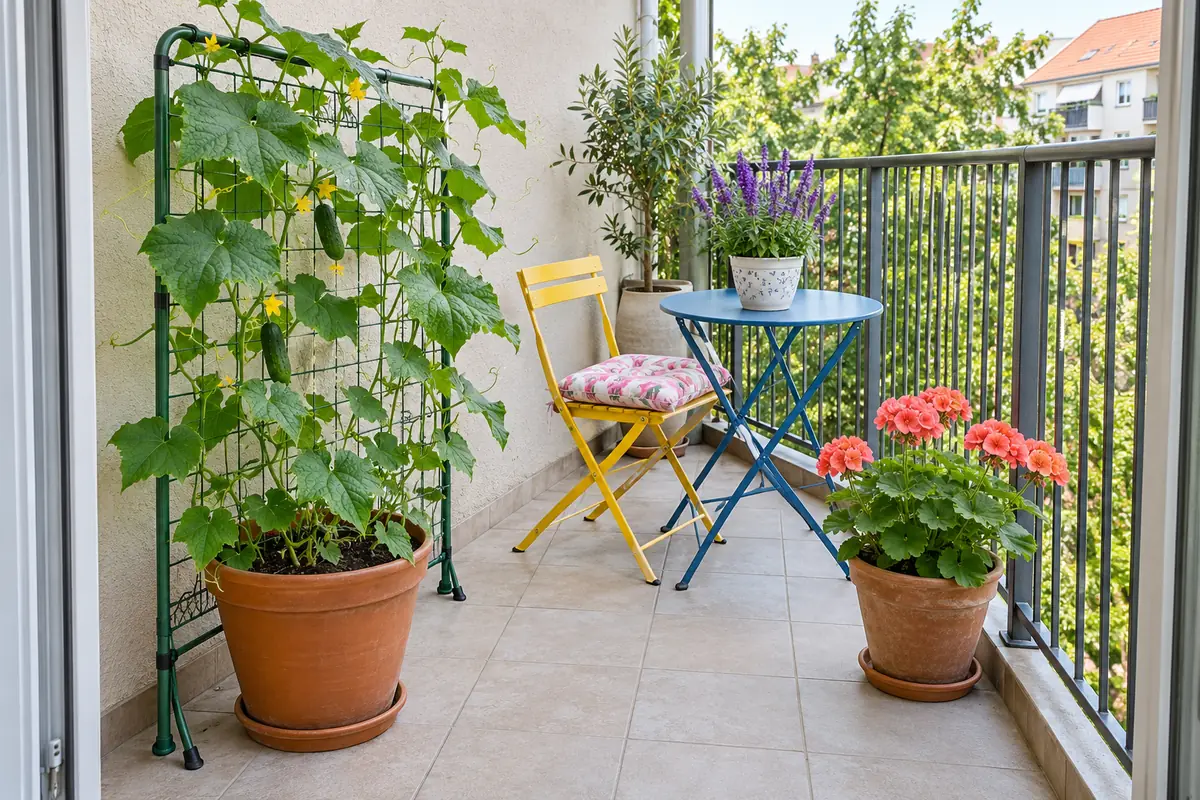
When flowers arrive, return to the packet’s pollination information. It is more useful than treating every cucumber flower the same way.
On a traditional plant with male and female flowers, early male flowers can appear before female flowers. A short wait for the first fruit is not automatically a problem.
Iowa State explains the flowering sequence and provides a real female-flower photograph. Use that botanical reference when inspecting your own plant.
For a bee-pollinated cucumber, keep flowers accessible to visiting insects. Do not leave an insect-excluding cover in place through flowering without another suitable pollination plan.
A nearby flowering pot can be a lovely part of the setting, but it does not guarantee that a high balcony receives enough cucumber pollination.
For a confirmed parthenocarpic variety, pollen is not needed for fruit production. Follow its supplier’s instructions, including any guidance about pollen exposure and fruit quality.
Do not remove male flowers from an ordinary outdoor cucumber because you have read a greenhouse instruction. That advice depends on the variety and growing system.
If hand pollination is needed, identify the flowers from a reliable botanical reference first and follow local extension guidance. Inspect the actual flowers on your own plant before starting.
If flowers repeatedly fail to develop, check the variety, insect access and growing conditions together. The terminology guide helps resolve the particularly confusing “all-female” label.
Follow the packet to decide about pollination
Read the specific variety description before changing your flower care. These labels describe different plant traits.
Packet confirms parthenocarpic
Fruit can form without pollination. Check outdoor suitability and follow the supplier’s advice about pollen exposure; do not assume every greenhouse variety fits an open balcony.
Packet says bee-pollinated or monoecious
Keep flowers accessible to pollinating insects. If you need help with hand pollination, use a reliable guide showing the real flower structures.
Packet says all-female or gynoecious only
Ask whether it also says parthenocarpic. If pollen is needed, check the pollenizer instructions before thinning a seed mixture to one plant.
Fruit still fails to develop
Review the label and growing conditions together. Water or fertilizer cannot replace the pollen required by a pollination-dependent plant.
Johnny’s terminology reference explains why mostly female flowers and fruit production without pollen are separate characteristics.
8. Harvest by variety and investigate problems carefully

Begin checking fruit regularly once it is developing. Look behind the leaves from inside the balcony; a cucumber can be surprisingly easy to miss against green foliage.
Use the packet’s harvest size for your variety. A mini cucumber should not be left to reach the length expected of a large slicer.
The RHS advises cutting the fruit stem cleanly with a knife or secateurs rather than pulling. Support the fruit while keeping your other hand clear.
Inspect the vine every few days during production. Iowa State warns that overmature fruit left on the plant inhibits further fruit set.
At the same visit, look over both leaf surfaces and the base of the plant. Notice changes early, before a dense vine makes inspection awkward.
If the plant wilts, check moisture before watering again. Maryland’s container guidance explains that both overly wet and overly dry roots can cause wilting.
Do not identify a pest or disease from a single symptom. Take clear photographs of the actual damage and ask your local extension service if the cause is uncertain.
Maryland’s cucumber guide links to common pest and disease problems, including cucumber beetles and powdery mildew. Use its factual references, not a generated garden scene, for comparison.
Keep a small record of the variety, pot size and watering difficulties. Next season, that practical information is more useful than a promised cucumber count per plant.
Questions before you grow balcony cucumbers
Can I grow just one cucumber plant?
Yes, provided its pollination requirements are met. A monoecious plant has both flower types, while some mostly female varieties need a separate pollenizer.
For a single pot with limited insect access, investigate a suitable parthenocarpic variety. Check its mature size and outdoor suitability before ordering.
Will a small pot give me smaller plants?
Choose a naturally compact variety instead of trying to control a vigorous vine through root restriction. Match its container recommendation and leave space for its support.
How many cucumbers will I harvest?
There is no dependable universal number for a balcony pot. Variety, season length, light, moisture and successful fruit set all affect production.
Should I water every morning?
Check the mix every morning while establishing your routine. Water when the root zone needs it, then let the container drain; repeat checks as conditions change.
Can I grow cucumbers in winter?
An open balcony needs a suitable warm growing season. In cool or frost-prone conditions, wait for the local planting window rather than treating the balcony as a greenhouse.
Start with the growing corner you can maintain
Choose one suitable plant and give it room to grow. A reachable pot, stable support and regular checks make this a much more manageable balcony project.
Keep the packet, note the planting date and inspect the first flowers carefully. You will have the information you need when it is time to pick.