
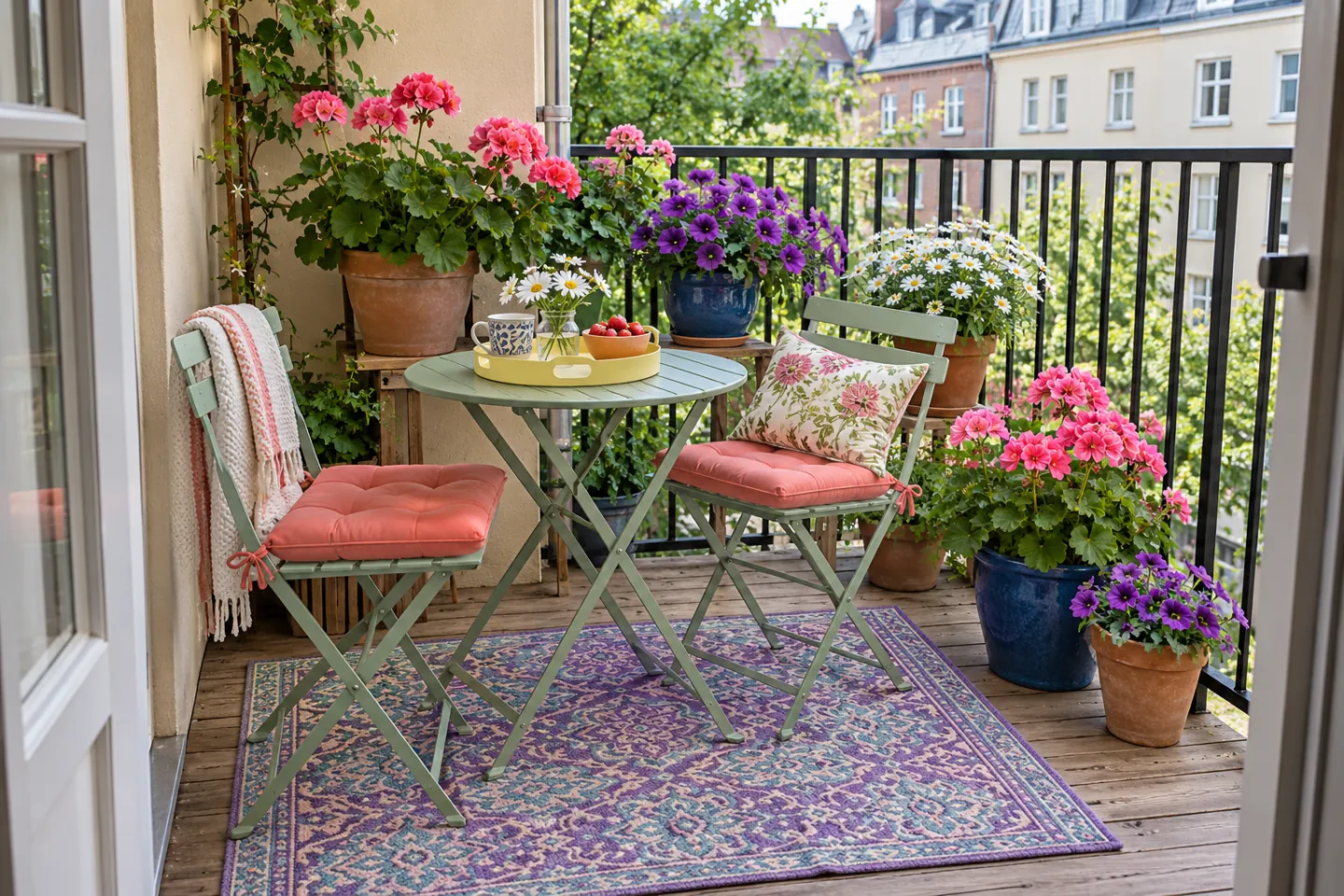
A balcony can be small and still feel like somewhere you want to spend an hour. A chair in the right corner can change the whole space.
Add flowers, a little pattern, and leaves at different heights. Leave somewhere for your cup, too.
These small balcony garden ideas bring the whole setting together, from planting and containers to furniture and finishing details.
Start with how you want to use the balcony. Then choose a garden that fits its light, space, and the care you can give it.
The photographs are AI-created design illustrations. Adapt the planting and layout to your balcony’s conditions.
Jump to one of the 25 garden ideas
- A Little Bistro Garden for Coffee Outside
- A Shady Woodland Reading Corner
- A Kitchen-Door Herb Garden with a Place to Pause
- A Rose-Pink Chair in a Cottage Flower Garden
- A Sheltered Mediterranean Courtyard in Miniature
- A Long Balcony with a Garden at the Far End
- A Sunshine-Yellow Seat Among Pollinator Flowers
- A Quiet, Japanese-Inspired Leaf Garden
- A Pegboard Herb Wall Above a Colorful Garden Seat
- A White-and-Green Outdoor Sitting Room
- A Hanging-Chair Retreat with Leafy Layers and Lights
- A Tiny Vegetable Garden with a Harvesting Seat
- A Private Reading Nook with a Filtered Backdrop
- A Low, Sculptural Succulent Terrace
- A Patterned Breakfast Nook with Flowers and Color
- A Low-Planted Garden for an Exposed Balcony
- A Sheltered Tropical-Style Leafy Retreat
- A Lilac Reading Garden with a Flowering Backdrop
- An Architectural Garden with Bold Plant Shapes
- A Colorful Renter-Friendly Garden That Packs Up Easily
- An Evergreen Garden with a Small Seasonal Spotlight
- A Blue-and-Yellow Courtyard with Terracotta Flowers
- A Three-Pot Garden for a Very Small Balcony
- A Potting Corner That Still Leaves Room to Relax
- A Flexible Garden for Dining, Lounging, and Everyday Life
1. A Little Bistro Garden for Coffee Outside

A sage-green bistro set gives this little garden a lovely starting point. Surround it with lavender, rosemary, and small white flowers in warm clay pots.
Keep the furniture toward the far end, with the taller planting tucked behind one chair.
A striped outdoor rug connects the seating area to the pots. Leave most of the tabletop empty so there’s actually somewhere for breakfast.
I love how the green chairs settle into the foliage instead of competing with it. A small flowerpot beside the doorway finishes the view.
Before buying anything, mark the chairs’ footprints with tape and test them pulled out. If the route feels tight, keep one chair folded and use fewer, better-placed containers.
2. A Shady Woodland Reading Corner

Think soft leaves, weathered textures, and somewhere comfortable to read. A wooden armchair with an olive cushion gives a shady balcony a natural focal point.
Place feathery ferns behind the seat, then bring a broader leaf shape forward in a lower pot.
Stone-colored containers keep the mix connected without making every vessel identical. A dark side table adds a useful spot for a book or mug.
Keep the center open. The empty floor makes the planting around the edges feel fuller.
Choose species suited to your shade and climate; the RHS fern guide is a useful starting point.
Check each pot separately for moisture, especially beneath an overhang where rain may not reach the soil.
3. A Kitchen-Door Herb Garden with a Place to Pause

Fresh herbs look especially inviting when they’re part of a usable little kitchen garden. Start with a sturdy raised trough, separate clay pots, and a folding stool.
Keep rosemary and thyme in their own containers beside a trough of suitable leafy herbs. Separate pots make different watering needs easier to manage.
A narrow shelf can hold scissors and spare pots, with the watering can underneath.
Add a small round table for trimming herbs or putting down breakfast. Match its wood tone to the trough for a calmer look.
What I like here is the balance between growing and sitting. Choose herbs you cook with regularly, and use the RHS container-herb guidance to match the plants to your conditions.
4. A Rose-Pink Chair in a Cottage Flower Garden

A rose-pink chair surrounded by flowers makes this corner feel cheerful before you add a single ornament. Give it a cream seat pad and one small floral cushion.
Then layer the planting: coral pelargoniums at the back, purple petunias lower down, and airy white blooms softening the edges.
Use terracotta and pale blue pots rather than matching everything to the chair.
A little teal table brings in a second color and keeps the scene from feeling too sugary. An outdoor rug ties the furniture together.
I’d leave a clear patch of floor beside the seat so the flowers frame the corner without swallowing it.
Choose varieties for your actual sun exposure, and keep every pot reachable for watering and removing faded blooms.
5. A Sheltered Mediterranean Courtyard in Miniature

One compact citrus tree can give a sheltered balcony the feeling of a tiny courtyard. Let its shape stand out against a warm, pale wall.
Cream folding chairs, a wooden table, and faded yellow stripes keep the furniture light.
Group smaller pots of lavender and thyme near the tree, leaving enough space to see the floor between them. The different heights create a garden rather than a row of containers.
Clay-look lightweight pots can carry the same warm palette without the weight of large ceramic vessels.
Plan for the tree’s future size and its winter home before buying it. Maryland Extension’s citrus guidance explains why cold-climate growers need a seasonal plan.
6. A Long Balcony with a Garden at the Far End

Give a narrow balcony a destination: a slim chair, a tiny table, and a planted corner at the far end.
Run a restrained line of containers along just one side. The opposite edge stays open, so the view feels longer and the route remains useful.
Repeat compact grasses or leafy shapes, then tuck in a few white flowers for contrast.
Keep the wall and flooring quiet.
Too many competing finishes can make a narrow space feel busy even when there aren’t many objects.
Measure the plants’ expected spread as well as the pots.
If the leaves will push into your legs, shorten the row and concentrate the garden around the chair instead. An open stretch of floor can be the nicest feature.
7. A Sunshine-Yellow Seat Among Pollinator Flowers

Here’s a corner worth stopping for: a yellow chair, a teal table, and flowers that look wonderfully alive in ordinary daylight.
Arrange compact sunflowers, open pink blooms, purple lavender, and white daisies at different heights. Keep the taller stems behind the lower pots so each planting gets its moment.
Terracotta containers and a simple striped rug give the colors somewhere calm to land. The table stays small, leaving space to reach the flowers without brushing through them.
Choose locally suitable pollinator plants with different flowering periods, rather than expecting the whole display to peak together.
I love this setting when some buds are still closed and a few flowers have opened fully. That variation makes it feel like a growing garden, not a shop display.
8. A Quiet, Japanese-Inspired Leaf Garden

A bench, a small tree, and a few foliage pots can make a balcony feel wonderfully settled. Give each shape enough space to be noticed.
Place a compact Japanese maple toward the back, where its canopy can frame the seat without covering it.
Lower fern pots soften the base, while a slatted backdrop adds warmth behind the leaves.
Keep the bench cushions charcoal and the table plain. The interesting part is the contrast between fine leaves, solid wood, and open floor.
Skip the extra ornaments. This corner doesn’t need them.
Choose a maple variety and container suited to your climate and space, and favor a sheltered position. An exposed balcony can be a difficult place for delicate foliage and a top-heavy arrangement.
9. A Pegboard Herb Wall Above a Colorful Garden Seat

A planted display wall can turn the back of a balcony into its most interesting feature. Pair separate herb pots with a compact outdoor seat below or beside them.
A white perforated panel keeps the background light. Mustard, teal, and leaf-print cushions bring color into the seating without covering every surface in pattern.
Repeat a few terracotta pots on the floor to connect the wall planting to the rest of the garden. Keep the table small and the center clear.
Use an outdoor-rated system with supports and fixings appropriate to its location and loaded weight. Follow its instructions rather than treating a decorative panel as a ready-made plant support.
Every pot should lift out easily for watering, pruning, and checking drainage.
10. A White-and-Green Outdoor Sitting Room

Sometimes a quieter garden is exactly what you want outside a busy room. White flowers, generous green leaves, and a little wooden sofa create that pause.
Use pale containers in a few different shapes. Their shared color connects the planting while the leaves provide variation.
Place the largest plant behind the seating, with lower flowering pots nearer the front.
A black table gives the pale scheme definition. One dark accent is enough; there’s no need to outline every object.
I’d keep the cushion fabric oatmeal rather than bright white, which can feel softer against the greenery.
Choose flowers for the balcony’s light, and keep incompatible care needs in separate pots. Leave room for your feet and a comfortable way to reach the containers.
11. A Hanging-Chair Retreat with Leafy Layers and Lights

A woven hanging chair gives a sheltered balcony a different rhythm from a standard bistro set. Surround it with leafy pots and keep the rest deliberately simple.
Mustard and teal cushions bring warmth to the white cords. A small painted side table adds somewhere for a cup without taking over the floor.
Group taller foliage near the back wall, with smaller pots beside the chair’s resting position.
A short run of outdoor-rated string lights can finish the overhead edge. Keep the daylight natural rather than making the whole scene glow orange.
Only use a suspended seat after a qualified installer approves the structure, anchors, and clearances. If that isn’t practical, borrow the planting and cushions for a regular outdoor lounge chair instead.
12. A Tiny Vegetable Garden with a Harvesting Seat

An edible balcony can be a place to sit as well as somewhere to grow dinner. Start with one supported compact tomato, a few salad containers, and a separate herb pot.
Arrange the crops along the back and side, keeping a small worktable within reach. A folding chair makes the table useful for sorting leaves or taking a quick break.
Choose containers for the mature crops, not the nursery plants you bring home. Put the tomato support in early so you aren’t disturbing established roots later.
Keep the planting modest enough to water comfortably.
The Wisconsin container vegetable guide covers crop choice, light, and pot size. One productive, reachable plant is a better start than an impressive collection that crowds the doorway.

13. A Private Reading Nook with a Filtered Backdrop

A little privacy can make a balcony feel much more inviting. Create an end corner with a slatted backdrop, a comfortable upright chair, and two leafy pots.
Keep the plants low enough to manage, with their foliage softening the meeting of wall and railing.
A blue-gray cushion and a simple side table give the seat a finished purpose. A small rug can define the corner if it suits the surface and drainage.
Leave space behind the pots for cleaning and inspection.
Screens need approved, well-supported fixings and must suit the wind exposure. The RHS balcony guide explains the main considerations.
If a new screen won’t work, use an existing sheltered wall as the backdrop and let the planting soften its edges.
14. A Low, Sculptural Succulent Terrace

Broad bowls of succulents give a sunny balcony a sculptural foreground without hiding the view. Pair them with a slim bench and one small side table.
Repeat a few rosette shapes in one bowl, then use a different leaf texture in another. Clay and warm gray containers keep the arrangement grounded.
Leave generous gaps between the groups rather than scattering tiny pots everywhere. From the chair, you should be able to enjoy the plants’ shapes and still see the floor around them.
Choose species for your climate and rainfall, with suitable growing mix and drainage.
Succulent doesn’t automatically mean frost-proof or happy in winter rain, so make the plant choices before settling on the final look.
15. A Patterned Breakfast Nook with Flowers and Color

A patterned rug can make a little breakfast corner feel collected rather than coordinated from a catalog. Start with wooden folding chairs and let purple, teal, and floral fabrics supply the color.
Keep the table simple, with room for plates and a small vase. A knitted throw adds softness without needing another piece of furniture.
Plant around the edges with purple blooms, pink flowers, and a little green foliage. Repeat one textile color in a pot to connect the garden to the seating.
I love the slightly mismatched feeling here. Choose outdoor-suitable fabrics, bring vulnerable pieces inside, and test the chairs pulled out before filling the remaining floor with plants.
16. A Low-Planted Garden for an Exposed Balcony

An exposed balcony needs a different approach to lushness. Broad, low containers and compact planting can create a garden without relying on tall stems.
Set a simple bench against the wall, then arrange grasses and small flowering plants along the edges.
Keep the table low and the accessories minimal. A removable olive cushion supplies the softness.
The open floor is useful space, not an unfinished part of the design.
Choose every container and plant for the actual exposure. Low planting is a design approach, not a promise that pots or furniture cannot move in gusts.
Follow the building’s guidance on securing objects and allowable loads.
If the conditions are severe, keep the arrangement simpler still and make the view from indoors part of the enjoyment.
17. A Sheltered Tropical-Style Leafy Retreat

Large leaves can make a sheltered balcony feel like a little green room. Give them a plain background and a compact seat with oatmeal cushions.
Cluster the broadest foliage at the back corner. A smaller trailing plant on a low stand softens the transition toward the table.
Warm gray containers and timber flooring keep the setting relaxed. Let the leaves provide most of the pattern.
Keep the center clear so you can step outside without pushing through foliage.
Plan an indoor winter home if your chosen plants cannot tolerate local cold. Match each species to the balcony’s summer light, and check its suitability around pets or children.
A few healthy leaves make a stronger impression than a crowded collection struggling in the wrong conditions.
18. A Lilac Reading Garden with a Flowering Backdrop

Carry lilac through the whole corner: a cushion, a little painted table, and flowers at different heights. White metal furniture gives the color a light, airy partner.
A suitable flowering climber on a properly supported trellis creates the backdrop. Lower pots of purple and pale pink blooms connect it to the floor.
Leave a small break between the containers so the arrangement feels layered rather than packed solid.
I’d keep the rug cream and let the planting do the decorating.
Choose the climber for your light, climate, container size, and available support.
Plan access for watering and pruning before it fills out, and remember that the flowers will change through the season while the cushion keeps the color present.
19. An Architectural Garden with Bold Plant Shapes

A few strong plant shapes can give a balcony more presence than a shelf full of small pots. Combine a rounded shrub with upright grasses and a simple teak bench.
Matte charcoal containers make the outlines clear against a pale wall.
Keep the tallest planting at the back, leaving an open stretch of floor beside the seat. A cream cushion softens the hard lines.
The small dark table repeats the planter finish without adding another competing material.
Check mature plant size before choosing the final containers. A shrub that quickly outgrows its corner will change the whole composition.
For a hot position, consider planter material and exposure together; the RHS container guide explains the practical differences between common options.
20. A Colorful Renter-Friendly Garden That Packs Up Easily

A turquoise plant stand, coral chair, and yellow table give this little garden a cheerful identity. Keep the walls plain so the individual colors have room to breathe.
Fill the stand with removable pots of herbs and seasonal flowers. A few cobalt containers and terracotta pots connect the furniture to the planting.
A striped outdoor rug finishes the setting without a permanent floor change. Leave a clear route from the doorway to the chair.
Everything should be practical to move, maintain, and take with you.
Choose an outdoor-rated stand that can be used safely in your conditions, follow its stability instructions, and check the building’s rules before adding anything that needs fixing in place.
21. An Evergreen Garden with a Small Seasonal Spotlight

Give the balcony a lasting outline with compact evergreen plants, then save one low container for changing flowers.
The whole garden doesn’t need replacing each season.
Place the structural plants toward the back, with the seasonal pot visible from indoors.
A weathered wooden bench and light gray containers keep the background quiet. A small table makes the seat useful even when there are fewer flowers.
The interesting part is the contrast between the steady green shapes and the changing foreground.
Choose plants for your local climate, light, and container conditions. Roots in exposed pots can need different winter care from plants growing in the ground.
Keep the layout accessible for watering and inspection during the months when you use the balcony less often.
22. A Blue-and-Yellow Courtyard with Terracotta Flowers

A cobalt-blue chair and yellow striped cushion make this courtyard-style corner feel sunny even before the flowers open.
Use terracotta pots for most of the planting, then add one or two blue-and-white vessels to echo the chair.
Coral flowers, purple blooms, and green rosemary create a loose garden border around the seat. A small mosaic-style table adds pattern without needing a busy rug as well.
Keep the wall warm white and the floor simple. That quieter background lets the painted furniture and flowers stay clear.
I love the combination of aged clay and clean blue.
Choose suitable plant varieties and check each pot’s moisture separately; porous terracotta and a glazed container won’t necessarily dry at the same rate.
23. A Three-Pot Garden for a Very Small Balcony
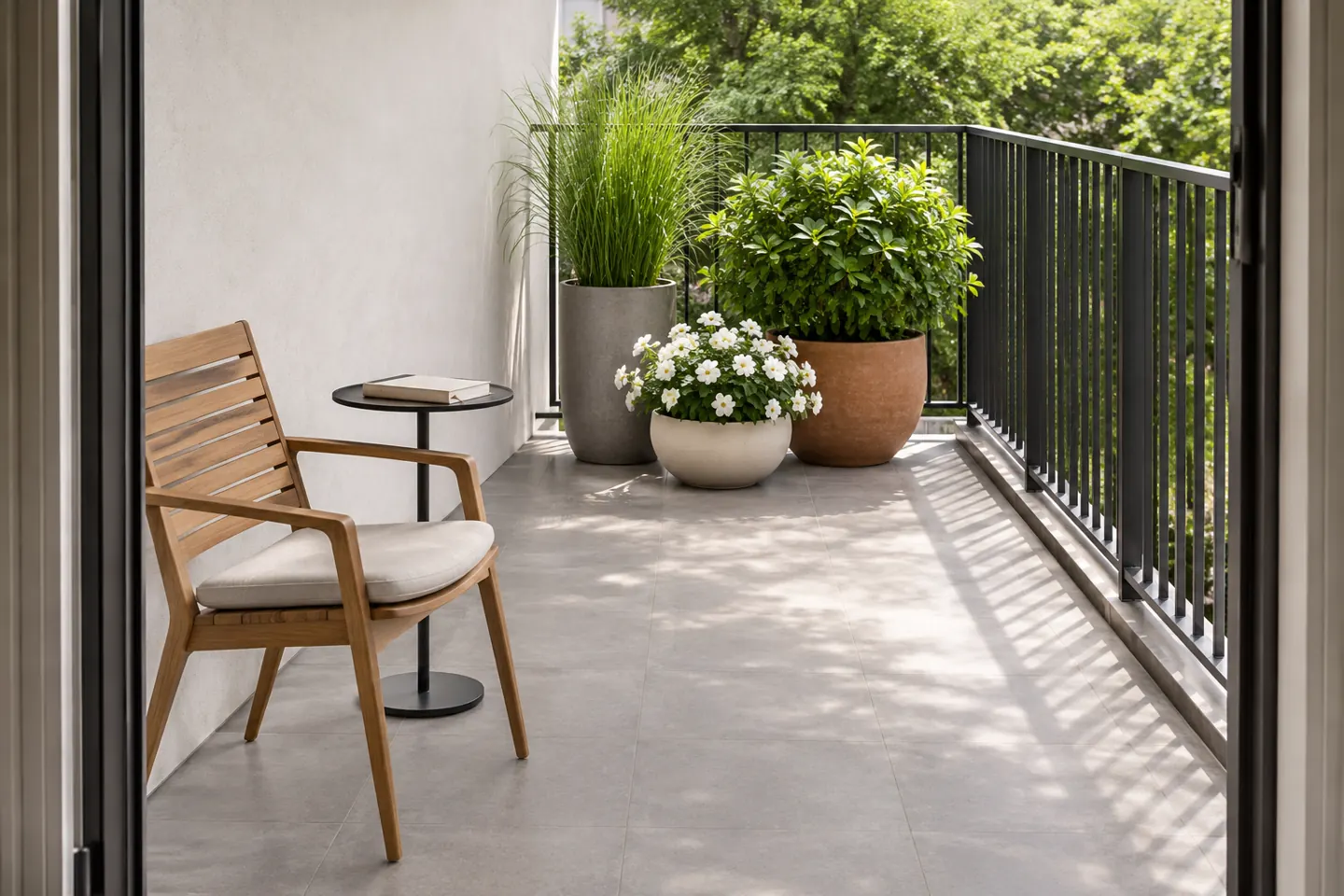
Three well-chosen pots can be enough. Use one upright plant, one rounded leafy shape, and one low flowering container to give the little group variety.
Set them at the far end, with a slender chair and small table nearer the doorway.
Keep the wall plain and most of the floor visible. The open space makes each plant feel more intentional.
A gray, clay, and cream palette works without requiring every pot to match.
Let the leaves provide the connection.
Mark the containers’ footprints before shopping, allowing for mature foliage and the balcony’s approved load.
This is a lovely option when you want a garden to enjoy from the window, with fewer separate pots to reach, inspect, and water outside.
24. A Potting Corner That Still Leaves Room to Relax
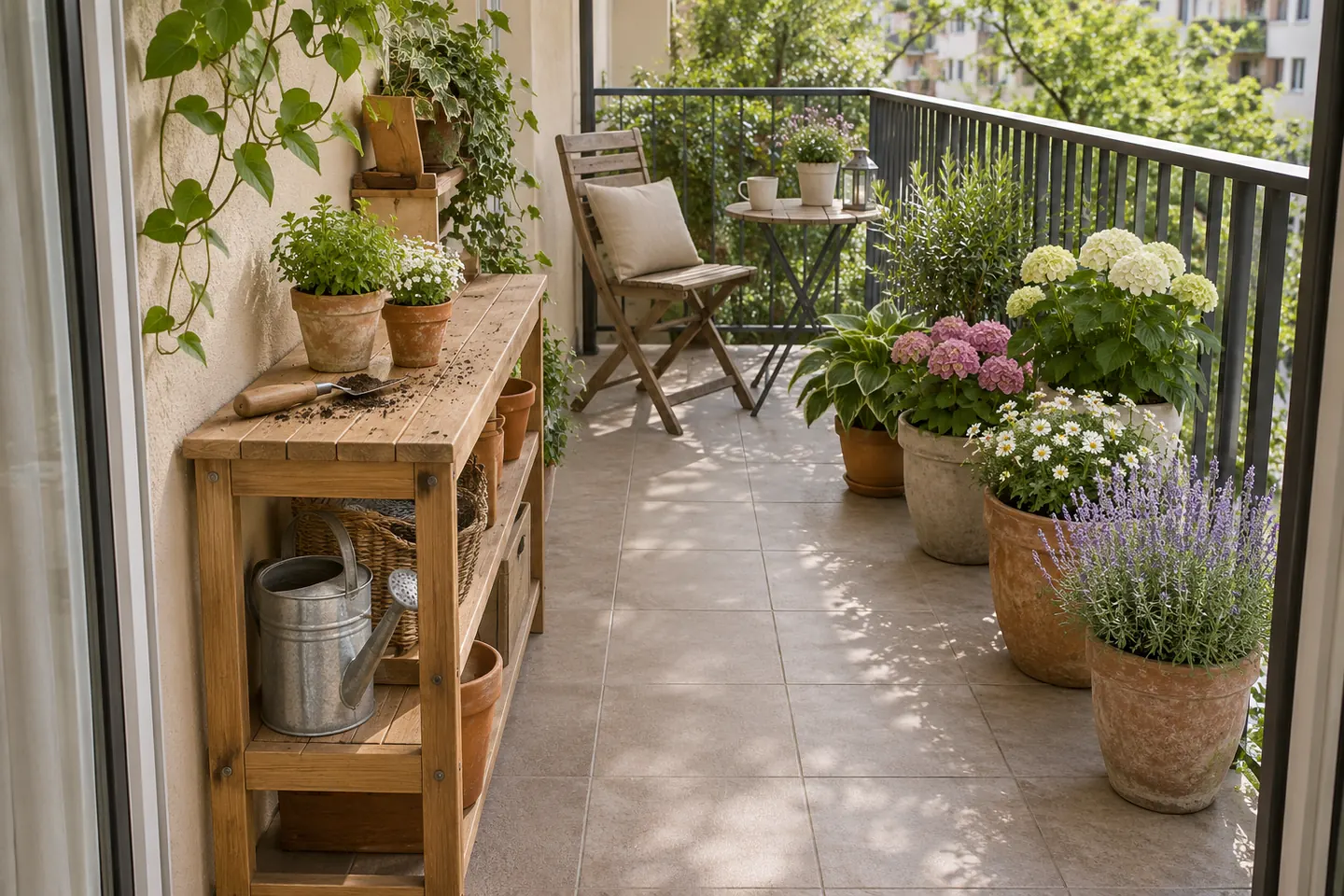
A working balcony garden can still look inviting. Give a narrow outdoor bench one wall, with the watering can stored below and finished pots grouped nearby.
Keep the worktop mostly clear. Two plants and a hand tool are enough to suggest its purpose without turning it into permanent storage.
A folding chair and tiny table at the far end create a separate place to pause. Repeat the bench’s wood tone in the furniture so the practical and decorative parts feel connected.
Before choosing the bench, check that you can stand, turn, and carry a pot comfortably. Keep bagged mix protected and drains accessible.
If a permanent workbench crowds the balcony, use a removable tabletop for occasional tasks instead.
25. A Flexible Garden for Dining, Lounging, and Everyday Life
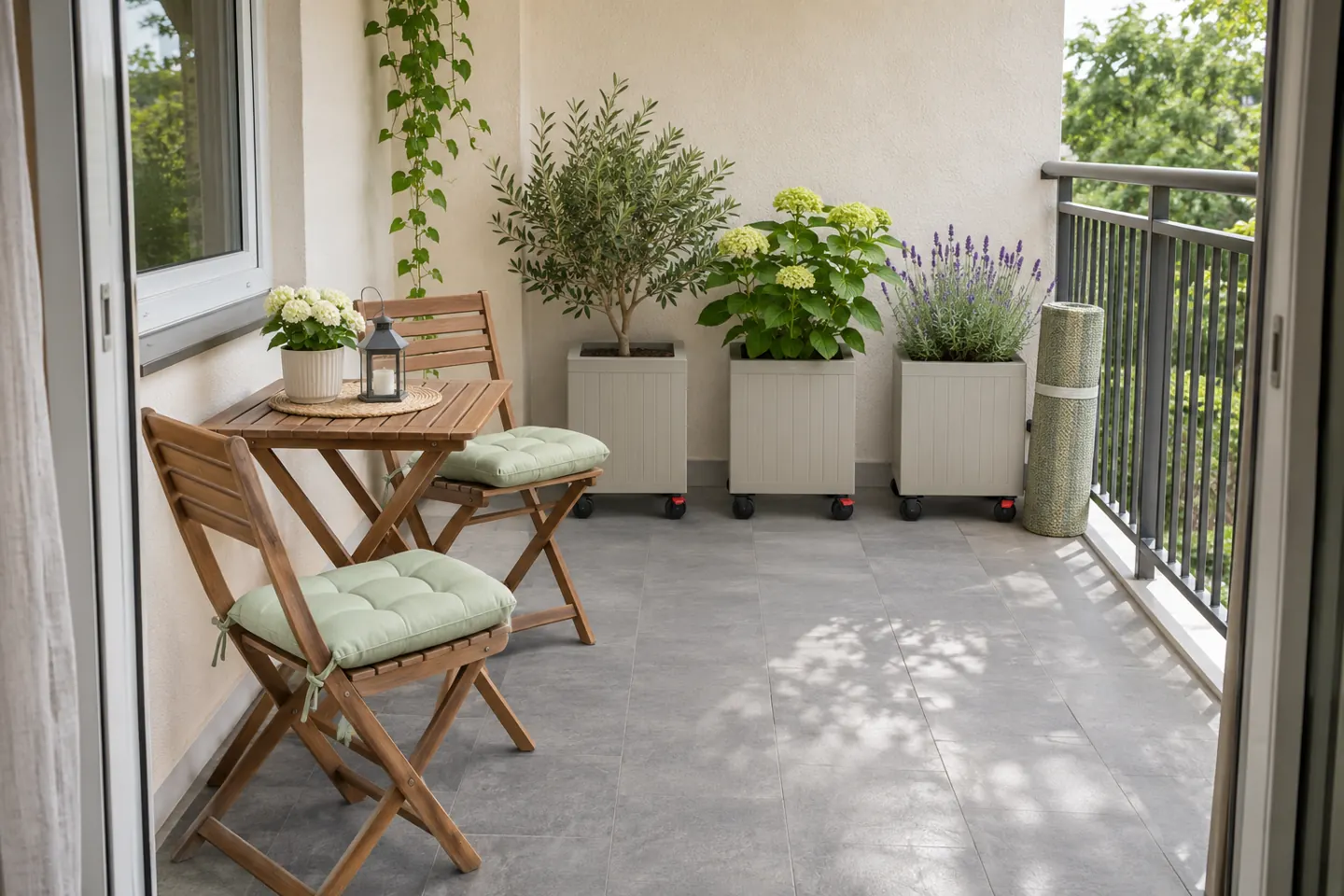
Some balconies need to change jobs during the day. A folding table, two compact chairs, and a modest group of plants make that easier.
Park the garden along the back wall for meals, then fold away one chair when you want more open floor.
Repeat a pale green cushion color in a pot or two. Keep the remaining finishes simple so the everyday arrangement still looks intentional.
Choose plants that don’t need a web of permanent supports. Movable containers are useful only when moving them is genuinely manageable.
Use suitable outdoor plant caddies with working locks, following their capacity and stability instructions. If rolling the pots is impractical, keep them in place and let the folding furniture provide the flexibility instead.
Choose a Garden You Will Actually Use
Shortlist two ideas that fit your light and the way you want to spend time outside. Compare their footprints and care needs before shopping.
Borrow the planting from one and the seating from another if that suits your space. Keep the combination easy to water, clean, and enjoy.
Small Balcony Garden Questions
How do I make a balcony look lush without filling the floor?
Group a few plants with different leaf shapes at two or three manageable heights. Leave a usable area open instead of scattering pots across it.
Allow for mature foliage so the arrangement stays comfortable as it grows.
Can I grow a garden on a balcony that gets little sun?
Yes, with plants suited to its actual light and exposure. A foliage-led design may be more satisfying than sun-loving crops struggling in shade.
Record the light through the day and use those observations when choosing plants.
Do I need stones in the bottom of every pot?
No. Use drainage holes and an appropriate container growing mix rather than assuming gravel improves drainage.
Wisconsin Extension’s container guidance explains that layers can impede water movement.
How can I keep the balcony easy to care for?
Start with fewer reachable pots and match plants to the conditions. Check moisture as weather changes rather than following a rigid watering calendar.
The RHS container guide covers the basics.