
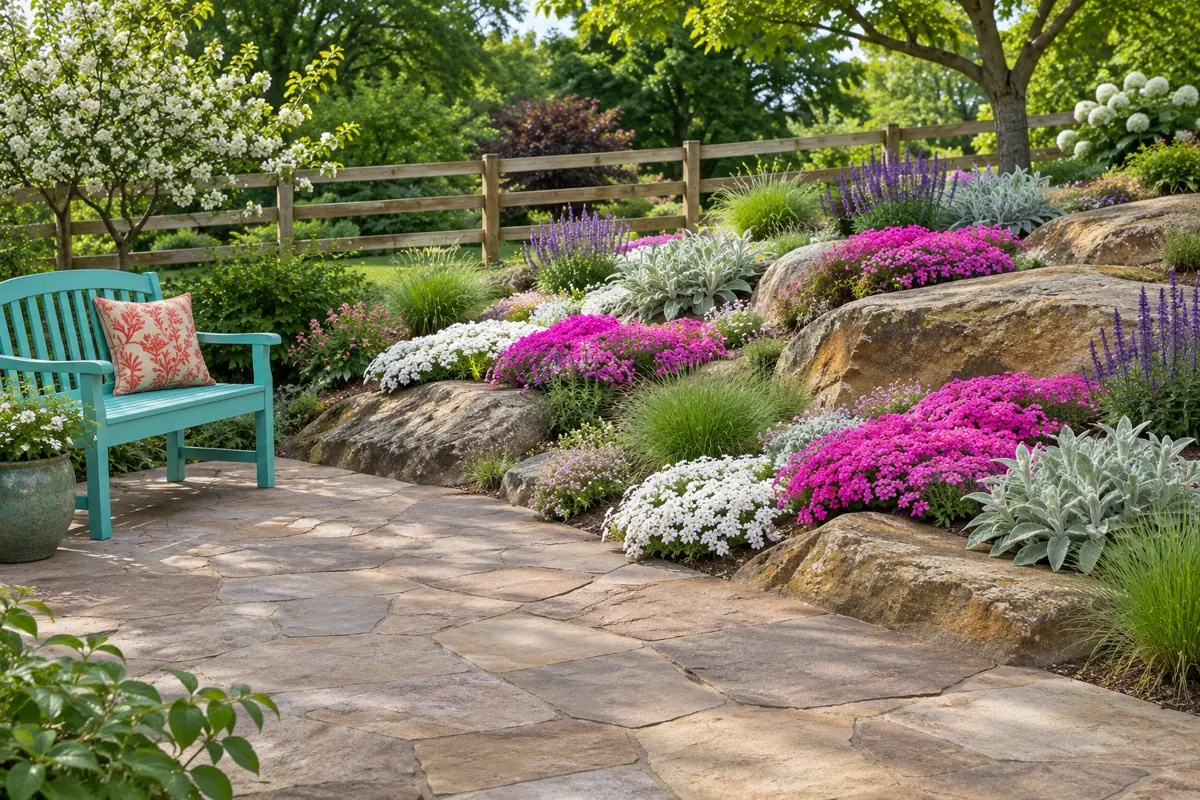
A rocky bank gives you something useful to work with: shape. Keep the stone visible, choose plants for the actual conditions, and give yourself a way to reach them.
These 18 rock garden ideas range from flowering banks to patio troughs. Some suit sunny, freely draining ground; the shaded and frost-free settings need different plant choices.
A rock garden is not automatically an erosion-control system. On unstable slopes, or where walls and concentrated runoff are involved, arrange qualified local advice before changing the ground.
Start with the setting that fits your site. Then adapt the planting to your winter lows, summer heat, rainfall and soil rather than copying a climate that behaves differently.
Quick choice: Try a flowering bank for a stable sunny slope, troughs for unsuitable ground, or a foliage-led border for dry shade.
Keep routes level and usable where possible. These are design concepts; they do not specify retaining structures, drainage engineering or safe boulder installation.
Find your rock-garden setting
- 1. A flowering limestone bank above a level path
- 2. A slate crevice garden with a consistent grain
- 3. A decorative pebble ribbon through a dry border
- 4. Prairie-style flowers around broad boulder groups
- 5. A Mediterranean-inspired rock-and-herb courtyard
- 6. A frost-free succulent crescent with open gravel
- 7. A leaf-mulched rock border in dappled shade
- 8. A flower-filled bank beside existing garden steps
- 9. Small flowering pockets in a sound low stone wall
- 10. A modern gravel island with dark stone accents
- 11. An alpine trough collection on a small patio
- 12. A narrow rock border below a side-garden fence
- 13. A curved rock bed framing the front walk
- 14. A level stone-seat nook below a gentle bank
- 15. Low rock outcrops within a loose meadow planting
- 16. A small rock border beside a garden shed
- 17. Spring bulbs through a low granite rock garden
- 18. Three stone forms in a quiet gravel garden
Check the slope and water before choosing a design
Walk the site in dry weather and again after rain. A dry-looking surface can conceal wet soil or a route for concentrated runoff.
Map sun and exposure
Note direct sun, shade, wind and reflected heat. Choose the plant palette for those conditions, then check winter hardiness and local invasive-plant guidance.
A sheltered warm courtyard and an exposed cold bank need different plants, even when both contain stone.
Trace the water
Look for ponding, channels, washed-out soil and water arriving from a roof or driveway. Record where water leaves the area.
Do not redirect runoff onto another property or toward a building. Active erosion or unstable ground needs qualified site-specific advice.
Describe the gradient
Use rise divided by horizontal run, multiplied by 100, to describe a slope. Iowa State explains this rise-over-run method.
Illustrative example: 2 feet of rise over 20 feet of horizontal run gives (2 ÷ 20) × 100 = 10%.
That number is not a stability test or a construction approval. Soil, water, access and existing structures still change the decision.
Keep establishment in the plan
Avoid stripping a whole hillside bare before the replacement cover is ready. New hillside plantings are particularly vulnerable to erosion while roots establish.
Plan temporary protection with suitable local advice, and choose a practical way to reach plants for watering and weed removal.
For a small flat site, a trough or low island may be simpler. Heavy stone, new retaining walls and changes around structures deserve an experienced professional.
1. A flowering limestone bank above a level path
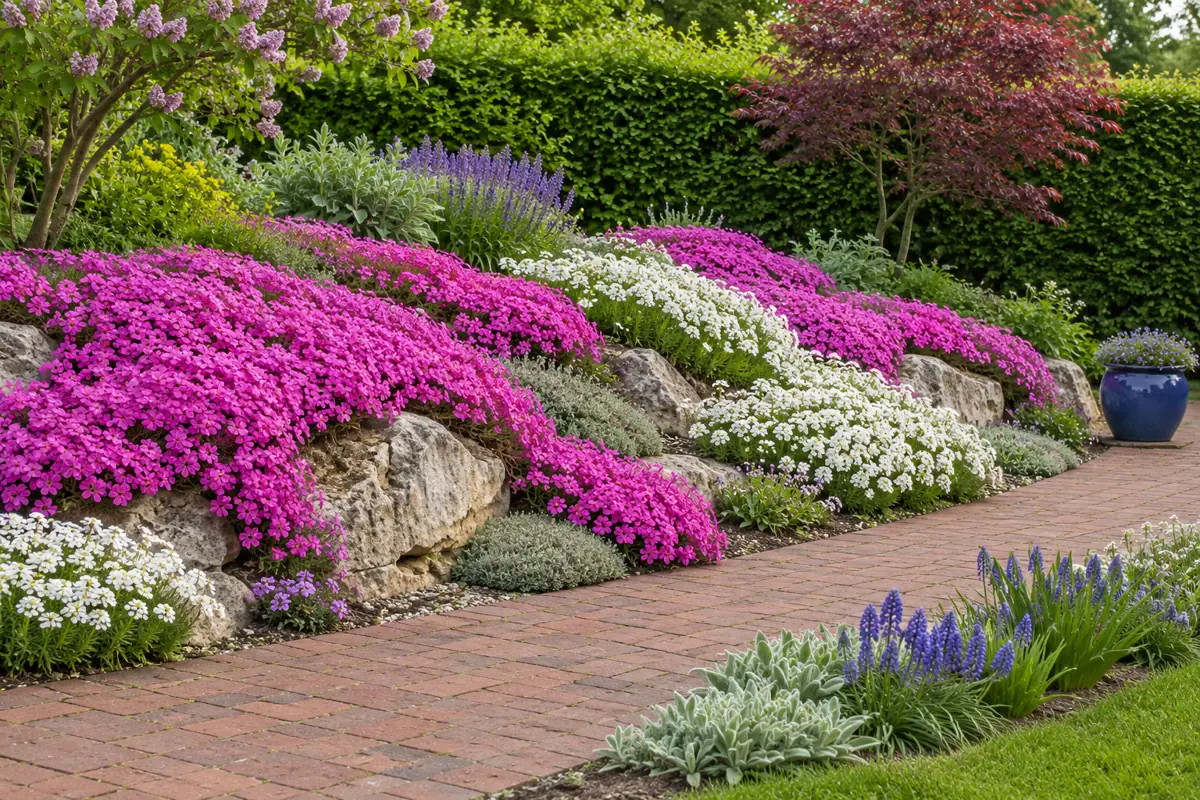
A low bank can look generous without needing a large collection of plants. Let pink phlox and white flowering cushions spread between visible limestone faces.
A brick path across the bottom gives the flowers a warm frame. Keep a small blue pot at the end rather than scattering ornaments throughout.
Choose repeating groups, leaving room for their eventual spread. The stone should remain part of the picture after the plants fill out.
Alpine phlox needs an open, sunny, freely draining position. Match the other plants to those conditions rather than mixing in thirsty border favorites.
This is a planting idea for an already stable, modest bank. Deal with concentrated runoff before installing delicate cushions, and leave the path clear for weeding access.
2. A slate crevice garden with a consistent grain

Parallel slate pieces give a small mound the character of exposed bedrock.
Keep their angle consistent so the arrangement feels connected beneath the soil.
Nestle small rosettes, pink dianthus and white alpine cushions into the spaces. A restrained plant scale lets you see the stone lines.
A gravel perimeter separates the mound from lawn and provides access from outside the planting.
Lay out the pieces before committing to their positions. Avoid a row of upright spikes or slabs balanced loosely on one another.
The RHS describes specialist crevice gardens as a distinct rock-garden approach. Seek experienced help with heavy stone and the planting medium.
The limitation is scale: vigorous plants can quickly hide narrow crevices. Choose modest growers and edit the planting as it develops.
3. A decorative pebble ribbon through a dry border

A curving ribbon of rounded pebbles can suggest a stream without adding water. Keep it shallow and contained within an almost level garden.
Granite boulders mark the bends, with pink thrift, silver foliage and small grass tufts on the banks. A plum chair belongs on separate level paving.
Use the ribbon to lead the eye toward the seating area, not straight into a fence.
Place edging and planting pockets so maintenance does not require stepping across the flower crowns. Repeat the same pebble color for a calmer finish.
Treat this as decoration, not a drainage installation. The RHS describes erosion and access among the challenges of sloped sites.
If runoff crosses the site, resolve its route first; a pretty stone channel can otherwise concentrate an existing problem.
4. Prairie-style flowers around broad boulder groups

Broader boulders suit a loose planting of purple coneflowers, yellow daisies and grasses.
The flowers rise above the rock instead of hugging every surface.
Keep the tallest groups back from a sidewalk. A low planted edge makes the transition feel intentional without narrowing the route.
Choose locally appropriate prairie species with compatible soil and moisture needs. Native in one region does not mean native everywhere.
Iowa State lists black-eyed Susan and little bluestem among Iowa natives for sunny, dry soils. Use local extension advice when adapting the palette.
I love how the broad stone faces give fine stems something solid to move against.
Allow room for mature clumps and a workable maintenance route. This fuller design needs more space than a miniature alpine collection.
5. A Mediterranean-inspired rock-and-herb courtyard

Pale gravel, sandstone and terracotta make a comfortable setting for a coral bistro table.
Put the furniture on level paving, with the planting around its edges.
Use lavender as the soft middle layer, with lower thyme near the stone and a rosemary accent farther back.
A blue-and-white cushion ties the warm furniture to the cooler foliage. Leave a generous route for carrying drinks and reaching the plants.
Lavender needs sun and freely draining soil. Check the hardiness and mature dimensions of each herb before buying.
Group plants by their watering needs rather than watering the whole courtyard as one bed.
This look struggles in a persistently wet position. In cold climates, select suitable hardy plants or use movable containers for tender choices.
6. A frost-free succulent crescent with open gravel

A crescent-shaped bed gives sculptural succulents a clear outline beside a turquoise gate. Dark porous-looking stone contrasts with pale gravel and fleshy foliage.
Keep rosettes toward the front, with small branching shrubs and flowering aloes behind. Leave individual shapes visible instead of crowding every gap.
Broad pavers provide a separate route through the courtyard. Set a yellow stool on a level pad beyond the bed.
This is a warm-climate concept, not a universally hardy plant combination. Echeverias need protection from frost; check the exact aloe and other succulent species too.
Choose a planting medium and exposure suited to the plants and your rainfall.
Where winters are cold or wet, recreate the arrangement in containers you can move to suitable winter protection.
Choose plants by the growing pocket, not the stone color
Use this selector to narrow the design. It is a starting point for checking labels, not a universal planting prescription.
| Your conditions | A useful direction | Check before buying |
|---|---|---|
| Sunny; freely draining | Alpine cushions and rosettes | Winter wet; eventual spread |
| Shaded; dry in summer | Selected epimediums and compatible foliage | Species moisture needs; tree roots |
| Sunny; larger dry bed | Locally adapted flowers and bunchgrasses | Mature height; local suitability |
| Warm; frost-free | Tender succulent composition | Species hardiness; wet-season drainage |
| Heavy or persistently wet soil | A suitable container collection | Container drainage; stable placement |
Most alpines need sun and free drainage. For a constantly wet site, choosing plants that suit the moisture may be wiser than forcing a dry rock-garden style.
Two labels worth reading
Check the plant’s eventual spread and the conditions it needs. “Dwarf” describes slow growth in many conifers; it does not promise a permanently tiny plant.
RHS rock-garden guidance emphasizes room for growth and caution with dwarf conifers. In a small bed, a named miniature choice is easier to plan around.
Match the mulch to its job
Decorative boulders, planting gravel and a walking surface do different jobs. Choose each for its location instead of using one aggregate everywhere.
Colorado State explains how gravel size and site conditions affect mulch behavior. Keep plant crowns and routes clear; a stone dressing does not repair unsuitable underlying drainage.
7. A leaf-mulched rock border in dappled shade
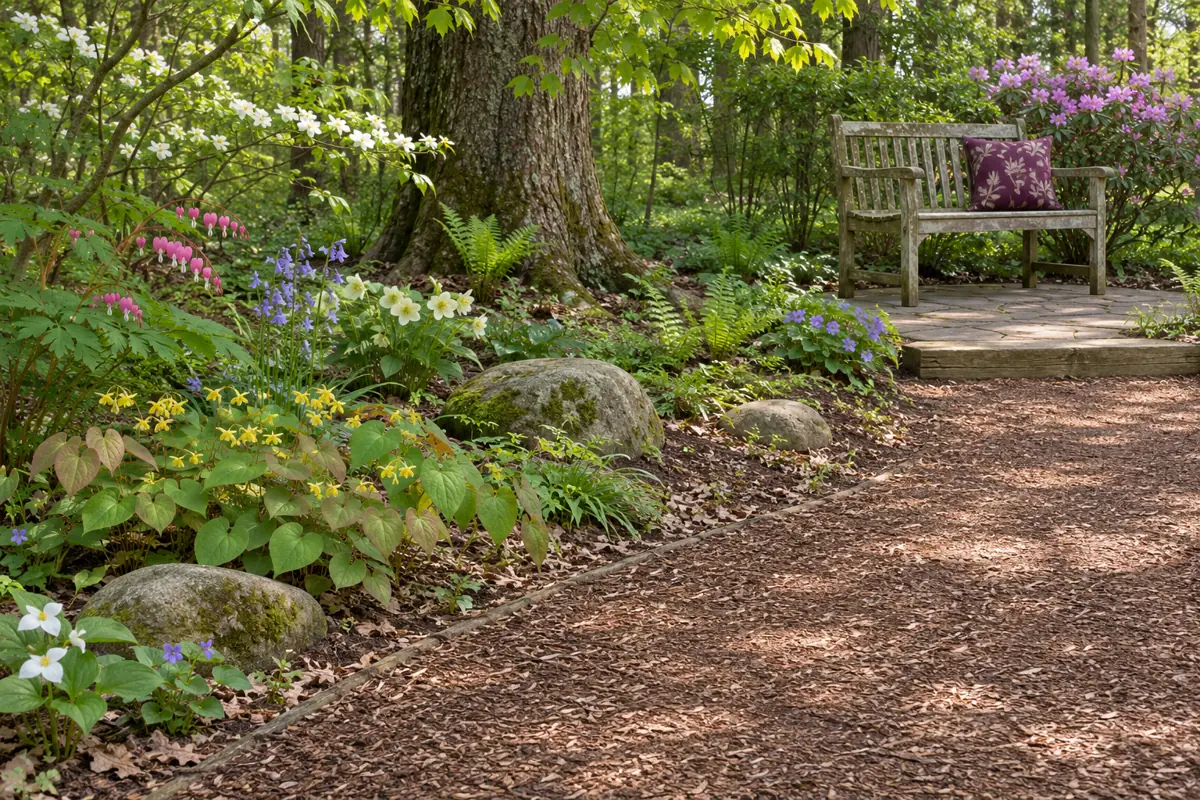
In a shaded corner, let weathered stones sit among foliage rather than covering everything with gravel.
Heart-shaped leaves soften their edges, with spring flowers providing small flashes of color.
A level woodland path and a timber bench make the whole scene inviting.
A plum patterned cushion adds warmth without competing with the planting.
Keep existing tree roots and the trunk flare undisturbed. Work with stones already present rather than excavating a new rockery beneath a mature tree.
Some epimediums, including ‘Sulphureum’, tolerate dry shade. Others need more moisture, so choose the label, not just the genus.
Any ferns belong in pockets whose moisture suits them.
Dry shade can be demanding during establishment. Check the root zone and water according to need, even when the planting looks settled.
8. A flower-filled bank beside existing garden steps
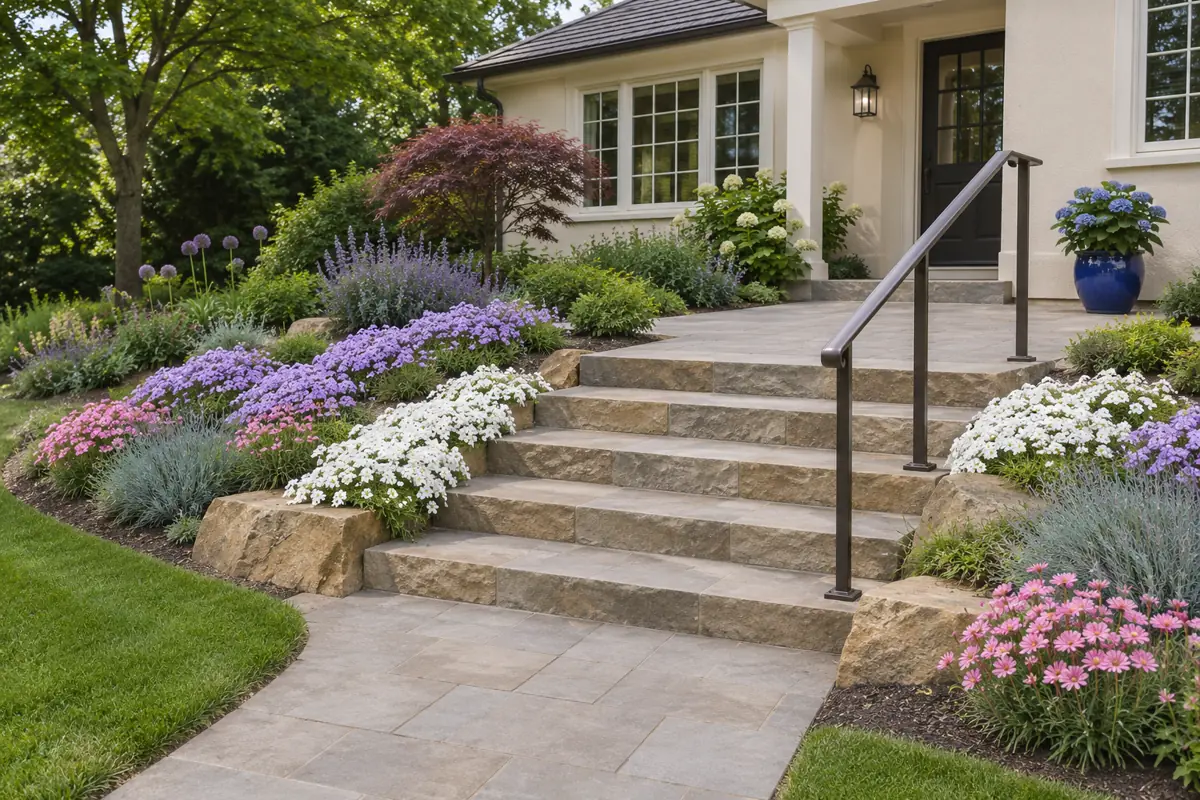
Existing steps can provide the strong line a rock garden needs.
Keep their treads, landing and handrail clear, with low flowers along the sides.
Let sandstone outcrops emerge through white and violet cushions. Pink dianthus adds a smaller upright note without hiding the edge of the route.
A blue pot at the top can connect the planting to the house. Place it well outside the landing and door swing.
Start by checking the condition of the steps and the way water moves around them. Planting should not disguise cracks or a slippery surface.
Use compact plants and remove gravel that migrates onto the treads.
For new stairs or structural changes, use qualified local advice. The garden styling does not provide a construction specification or an accessibility assessment.
9. Small flowering pockets in a sound low stone wall

A low dry-stone wall brings the planting closer to eye level from a patio.
Violet bellflowers can soften selected upper joints while pink cushions finish the top.
Keep enough bare stone visible to appreciate its texture. A sage bench and coral striped cushion make the level space below feel like a destination.
The RHS recommends planning plant pockets as a dry-stone wall is built. Coordinate them with the person constructing the wall rather than loosening stones afterward.
Leave the seating route clear of trailing growth and collected debris.
The wall must be sound before it becomes a planting opportunity. A retaining structure needs appropriate professional assessment, foundations and drainage.
This idea suits a few carefully placed plants; oversized clumps can hide joints you need to inspect.
10. A modern gravel island with dark stone accents
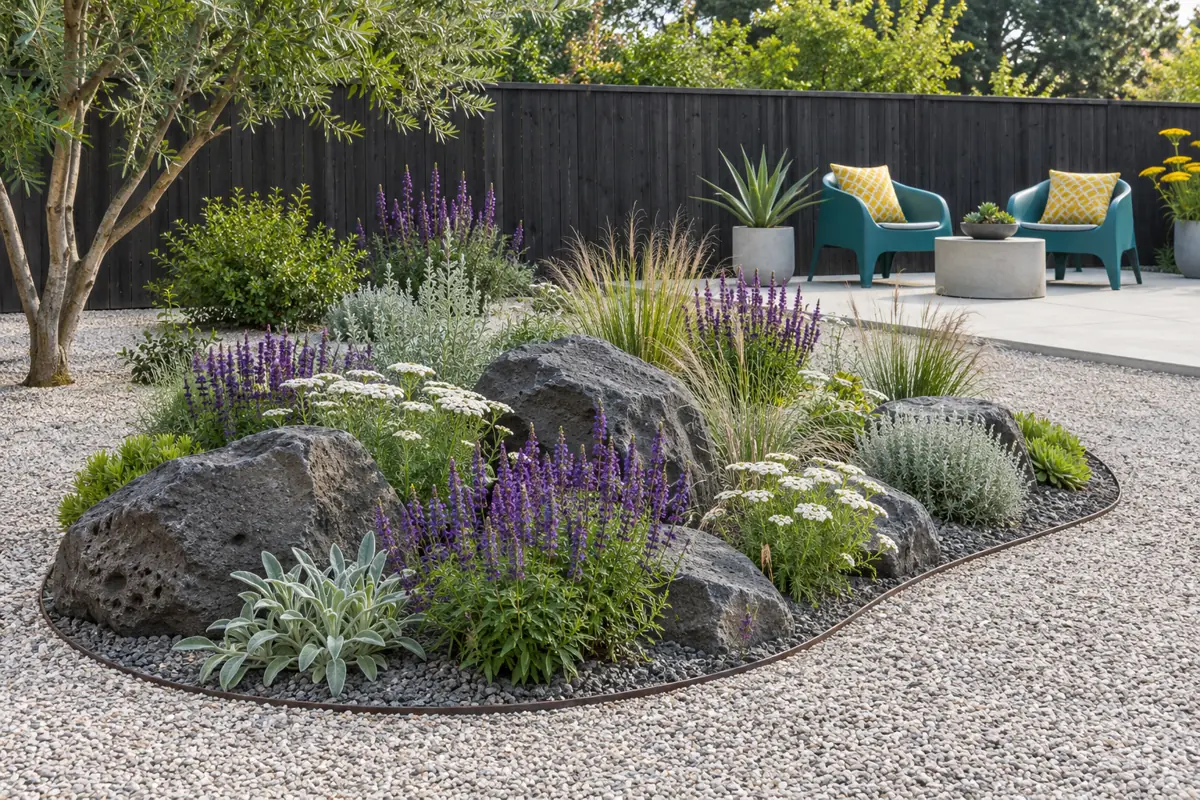
A kidney-shaped planting island can break up a flat gravel garden without introducing a slope. Use dark boulders as anchors and leave a clear route around them.
Purple flower spikes, white blooms and silver foliage make a lively contrast against a plain timber fence.
Put teal chairs on an adjoining paved area, with a yellow patterned cushion linking the furniture to the flowers.
Choose plants with matching exposure and moisture requirements, then space them by mature spread. Resist filling every open patch on planting day.
The RHS cautions that heavy, damp soils may not suit gravel-garden plants. A surface dressing does not change the soil underneath.
This layout also needs weeding and leaf removal. Its clean shape works best when the island edge remains easy to maintain.
11. An alpine trough collection on a small patio

Two low stone troughs can create a rock garden where the ground is unsuitable.
Give each a tiny landscape of stones, low cushions and a few distinct rosettes.
A blue folding chair and coral patterned cushion turn the surrounding paving into a place to pause.
Keep a clear route between the door and chair.
Choose stable containers with drainage holes and set them level on suitable supports. Leave the outlets unobstructed.
RHS trough guidance explains that a bottom layer of pebbles is unnecessary and can hinder drainage. Use an appropriate freely draining growing medium instead.
Troughs still need moisture checks, especially while plants establish.
The main limits are container weight and summer drying. Position them before filling and obtain help moving heavy stone containers safely.
12. A narrow rock border below a side-garden fence
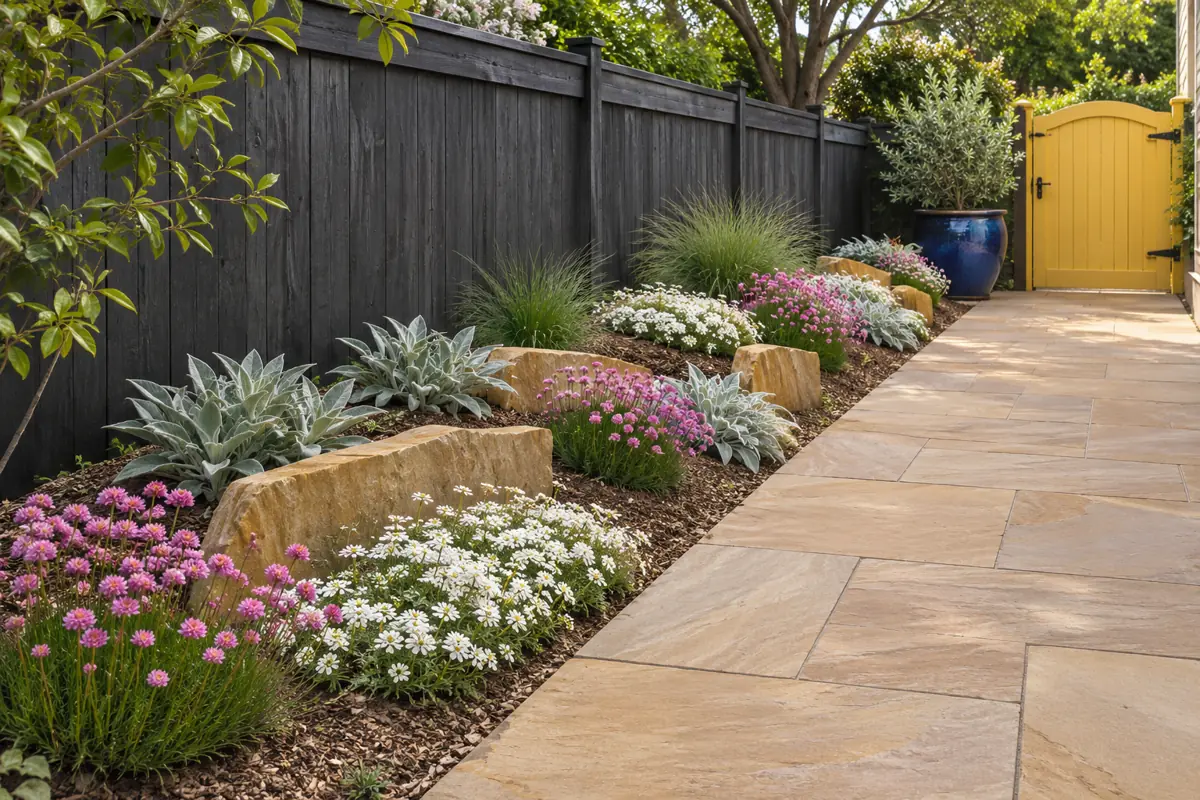
A narrow bank beside a fence can carry more texture than another continuous hedge.
Repeat short sandstone groups, pink thrift and white flowering cushions along its length.
Keep the lowest plants beside the walkway and taller tufts toward the fence. A yellow gate gives the eye a clear destination.
Choose a few plant groups and repeat them, rather than squeezing in a different specimen at every step.
The route needs to stay usable when foliage reaches its full spread. Mark that boundary before positioning stone.
Check the fence footing and access needed for repairs. Do not bury posts or pile material against timber.
This arrangement suits a small, stable bank with suitable drainage. If it is a runoff corridor, settle the drainage problem before adding planting pockets.
13. A curved rock bed framing the front walk
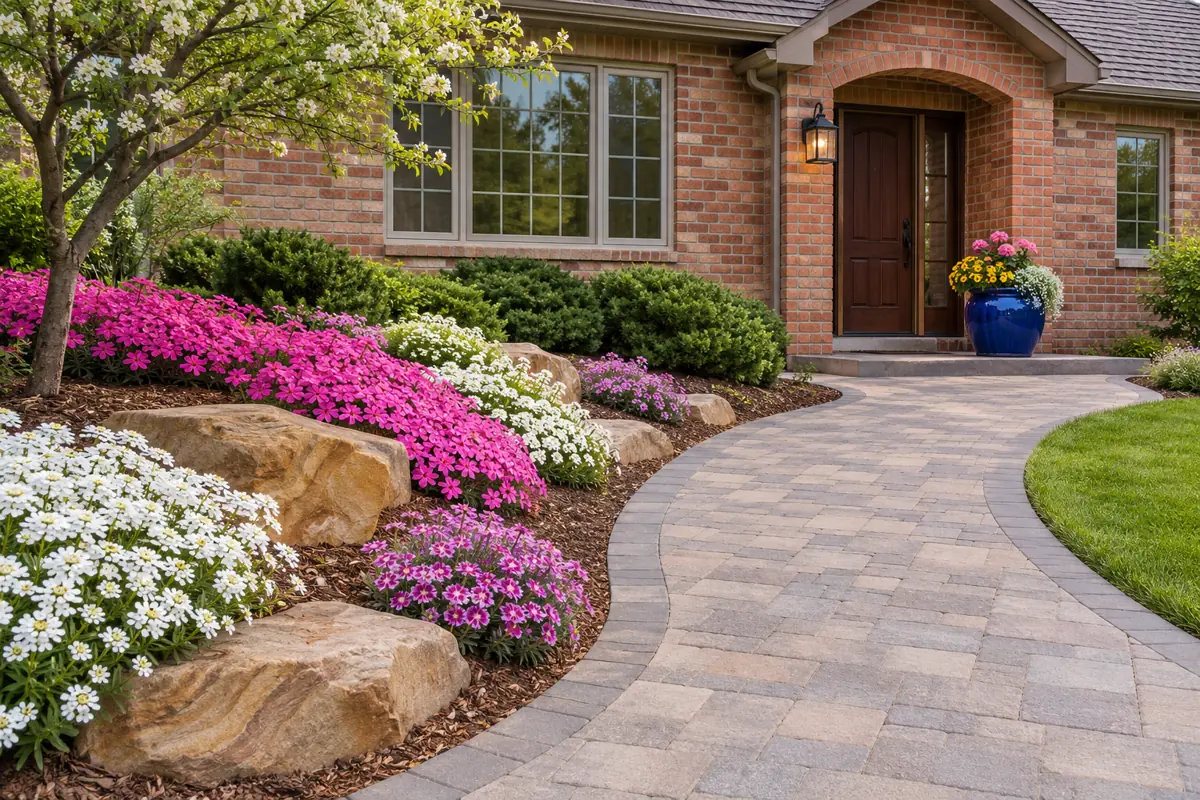
A sweeping front walk gives a rock bed a natural shape to follow. Keep the outer bank low, with pale stone between pink phlox and white cushions.
Use a few rounded foliage plants behind the flowers to connect the bed to the house. A cobalt pot near the door provides one deliberate finishing detail.
Leave the threshold and door swing open. The garden should frame the entrance rather than make visitors weave around it.
Lay out the curve with a hose before deciding where the boulders belong. Check the view from both the street and front door.
Allow for mature spread and keep plants away from required sightlines.
A front entry also needs seasonal tidying: faded flowers, fallen leaves and spilled aggregate show quickly against a simple paved route.
14. A level stone-seat nook below a gentle bank
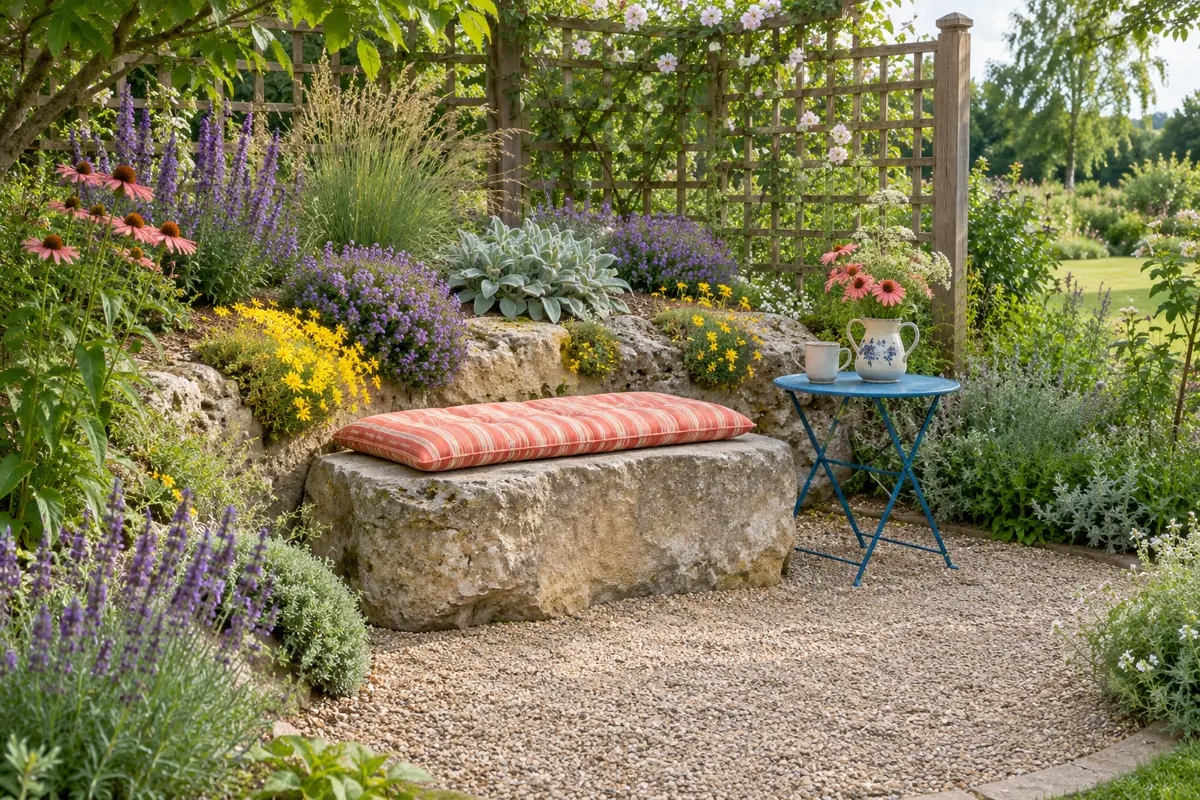
A broad stone seat can make a planted bank feel like a room.
Set it on a stable, level base with an easy approach from the garden.
Behind it, low limestone outcrops support a composition of yellow flowers, violet cushions and grey foliage. A small blue table provides somewhere useful for a cup.
A coral striped pad softens the seat without adding another permanent structure.
What I like to do when planning is draw the sitting area first. Then leave room for feet, the table and a maintenance route.
Have heavy seating stone selected and installed by someone equipped for the job.
The bank is the backdrop, not the seat foundation. If ground movement or retained soil is involved, obtain a proper assessment before treating this as garden styling.
15. Low rock outcrops within a loose meadow planting

Let a few broad granite faces emerge from a loose matrix of flowers and fine grasses. The planting should connect around them rather than form isolated circles.
A level mown viewing strip gives the informal bed a deliberate edge. Beyond it, a simple post fence suits the relaxed composition.
Choose locally adapted species with compatible growing requirements and manageable height. Check whether any vigorous spreaders would overwhelm smaller neighbors.
Use young plants in repeating groups, leaving yourself access for early weed removal.
Low water use does not mean a plant never needs watering. Establishment and unusual dry spells still deserve attention.
This is a cultivated meadow effect, not an instant restoration. It takes editing, and the planting will look different as flowers fade and grasses develop.
16. A small rock border beside a garden shed
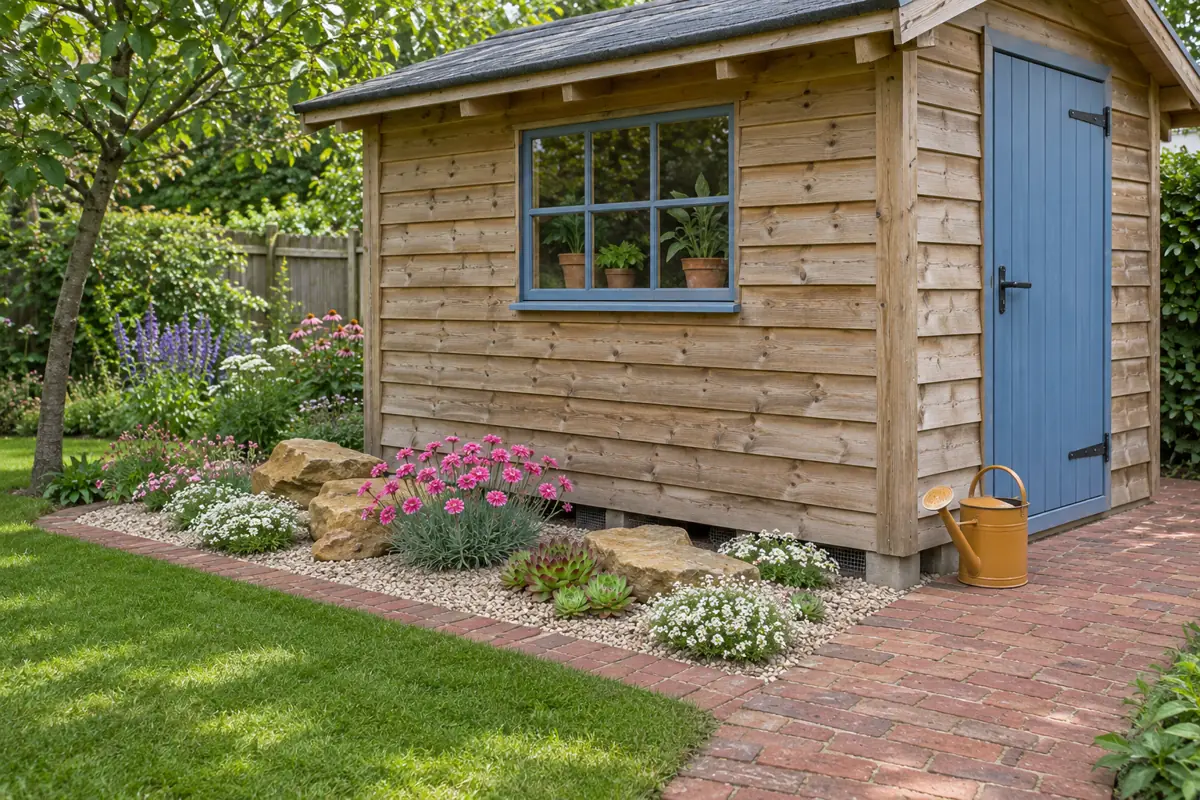
A dry strip under a shed overhang can become a compact rock display. Pink dianthus, low green rosettes and white cushions brighten sandstone against a blue door.
A brick maintenance path keeps the small planting easy to approach. Place the watering can at the end rather than among delicate plants.
Keep siding clearance, vents and door operation unobstructed. Do not raise the ground against the building to create a mound.
Watch the site during rain: the roof edge may leave one strip dry while drenching another.
Match plants to those actual pockets and keep roof runoff out of planting that cannot tolerate it.
The overhang is not a watering system. Check the soil beneath the surface and provide establishment care when rain misses the root zone.
17. Spring bulbs through a low granite rock garden
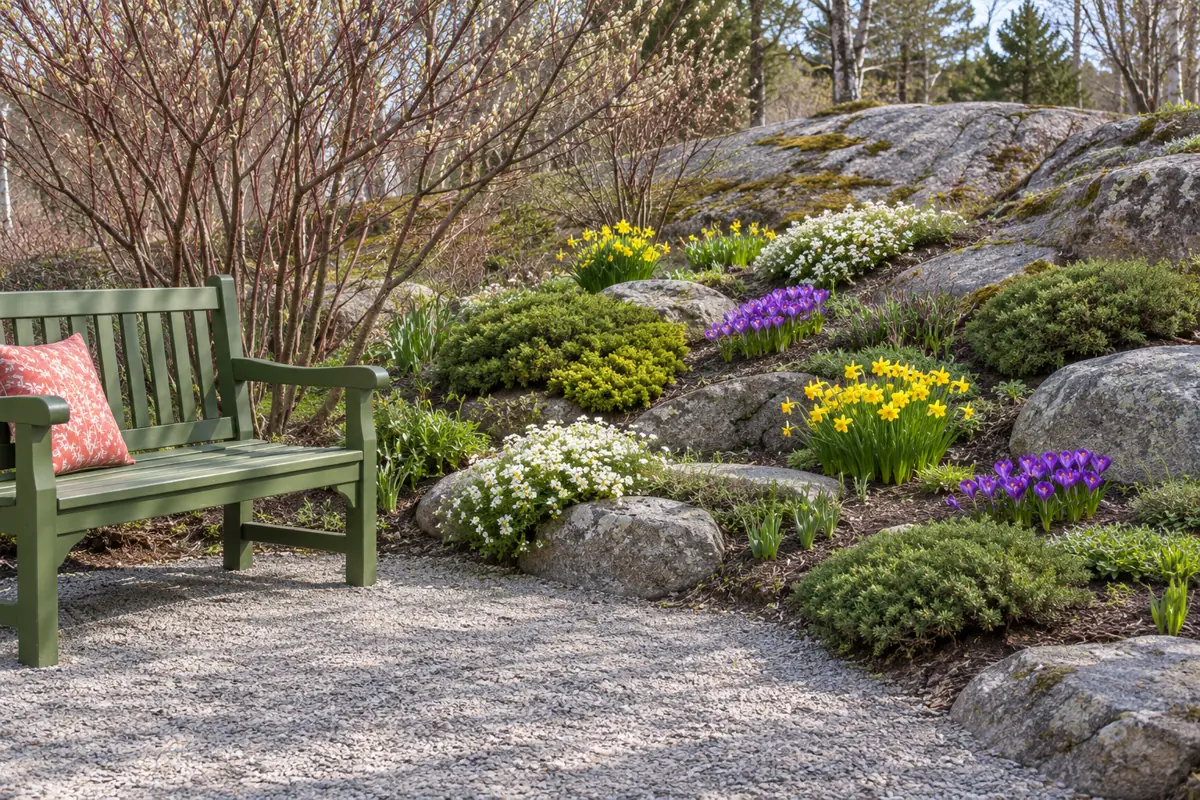
Yellow miniature daffodils and purple crocuses can give a low rock garden an early season.
Plant them in small drifts between evergreen cushions and visible granite.
A pale path keeps the scene open, with a green bench at one end.
A coral cushion adds color even before every bulb opens.
Choose crocuses suited to ordinary well-drained garden conditions rather than specialist types needing protected cultivation.
Select miniature daffodils whose needs match the position, and follow their planting guidance. Plan around their leaves as well as their flowers.
Leave bulb foliage to finish naturally after flowering; do not make the whole bed depend on its brief spring display.
The evergreen cushions provide the later framework. In warm climates, check whether the chosen bulbs need winter chilling you cannot provide.
18. Three stone forms in a quiet gravel garden

Three weathered stones can hold a quiet garden together without a mass of flowers. Arrange them asymmetrically, with one clearly leading the group.
A compact pine, small grass clumps and low green planting soften the back edge. Keep the foreground gravel open enough to appreciate the stone shapes.
A dark timber screen and one blue ceramic vessel provide a restrained backdrop. Use a separate stable route instead of walking through the raked surface.
Buy a named miniature conifer suited to your conditions. Even slow-growing conifers can become large over time.
Check its eventual dimensions before giving it a permanent position.
This Japanese-inspired composition needs patient editing and regular debris removal. It is best on almost level ground, where gravel patterns are easier to maintain.
A practical care plan for the first year and beyond
Rock gardens reward small, regular checks. Keep a note of what happens after rain, during dry spells and as the planting fills out.
While plants establish
Check root-zone moisture and the condition of new plants. Water where needed rather than assuming a drought-tolerant label means immediate independence.
Watch for soil washing away from roots or collecting against crowns. Investigate the water source before simply adding more material.
During active growth
Remove weeds before they become rooted between stones. Keep vigorous neighbors from covering smaller plants or blocking maintenance access.
Review the view as flowers fade. A useful balance of stone and foliage matters outside the peak flowering week too.
After heavy rain
Look from a safe position for displaced gravel, washed soil and new channels. Clear loose material from paths and steps.
Movement in a wall, seat or heavy stone needs assessment; do not treat it as a cosmetic planting problem.
Before winter or a long absence
Check the requirements of tender plants and arrange suitable protection. Inspect drainage outlets on troughs and leave a usable watering route.
Record which plants need checking during a dry spell. Seasonal care depends on your climate, not one calendar shared by every reader.
Colorado State notes that rock gardens still need maintenance, especially weed control. Start with an area you can realistically look after.
Questions before you bring in the stone
Does adding gravel fix heavy clay?
A surface layer does not change the drainage of the soil below. RHS gravel-garden guidance warns about heavy or damp sites; consider a different planting style or a suitable container.
Can a rock garden stop a slope eroding?
A planted rock garden may be part of a site plan, but loose decorative stone is not a universal erosion remedy. Have active erosion, unstable ground and concentrated runoff assessed.
Can every rock-garden plant share one watering routine?
No. Match plants by root-zone moisture needs and check actual conditions; a shaded pocket, sunny trough and tender succulent bed behave differently.
Will it look like the picture all year?
Flowering periods, foliage and seasonal growth change the scene. Choose a framework of stone and suitable foliage you enjoy between flowering peaks.
Start with one reachable setting
Choose the view and the route first. Then check water, light and plant needs before ordering stone or clearing a bank.
A small, well-planned rock garden gives you room to learn how that corner behaves. Expand when the planting and maintenance routine fit the site.