
A potager is a kitchen garden with a sense of design: vegetables, culinary herbs and flowers arranged to be useful and lovely to look at. The RHS describes the tradition as an ornamental kitchen garden.
Start with reachable growing beds, a clear route to water and crops suited to your light. Then add the shape, flower colors and sitting spot that make you want to spend time there.
These 18 potager garden ideas range from a small patio collection to a formal four-square layout. Each combines the planting with paths, boundaries and finishing details, so you can borrow a whole plan rather than one pretty object.
Before you choose a layout
Measure direct sun across the growing season. Minnesota Extension recommends six to eight hours for sun-loving crops such as tomatoes and peppers; the right planting still depends on your climate and varieties.
Check drainage, safe growing soil and the route from tap to bed. Keep room for mature foliage, turning, harvesting and the equipment you actually use.
Find a potager idea for your space
- Four square beds around a useful crossroads
- An L-shaped potager beside the kitchen door
- A long harvest avenue for a narrow plot
- A round potager with wedge-shaped beds
- A walled courtyard with a trained fruit backdrop
- A container potager on a sunny patio
- Curving vegetable ribbons through a flower garden
- Level planting terraces on a gentle slope
- A raised working bay with room to turn
- A gated potager with a practical perimeter
- A bean arch over the main harvesting path
- A front-garden edible border with curb appeal
- A dining courtyard framed by productive beds
- A strip-bed potager with a nursery corner
- A permanent berry edge beside annual crop beds
- A cool-season quilt beside a paved promenade
- A sunny courtyard for supported summer crops
- A low herb spiral with vegetable beds around it
1. Four square beds around a useful crossroads

Four matching beds give a potager an immediate sense of order.
The crossed paths do most of the design work before anything starts growing.
Use low timber sides and brick paving, then repeat green and burgundy leaves across the squares. Put taller supported crops where their shade will cause least trouble.
Keep the central crossing empty. A terracotta pot looks charming there until you need to turn with a watering can.
Place flowers around the outside and give a bench its own paved pocket beyond the beds.
Check your comfortable reach before choosing bed width. You should not have to stand on the growing soil.
This is a good fit for a fairly square plot, but awkward boundaries may leave unusable corners.
2. An L-shaped potager beside the kitchen door

The best place for a small harvest can be the corner you already pass several times a day. An L-shaped layout keeps that garden close.
Run one narrow bed beside the doorstep and a second across the rear boundary, leaving a generous working pad between them.
Put frequently picked salad leaves near the door. Use the back for supported tomatoes or climbing crops, checking where their shade falls.
Individual herb pots soften the hard corner and let you water plants with different needs separately.
I love how a coral chair and patterned cushion make the space feel like part of the house.
Leave the doorway, drainage and access to the wall clear. A convenient corner still needs enough direct sunlight for its chosen crops.
3. A long harvest avenue for a narrow plot
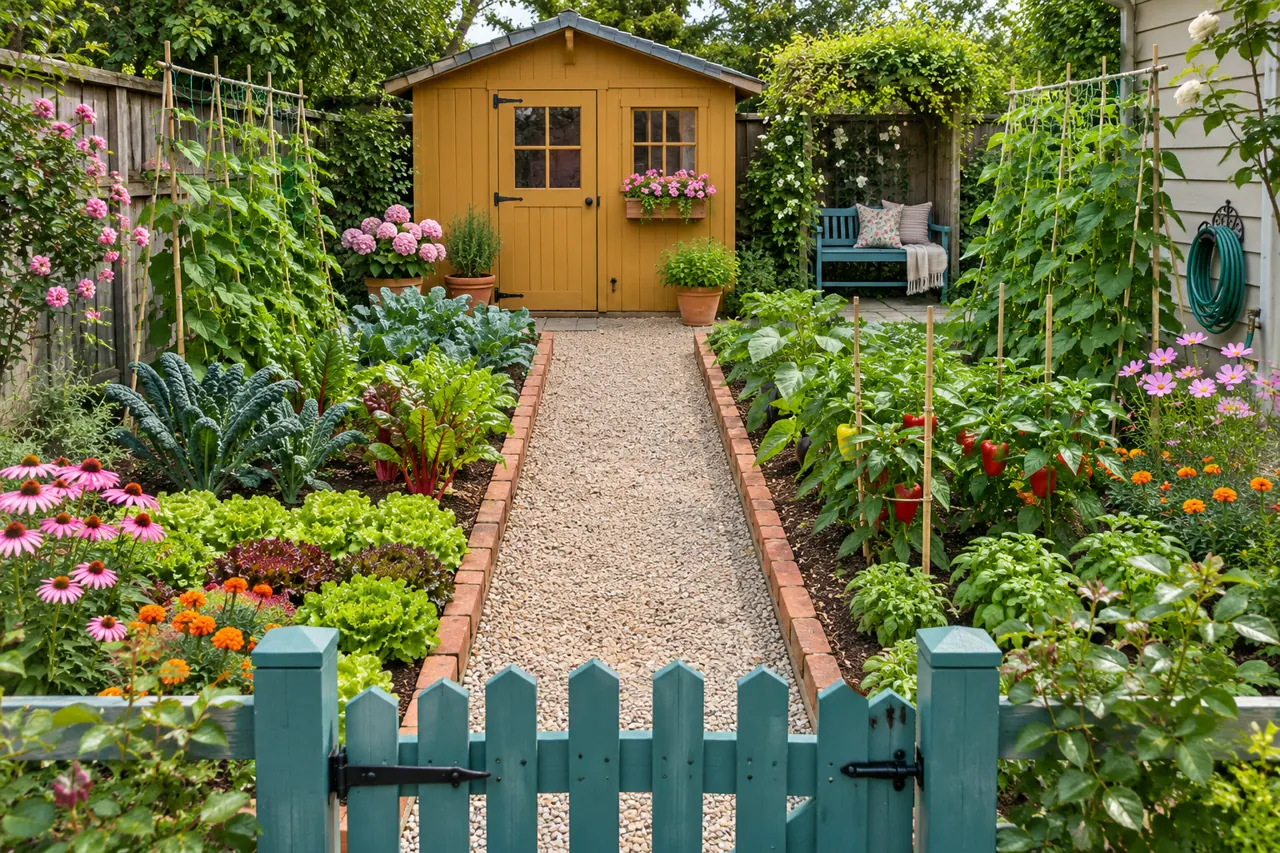
A straight path can make a narrow plot feel deliberate instead of squeezed. Give it a clear destination, such as a shed door or small bench alcove.
Two long, shallow beds run alongside it, edged in brick to hold the line. Divide the planting into short blocks rather than one continuous row.
Leafy greens can lead into peppers, herbs and supported climbing crops, with flowers tucked into separate outer pockets. Keep the bench out of the travel lane.
Build only as wide as you can maintain from the available sides. If a fence blocks outside access, the bed needs to be narrower.
The main limitation is the long watering route. Plan the hose position before plants grow across the edges and make turning difficult.
4. A round potager with wedge-shaped beds

Wedge-shaped beds give a round potager the look of a small living compass.
Gravel spokes connect a central standing area to the outer walking ring.
Low stone edging keeps the geometry readable, while red lettuce, chard and small herbs provide contrasting textures.
Place taller supports toward the outside where they will not crowd the center. A yellow bench can sit beyond the circle beside a flower border.
Mark the paths first and test every wedge with an actual reach.
The pointed inner ends are easy to overplant, and a broad wedge may need another access route.
This design suits a visible open patch where you can enjoy the whole shape. It is less efficient against a tight rectangular boundary, where the curved corners can waste useful ground.
Choose a path for the way you work
Compare samples on site before buying the whole surface. The route to the tap, gate and working area matters as much as the view.
Loose gravel: check the wheels
Try your actual barrow or mobility aid on the proposed finish. Loose or deep material may make movement harder; edging and ongoing raking are part of the decision.
Wood chips: plan the top-up
A useful informal option where you can replenish the surface. Keep the edge distinct so chips stay on the path when you weed the growing beds.
Paving: check the drainage
Ask how water will leave the surface and how the base suits the site. Check grip when wet, level changes and the work needed to keep joints usable.
Any surface: test the full route
Measure the narrowest gate and corner, then mock up turning and passing space. A wide straight path can still end at a cramped threshold.
For individual access needs, the RHS guide to adapting a garden points to specialist advice and demonstration gardens. A material name alone is not an accessibility specification.
5. A walled courtyard with a trained fruit backdrop
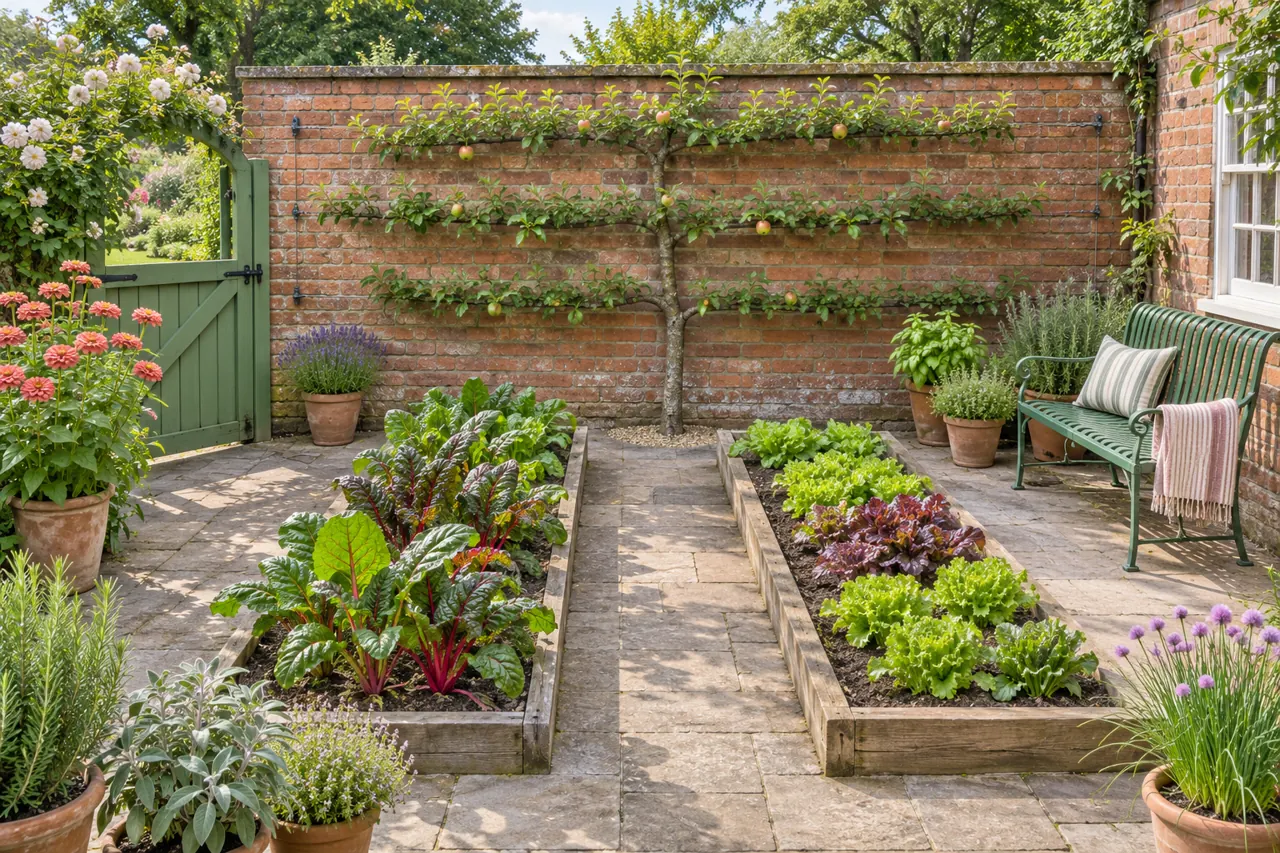
A trained fruit tree can turn a plain courtyard wall into the potager’s backdrop.
Keep two narrow vegetable beds in front, separated from the tree by working space.
Leafy crops suit the low foreground, while terracotta herb pots and coral flowers soften the gate.
A green bench finishes the paved side.
Choose the fruit tree before planning its supports. An espalier needs a suitable cultivar and rootstock, permanent support and regular training.
Check whether it needs a pollination partner too.
The wall must offer enough width for the mature trained tree, not just the small plant you buy.
This is a long-term layout with pruning commitments. If the courtyard is too tight, choose a smaller trained form rather than forcing a full espalier into it.
6. A container potager on a sunny patio
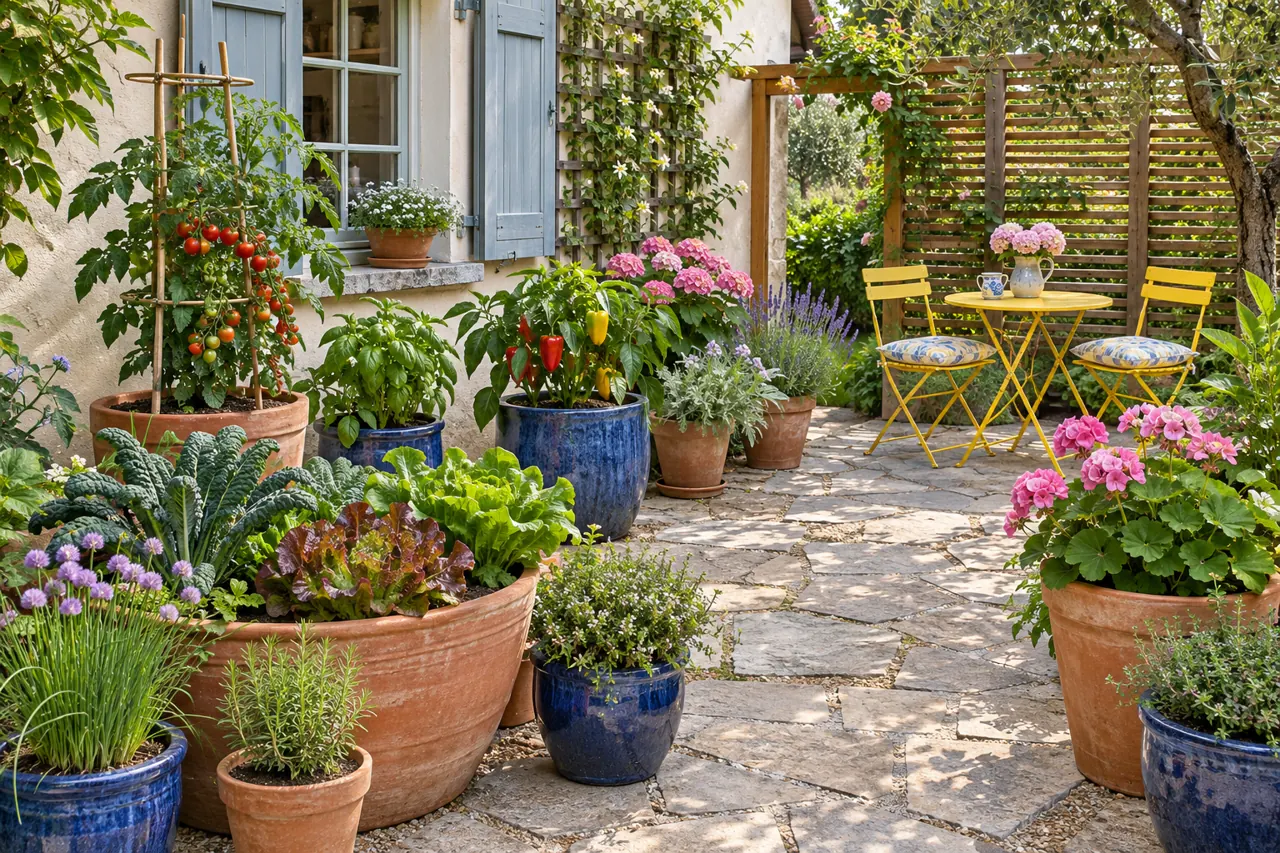
A ground-level patio can become a potager without a single fixed bed. Use a few substantial containers rather than filling every gap with small pots.
Wide tubs hold leafy crops, while deeper containers give supported tomatoes and peppers their own growing space. Keep herbs in separate pots near the door.
Repeat terracotta and blue glaze, then add pink flowers and a yellow bistro set. The furniture gets its own clear patch of paving.
Choose containers with drainage and a suitable potting mix. Match their volume to the crop rather than its nursery size.
Check moisture frequently in warm weather; containers have a limited water reserve.
The tradeoff is ongoing attention to watering and feeding. This layout works best where the water source is close and easy to use.
Count planting positions before buying plants
This is a spacing calculation, not a crop recommendation. Use it only after the variety’s growing guidance confirms that 12-inch spacing in both directions is appropriate.
Measure the usable bed
Example: 3 ft × 6 ft = 36 in × 72 in inside the edging. Exclude any area occupied by a permanent support or another plant.
Allow the example edge margin
With centers 6 inches from each edge, the width positions are 6, 18 and 30 inches. The length positions are 6, 18, 30, 42, 54 and 66 inches.
Multiply rows by columns
3 × 6 = 18 planting positions on this example grid. That is a plant count, not a predicted harvest or a rule for tomatoes and other large crops.
Check mature spread again
If the crop needs wider spacing, recalculate before shopping. Account for airflow, supports, paths and harvesting access rather than squeezing in the original count.
7. Curving vegetable ribbons through a flower garden
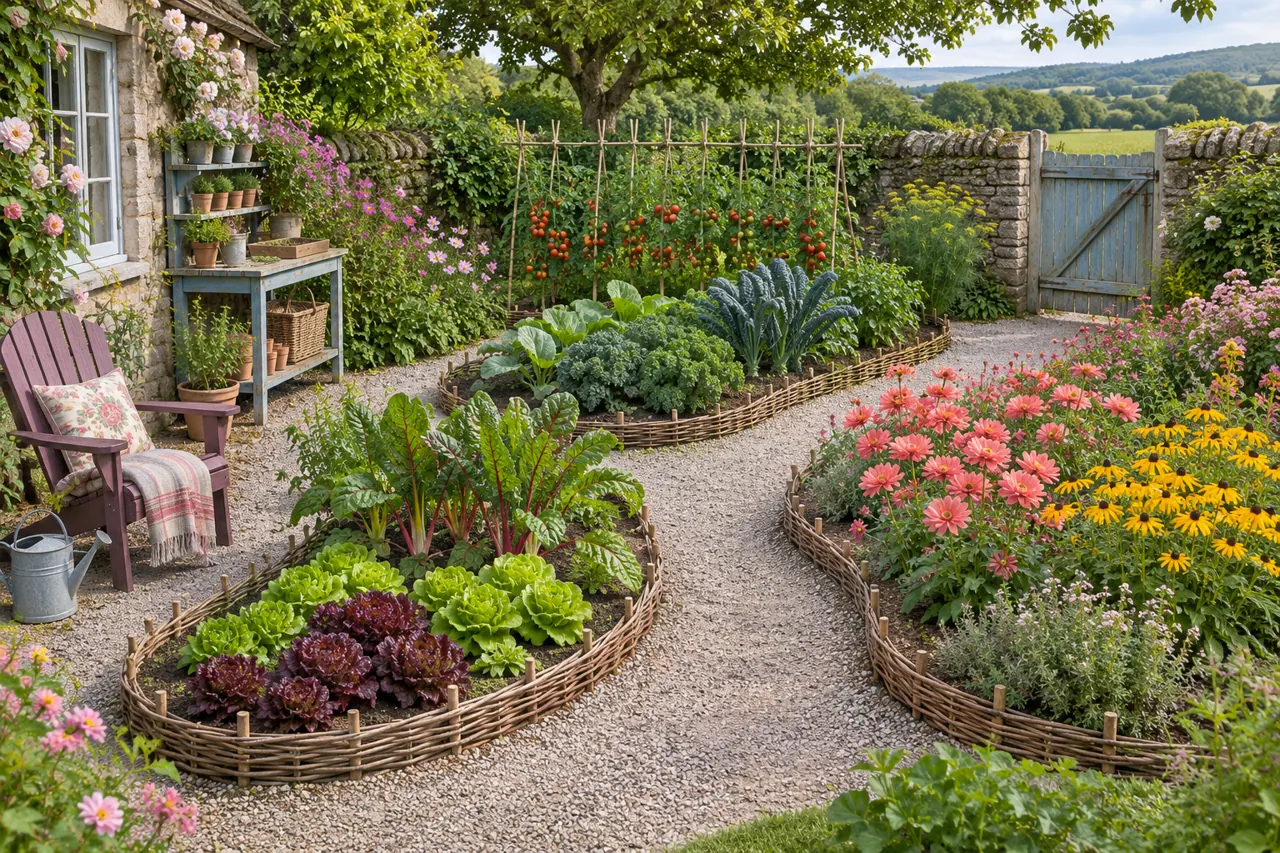
For a softer potager, let narrow beds curve through an existing flower garden.
A winding gravel path makes the vegetable patches feel discovered rather than regimented.
Low woven edging unifies the shapes. Repeat leafy crops in reachable groups, with taller supports at the back and generous flower patches between the productive areas.
A weathered-looking blue gate, plum chair and small potting shelf give the garden a useful stopping point.
Choose edging made for the job and expect natural woven material to need replacement over time.
The biggest risk is losing the paths beneath summer growth.
Mark the mature spread of flowers and crops before planting. Keep the curves broad enough to weed and harvest without stepping into beds or pushing through wet foliage.
Flower note: Pick a palette you enjoy, then check each flower’s local suitability and mature size.
Do not treat a mixed flower border as a universal pest repellent. Minnesota Extension explains the limits of common companion-planting claims.
8. Level planting terraces on a gentle slope

A gentle slope can become a sequence of level growing spaces instead of one difficult tilted bed. Low stone edges give each terrace a clear outline.
Keep planting strips narrow enough to reach and connect them with a reliable side route. Broad steps can provide a second connection between landings.
Leafy crops, supported climbers and low flower patches bring the levels together. Put a sage bench on a separate flat landing.
The stonework and drainage need proper site assessment. Retaining edges must suit the soil, slope and local requirements.
Do not copy their construction from an attractive photograph.
This approach is most useful when leveling small areas solves a real access problem. On a steep or unstable site, get qualified design advice before moving soil.
9. A raised working bay with room to turn

An open U of tall, narrow planters brings several growing areas around one working bay.
Leave the entrance wide and the middle free of furniture.
Use leafy vegetables and herbs along the arms, with supported compact tomatoes across the rear.
A blue backdrop and separate flower pots keep the arrangement cheerful.
A chair belongs on an adjoining pad, not in the turning space.
Test the proposed height, reach and approach with a temporary mock-up before building. The right dimensions depend on the person and how they work.
Tall beds are heavy when filled and need a sound design, suitable base and drainage.
They can also dry faster than surrounding ground. This is a comfortable-work concept to adapt, not a promise that one set of dimensions meets every accessibility need.
10. A gated potager with a practical perimeter
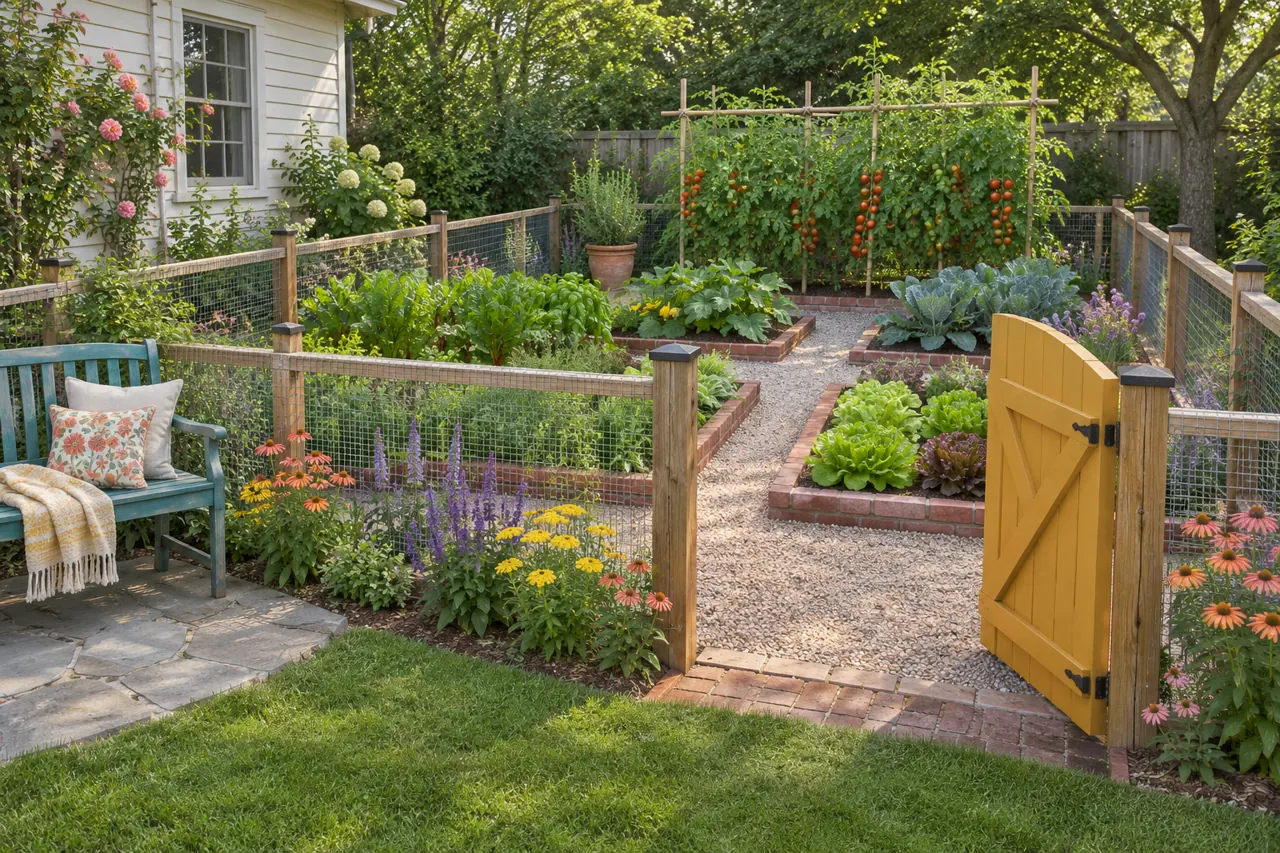
A gate gives a potager its own small-room feeling.
Use the enclosure to define the growing area while keeping the surrounding flowers and seating outside.
Offset rectangular beds create a less formal route than a central cross. Brick edges and gravel keep the working spaces distinct.
A mustard-yellow gate and teal bench add color even between crops, when the vegetables are mostly green.
Choose the fence for the actual animals you need to exclude. Height, mesh openings, ground gaps and gates all affect performance.
A decorative low fence alone will not solve every pest problem.
Make the gate wide enough for your equipment and leave a clear threshold. Plan how you will close gaps without trapping wildlife or creating sharp edges along the path you use daily.
11. A bean arch over the main harvesting path

A climbing arch makes the walk into the potager feel special while keeping the growing footprint compact. Place it over a genuinely useful harvesting path.
Low vegetable beds sit on either side, with leafy crops toward the front and a flower border beyond. A coral bench can mark the far stopping point.
Anchor the arch for its expected plant load and local wind. Keep pods and foliage from lowering the usable headroom.
The arch will cast shade as it fills.
Watch that shade through the day and match nearby crops accordingly. This layout needs regular training and picking; it works poorly if the arch becomes a dense curtain across the only route.
12. A front-garden edible border with curb appeal
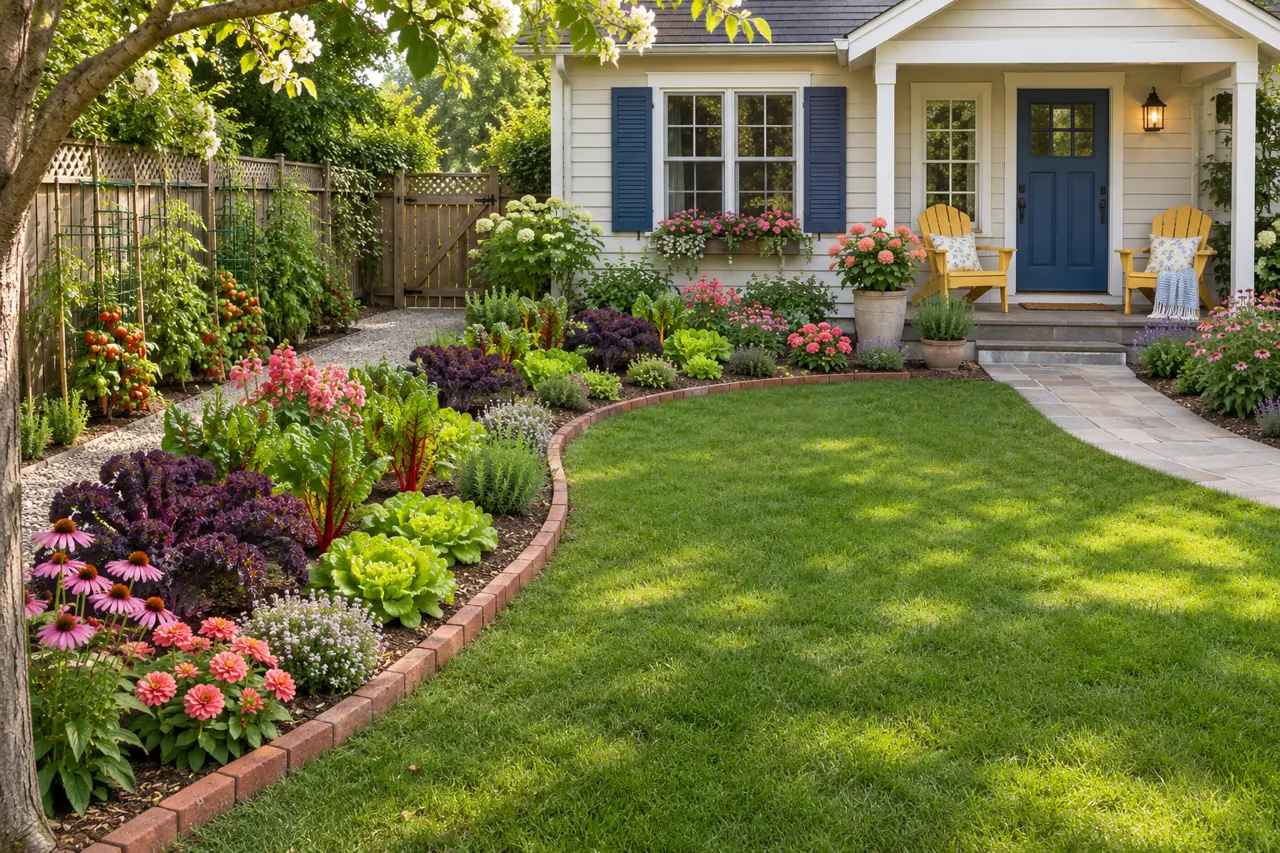
A potager can fit into the front garden as an ornamental border rather than a separate fenced plot.
Repeat attractive foliage along a tidy curved edge.
Burgundy kale, bright chard stems and green leaves provide structure, with pink and coral flowers in distinct groups. Keep larger supports toward a suitable rear boundary.
A low brick edge connects the border to the house path. A service route behind the planting makes harvesting less disruptive.
Check local rules, sightlines and the suitability of the soil for food growing before committing.
Keep entry paths and public pavement clear.
The main challenge is appearance after harvest. Reserve replacement plants or a suitable seasonal cover so an emptied crop section still looks intentional beside the front door and seating.
13. A dining courtyard framed by productive beds
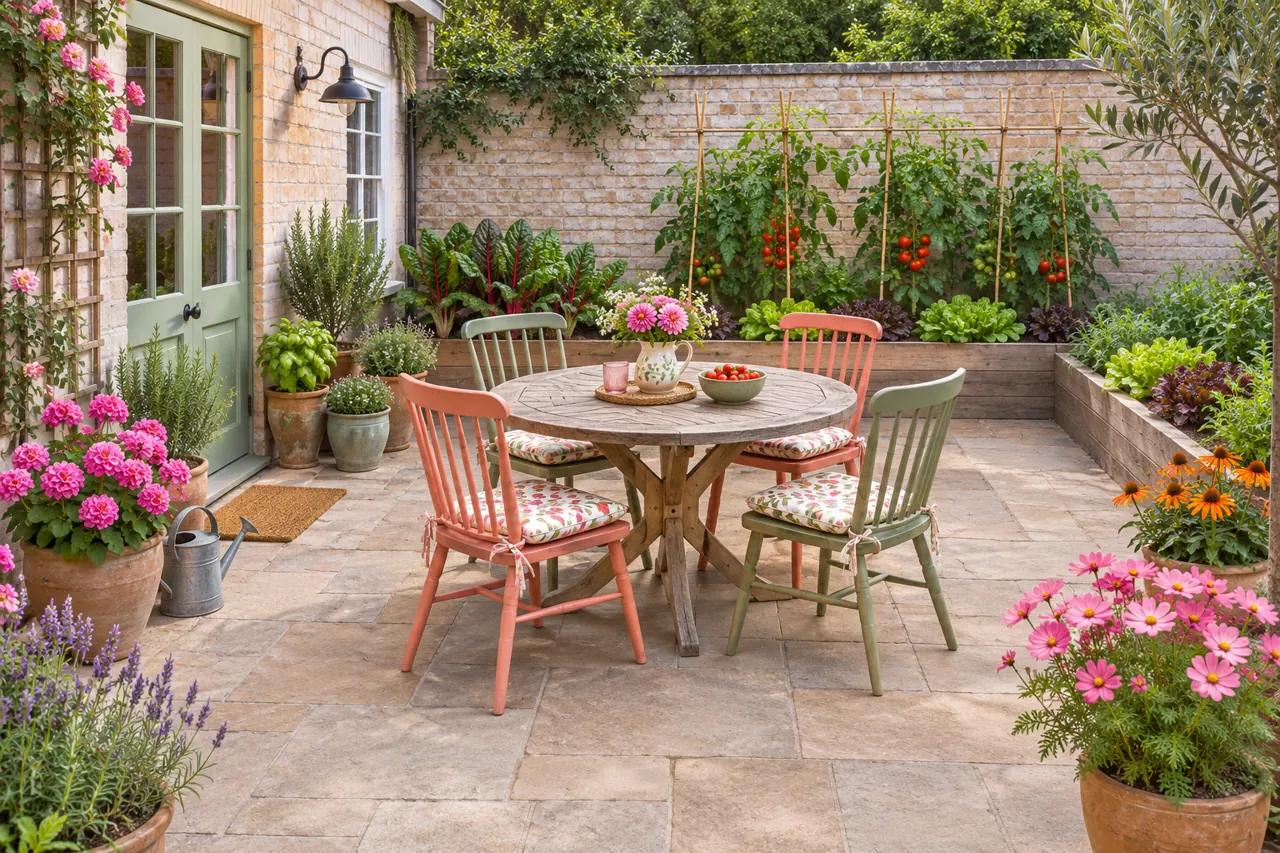
Let the table set the proportions of this potager. Productive beds belong around the outside of a dining courtyard, leaving clear space to pull out every chair.
A modest round timber table softens the rectangular boundaries. Coral and green chairs, patterned cushions and bright flower containers make the center inviting.
Use low leafy crops near the sitting area and taller supported vegetables farther back. Herb pots can stay close to the kitchen door.
Walk behind an occupied chair while carrying a watering can before fixing the bed positions. Keep water off the dining surface and choose paving that drains appropriately.
This plan gives up growing area for everyday use. It suits a household that wants a few useful crops alongside a place to eat, rather than maximum planting capacity.
14. A strip-bed potager with a nursery corner
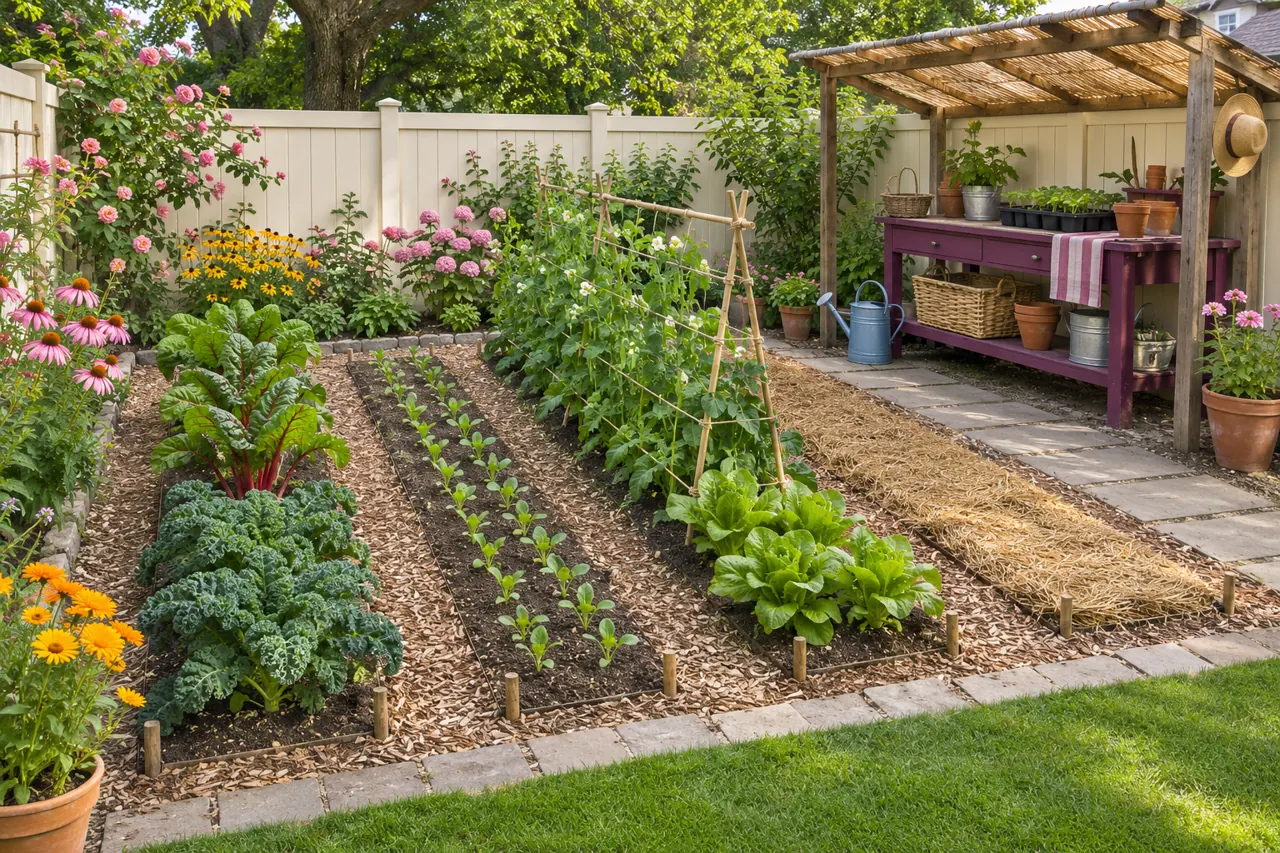
A strip-bed potager makes room for the next crop as well as the current one.
Short parallel strips let you manage small sections independently.
Keep wood-chip paths between them and a separate potting bench at one side. A simple shaded work station can hold seedlings temporarily where conditions suit them.
Let one strip carry mature crops, another younger plants and another suitable cover while it rests. Flowers along the outside keep the whole garden welcoming.
Record what will follow each harvested section before sowing replacements.
Choose dates from the crop’s temperature needs and your remaining growing season. A pretty empty strip is not a reason to plant a crop too late.
The nursery corner adds work too: seedlings need suitable light, watering and hardening off before moving outdoors.
Plan the next harvest with a four-field handover note
Give each bed a small record before the current crop finishes. This makes the next decision visible without committing the whole potager to one calendar.
Bed and release date
Record the bed name, current crop and likely clearing window. Add a backup option if harvest runs later than expected.
Growing window
Write down local frost expectations, likely heat and the replacement crop’s temperature needs. A distant region’s sowing date is a reference, not your deadline.
Maturity and starting method
Record the variety’s days-to-maturity estimate and whether it counts from sowing or transplanting. Leave room for slower growth as light and temperatures change.
What must be ready
List seed or transplants, irrigation changes and supports needed before the swap. If the window is unsuitable, choose a locally appropriate soil-cover option instead of forcing another crop.
Minnesota Extension’s fall-planting guide explains the timing calculation for its region; adapt its approach with local crop guidance.
15. A permanent berry edge beside annual crop beds

A permanent berry row can give a potager a lasting framework, while annual vegetables change in separate beds nearby. Keep the two planting systems clearly divided.
Run the supported canes along one side with a continuous harvesting path on both faces. Leave enough room to work when the canes are fully grown.
Low vegetable beds, gravel cross-paths and a pale blue bench keep the remaining space open. A flower patch can finish the far end.
Choose raspberries for your climate and understand their fruiting type before planning pruning.
They need suitable light, drainage and regular cane management.
The limitation is permanence: a berry row cannot move with the annual crop rotation. Allow for spreading growth and maintenance rather than treating it as a thin decorative fence.
16. A cool-season quilt beside a paved promenade
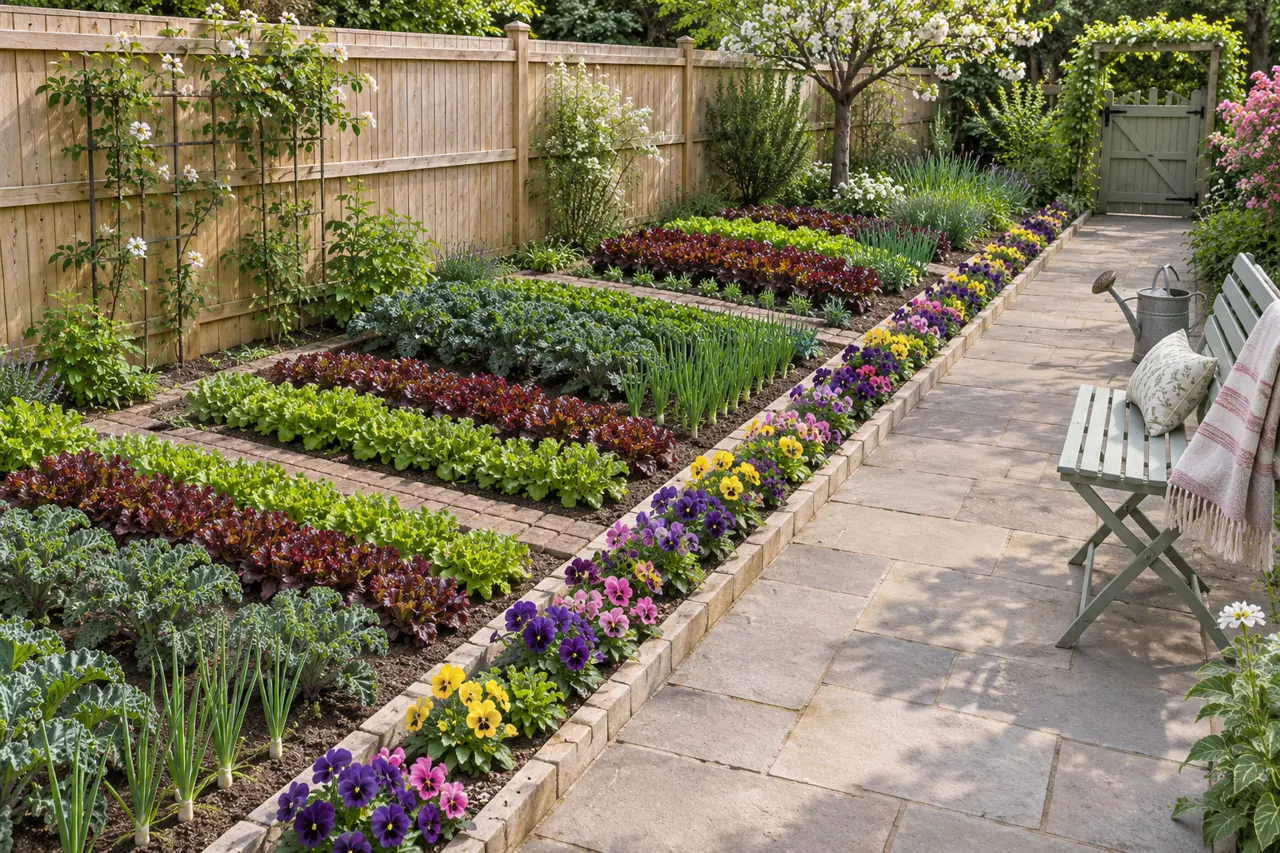
Low crops can make a potager look like a planted textile.
Repeat short bands of red and green lettuce, kale and scallions beside a paved promenade.
Cross-paths divide the long growing area into reachable sections.
A pale brick edge and separate pansy border give the soft leaves a crisp frame.
A folding sage bench can sit outside the walking line without becoming a permanent obstacle.
Keep the crop bands practical rather than tiny decorative patches that are awkward to thin and harvest.
Cool-season crops need a suitable planting window; heat can change their growth and quality. Plan replacements before the first sections finish.
This is a seasonal display, not a year-round planting recipe. Choose local timing and mature spacing, and do not assume the ornamental flowers are edible.
17. A sunny courtyard for supported summer crops

A sunny courtyard can hold a compact warm-season potager when the beds have their own working lanes.
Stagger three rectangular beds instead of pushing them into a single block.
Cream masonry edges and terracotta-colored paving make a coherent backdrop for supported tomatoes, peppers and compact crops.
A turquoise chair, striped cushion and pink and yellow flower pots add a sitting corner away from the irrigation route.
Install supports before the vegetables become large. Check mature height and spread when selecting varieties.
The warm paving is part of the tradeoff.
Reflected heat and quickly drying beds can increase watering demands. Measure direct sun, check soil moisture and choose planting dates for your climate rather than assuming a sheltered courtyard always gives ideal conditions.
Climate note: These are layout concepts, not a universal planting calendar. Match crops to local frost risk, summer heat, rainfall and the conditions inside your particular courtyard.
18. A low herb spiral with vegetable beds around it
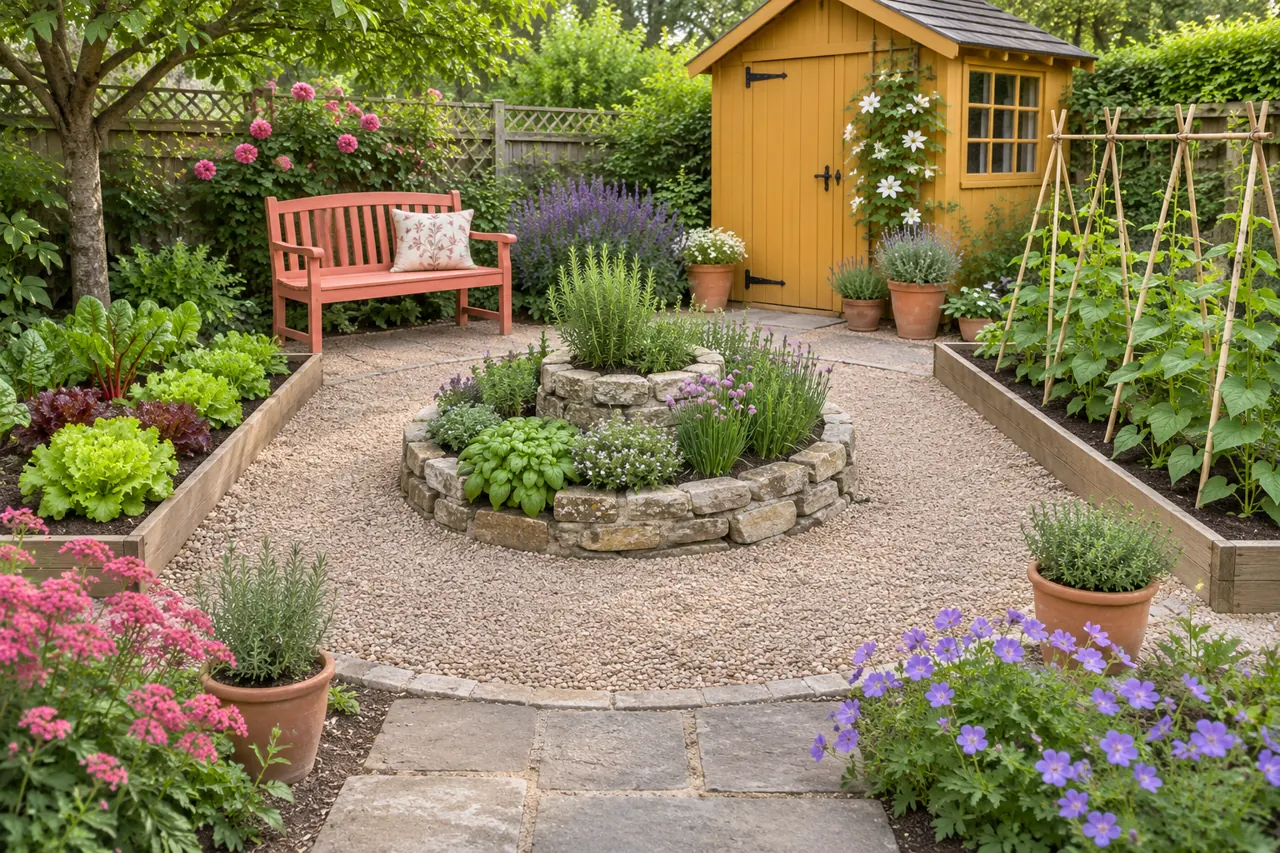
A low herb spiral can be the organizing feature of a kitchen garden. Keep it modest, with a gravel route around it and straight vegetable beds beyond.
The stone curve contrasts with simple timber beds, while an ochre shed, coral bench and separate flower patches finish the setting.
Choose culinary herbs for their individual conditions. The raised center may drain differently from the lower edge, but a spiral does not automatically create every microclimate you need.
Keep vigorous mint in its own container rather than letting it take over the structure.
Test your reach to the center before adding height.
This shape takes more edging and careful planting than a bed. If the stonework would be unstable or hard to maintain, use a flatter curved herb island instead.
Questions before you start planting
Does a potager need raised beds?
No. In-ground beds, containers and edged borders can all form a potager, as the layouts above show.
Choose the growing system for your soil, available space and working needs. A timber box is an option, not the definition of the garden.
How do I keep it attractive after harvesting?
Give the garden structure that remains between crops: clear paths, consistent edging, a gate or a well-placed bench. Leave space for replacement planting rather than relying on every bed being full all the time.
What I like to do when planning is sketch the garden with half the vegetables removed. If the paths and boundaries still look intentional, the design has something to carry it through the quieter weeks.
Can all the herbs share one bed?
Only when their conditions suit one another. The RHS groups sun-loving Mediterranean herbs for a well-drained container, while noting that mint and chives prefer more moisture.
Use separate pots where that makes watering easier. An attractive spiral or matching set of planters does not erase the plants’ different needs.
Make one useful corner first
Choose the layout that fits the site you have, then mark it out before buying edging. Walk the routes and check your reach with the beds still empty.
Add the plants, flowers and a comfortable stopping place in stages. A potager earns its place when picking dinner feels as natural as enjoying the view.