
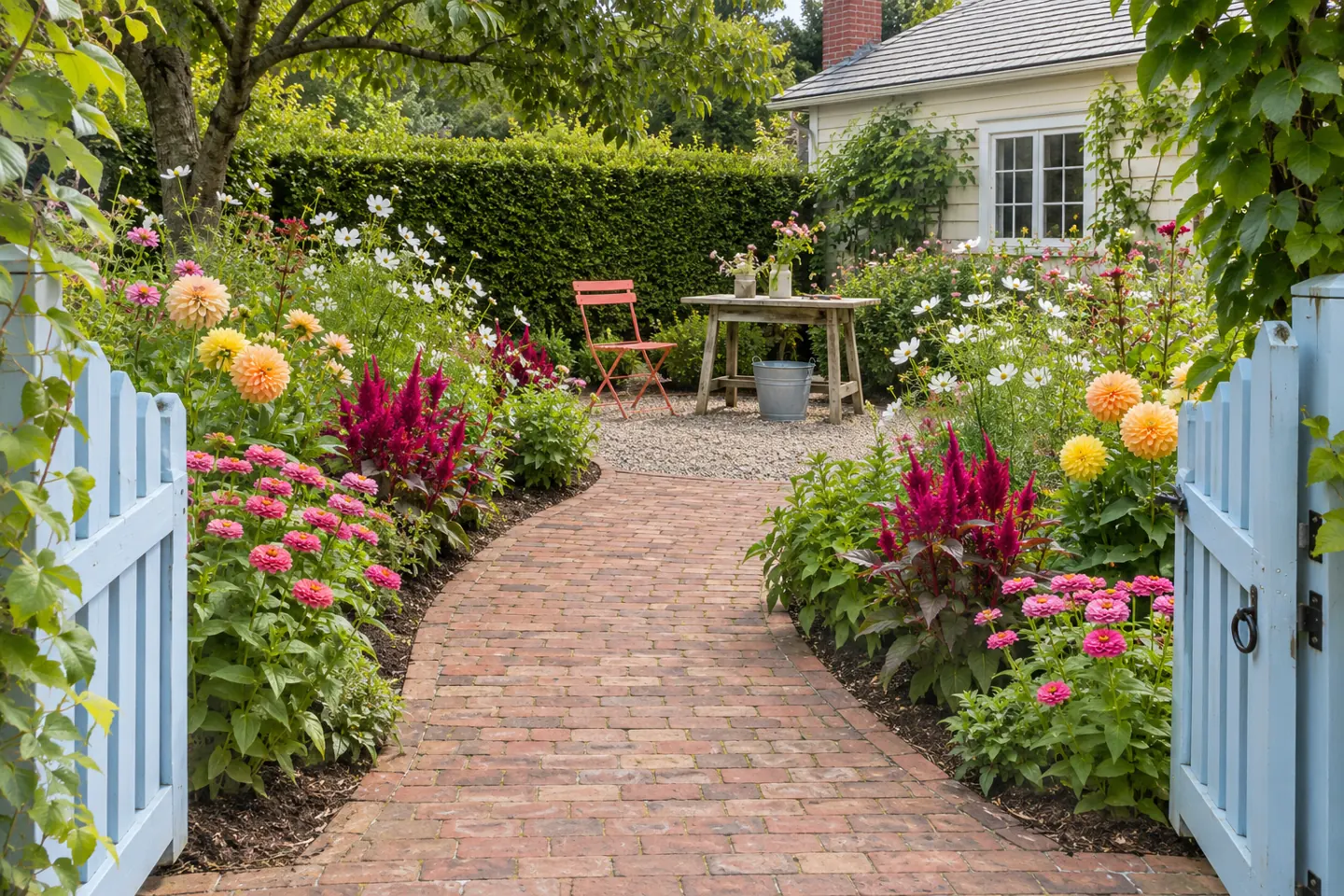
The best cut flower garden layout leaves room for a bucket, a watering can and the flowers that have not opened yet. The paths matter as much as the petals.
For bouquets over a longer summer season, combine suitable repeat-flowering plants with carefully timed new sowings. These fifteen ideas show ways to fit that growing space into a yard, patio or mixed border.
“All summer” depends on your climate, planting dates and care. A late start, extreme heat or early frost can shorten the cutting season, so use local conditions to plan the overlap.
Start with a sunny, well-drained site and easy water access. National Garden Bureau recommends at least six hours of sun and beds narrow enough to reach from the paths; check the needs of each flower you choose.
Jump to a cutting-garden layout
- Two long beds with a clear harvesting lane
- An L-shaped cutting border by the kitchen door
- Four small beds around a bucket station
- A one-sided fence border for a narrow yard
- A patio bouquet garden in three generous pots
- A reachable oval island that doubles as a flower border
- Dedicated flower strips beside the vegetables
- A sunflower screen with a sunny working edge
- A U-shaped raised bed with a work bay
- Two existing level terraces joined by a broad path
- A dahlia collection with room to stake and cut
- A perennial backbone with annual cutting pockets
- Separate cutting and leave-to-bloom beds
- A removable grow-bag garden for a rented courtyard
- Three planting blocks for an overlapping harvest
Shop for a bouquet, not just a color
Before ordering seed, check that your shortlist offers more than large flower heads. These roles help you spot what is missing.
Choose a focal flower
Zinnias, dahlias or sunflowers can give the arrangement its main shape. Check the selected variety’s stem length and growing space.
Add a contrasting form
Airy cosmos, small globe amaranth or upright celosia can change the outline. Choose the effect you want rather than collecting every available packet.
Include useful foliage
Consider a suitable basil or another verified foliage plant for your conditions. Keep its own growing needs and mature spread in the plan.
Check the overlap
Make a simple flowering calendar for your location. A perfect color match is less useful if the plants flower in completely different months.
Vermont Extension recommends long stems, filler and foliage. Iowa State lists suitable cut flowers by season.
1. Two long beds with a clear harvesting lane
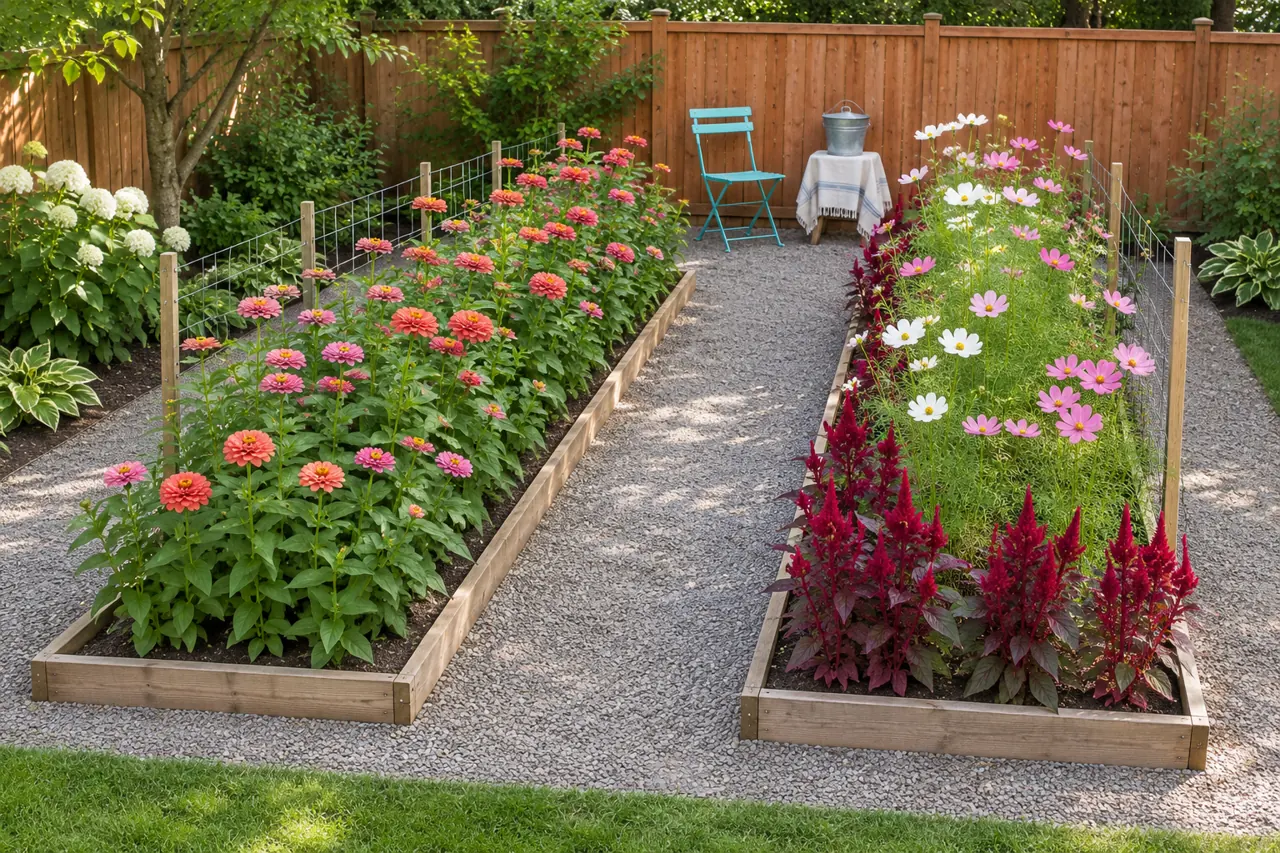
Two long beds make a small cutting patch feel organized without turning it into a miniature farm. Put pink zinnias in one and airy cosmos with burgundy celosia in the other.
Room for the bucket. Give yourself room to carry a bucket without brushing the flowers.
Low timber edging keeps gravel out of the soil, while open supports help contain taller stems. Keep access around the outside too.
A turquoise chair and bucket stand at the far end make a useful stopping place.
Choose cutting varieties with worthwhile stem length, and follow their spacing guidance instead of filling every gap immediately.
This layout suits a sunny rectangular plot. If you cannot reach the middle comfortably, narrow the beds before planting.
2. An L-shaped cutting border by the kitchen door

An L-shaped border can turn the edge of a kitchen patio into a small source of flowers. Keep its two arms narrow enough to work from the paving.
Let coral zinnias mark the bend, with white cosmos and magenta celosia adding height beyond them.
A separate basil pot gives the patio another texture without crowding the flower roots. The sage door, cream stool and blue striped cushion tie the space together.
I love how this arrangement makes a quick cutting trip feel easy.
Leave the doorway, drain covers and ordinary walking route clear.
Check summer sunlight rather than assuming a bright wall guarantees a sunny bed.
Keep the little bucket table outside the main route, and plant far enough back that mature stems will not lean across it.
3. Four small beds around a bucket station

Four small beds give you a convenient way to organize several flower groups. A cross-shaped path brings each planting within reach from more than one side.
Repeat pink, apricot and purple across the squares so the garden looks connected. Repetition also helps the flowers combine naturally in a vase.
Put a sturdy bucket table on a central paved area, with enough room to walk around it.
The yellow bench belongs outside the working paths. It adds a cheerful backdrop without becoming something you must squeeze past.
Stake taller dahlias while they are still manageable, using support appropriate to their mature height.
Four beds mean more edging and path maintenance than one strip. Start with fewer squares if the available space or upkeep feels too much.
4. A one-sided fence border for a narrow yard

A shallow cutting border can fit a side yard that has no room for freestanding beds. Run it along the fence and preserve a continuous path in front.
Tall cosmos and a few supported sunflowers form the backdrop.
Coral zinnias and purple globe amaranth bring color closer to the path.
Keep the bed shallow enough to reach its back edge without stepping between plants.
A blue garden cart can live in a widened bay at the end, where it will not obstruct the route.
Check where the fence and house cast shadows through the day. This works as a cutting garden only if the chosen flowers receive enough light.
Leave space for stems to expand, and keep planting clear of gates, utility access and the building wall.
5. A patio bouquet garden in three generous pots

Three generous pots can supply a few bouquet stems while keeping a courtyard useful for sitting. Arrange them around the edges rather than lining the narrowest part of the path.
Try an apricot dahlia, pink zinnias and purple globe amaranth in separate containers.
Choose varieties with useful stems whose mature size fits the pot; a tiny bedding selection may offer very little to cut.
A mint chair and coral patterned cushion make the grouping feel like part of an outdoor room.
Use containers with drainage and a suitable potting mix. Check moisture regularly, especially beside warm paving or walls.
The tradeoff is a smaller harvest and closer watering attention than a generous ground bed.
Keep the supports inside each pot’s footprint and leave room to reach the soil.
6. A reachable oval island that doubles as a flower border

An oval island can provide cutting flowers while still looking like a deliberate part of the lawn.
Keep the shape long and relatively narrow, with access all the way around.
Pink cosmos makes an airy center, while coral zinnias and purple globe amaranth soften the edge. A few supported yellow dahlias add larger blooms.
Leave a mowing strip wide enough for your own equipment.
The cobalt bench sits on a separate brick pad, where the plants will not swallow its legs.
What I like to do when planning an island is test the reach before removing turf.
The center must remain workable once everything fills out.
This is less suitable for a wet lawn or an area you can reach only by crossing soft ground.
7. Dedicated flower strips beside the vegetables
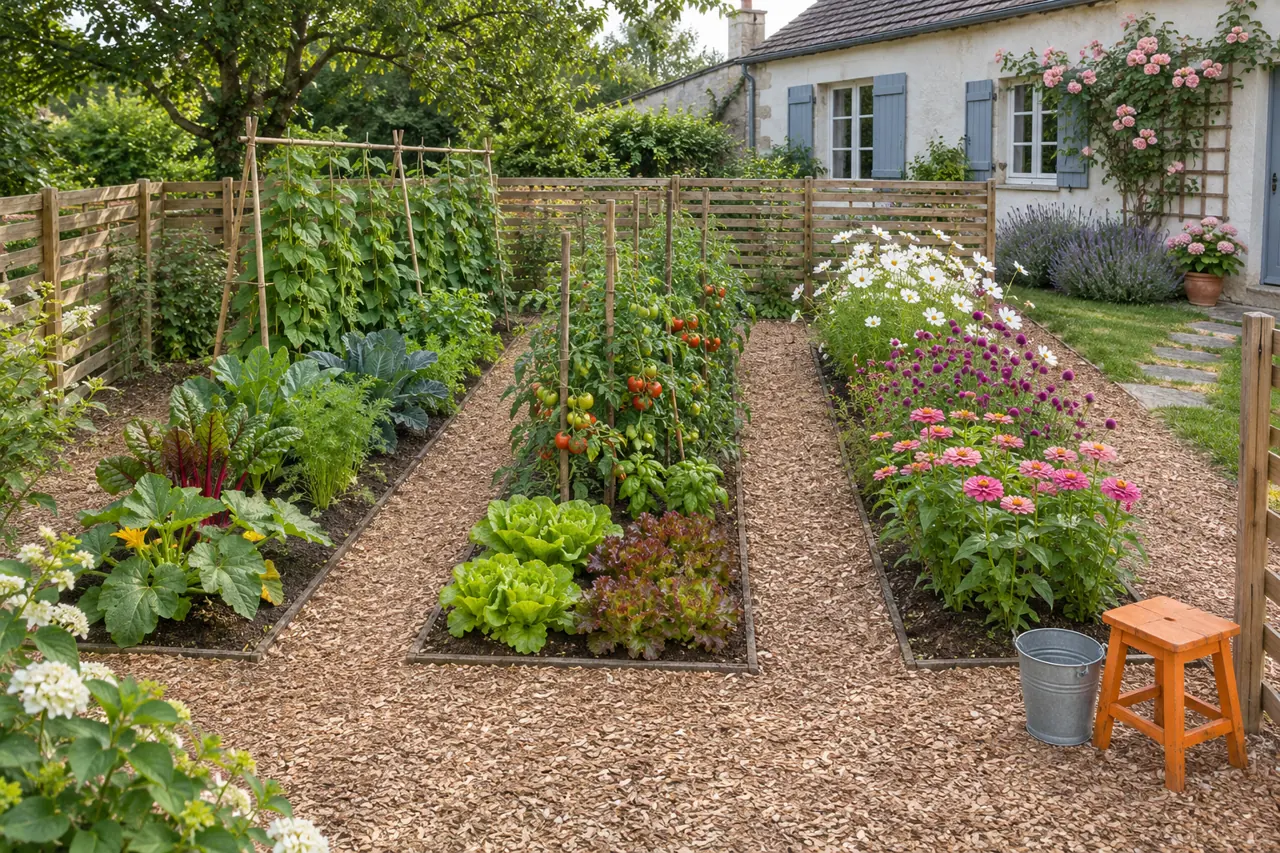
Give flowers their own strip beside the vegetables instead of dropping a few plants wherever space appears. Separate growing areas make cutting, watering and crop changes easier to manage.
Pink zinnias, white cosmos and purple globe amaranth provide contrasting shapes beside the leafy food crops.
Keep the tallest supports where they will not shade the flower strip. Follow mature spacing for the vegetables as well as the flowers.
Broad woodchip lanes and an orange utility stool make the setting practical rather than precious.
Do not assume the flowers will solve pest problems or improve every vegetable harvest. Choose them because you want bouquet material.
Leave room to bring a bucket through when the tomatoes and beans are fully grown, not just when the garden is newly planted.
8. A sunflower screen with a sunny working edge

A sunflower back row can give an open garden a loose seasonal screen. In front, shorter zinnias and white cosmos create a second layer of cutting material.
Place the tallest row where its shade will not fall across the lower flowers for most of the day.
Keep a generous harvesting lane in front and install sturdy supports suitable for the chosen sunflower variety.
A lavender chair on a separate pad gives you a place to enjoy the flowers you leave standing.
Check the seed packet carefully: branching and single-stem sunflowers need different harvest plans.
A single-stem plant will not keep replacing its main flower after cutting.
Use later sowings where the local season allows. This screen is temporary, and heavy wind may make a more sheltered layout preferable.
Calculate fill from inside measurements
A worked example for one new rectangular raised bed. It shows volume only, not the correct soil depth for every flower or a universal soil recipe.
Measure the usable bed
Example inside dimensions: 3 ft × 8 ft, filled to 9 inches deep. Convert 9 inches to 0.75 ft.
Multiply length, width and depth
3 × 8 × 0.75 = 18 cubic feet. Measure the actual interior, not the outside of thick boards.
Convert if shopping in liters
One cubic foot is about 28.317 liters. 18 × 28.317 ≈ 510 L, or about 0.51 m³.
Adjust the order to the site
Subtract existing usable fill and leave appropriate watering headspace. Account for settling and the supplier’s actual bag or bulk volume.
9. A U-shaped raised bed with a work bay

A U-shaped raised bed creates an open working bay surrounded by flowers. Keep each arm narrow, with access outside the planter as well as inside it.
Use coral zinnias on one side and purple globe amaranth on the other. Supported dahlias across the back give the arrangement a taller focal layer.
The central paving needs enough room for you, a bucket and turning space.
Place the green tool cabinet and mustard stool outside the opening. The entrance should remain obvious and easy to use.
This shape uses more edging than a simple rectangle, so measure the internal growing area before ordering fill.
It can make tending convenient, but it is not automatically an accessible design. Set the height, reach and path surface for the person using it.
10. Two existing level terraces joined by a broad path

Existing level terraces can become two coordinated cutting areas without trying to plant rows down a slope.
Treat each flat section as its own small garden.
Put taller cosmos and staked dahlias on the upper level, with zinnias and globe amaranth below.
A broad connecting route makes moving between the two areas easier. Keep level standing space beside the flowers rather than harvesting from a sloping path.
The teal bench belongs on the lower landing, away from the circulation route.
Check drainage after rain before choosing the beds. Water should not collect around roots or wash soil onto the path.
This idea assumes sound existing terraces. New retaining work, altered drainage or a new ramp needs appropriate site-specific design; the planting arrangement is not a construction plan.
11. A dahlia collection with room to stake and cut
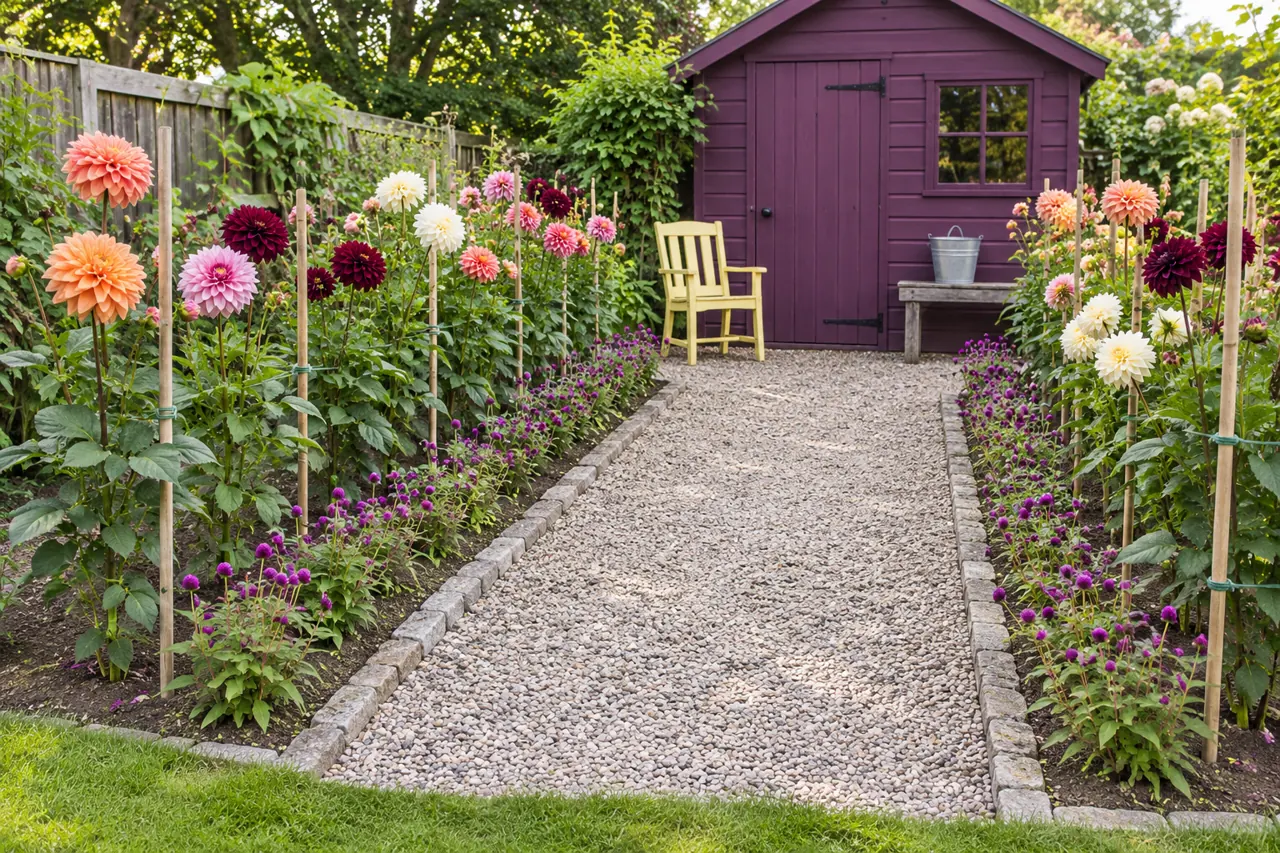
If dahlias are the flowers you most want indoors, give them a layout built around support and access. Single rows on either side of a working lane make the stems easier to reach.
Mix apricot, cream, pink and burgundy blooms for variety without changing the whole garden palette.
Install suitable stakes before the plants become large, then tie stems without constricting them.
The plum shed and pale yellow chair provide a colorful background even between the biggest flushes of flowers.
Keep neighboring filler plants from crowding the dahlia bases. Leave space to inspect stems and reach the root zone.
Dahlias are frost-sensitive, and winter care depends on your climate. In cold regions, lifting and storing tubers adds a seasonal task beyond simply cutting summer flowers.
Make a succession plan you can actually use
Use a notebook row for each flower variety. The aim is to decide whether another sowing is worth the space before you start it.
Record the starting point
Write the variety, sowing date and whether its stated days to flowering begin at sowing or transplanting. Keep the seed packet.
Compare with the remaining season
Check local frost risk and the temperatures the crop needs. A packet estimate is a planning aid, not a promised flowering date.
Reserve the destination
Mark the bed or container that will receive the next batch. Growing replacement plants is less useful when there is nowhere suitable to plant them.
Review the actual result
Record first usable stems, final useful harvest and any gaps. Use those observations to adjust your next planting rather than repeating a calendar blindly.
Mississippi State explains succession planting for a longer harvest.
12. A perennial backbone with annual cutting pockets

A perennial border does not need to be stripped bare to contribute to bouquets. Reserve reachable pockets near the path for annual cutting flowers.
Summer phlox and coneflowers provide an established framework, with coral zinnias and purple globe amaranth filling the seasonal gaps.
A curved brick edge and raspberry bench make this feel like a garden border first. The blue patterned cushion adds a small contrasting detail.
Choose perennials for local hardiness, mature spread and flowering time.
They will not all bloom continuously or necessarily reach full size in their first season.
Keep the annual pockets clear of expanding crowns and dense root competition.
This suits someone who wants occasional stems from a mixed landscape. A separate production bed is easier if you want to cut heavily.
13. Separate cutting and leave-to-bloom beds

Separate the flowers you intend to cut from a bed you prefer to leave blooming. That simple division removes the feeling that every bouquet is taking the garden apart.
One side can hold neat rows of zinnias and cosmos. Across the brick path, let coneflowers and open-centered rudbeckias form looser drifts.
Choose plants and varieties that offer useful pollen or nectar; flower color alone does not tell you that.
A blue bench faces the standing flowers, while the tool table sits nearer the cutting side.
Keep both beds reachable and leave space for their mature spread.
This arrangement trades some potential cutting area for flowers left in the garden.
I love the clarity of deciding that balance before planting, rather than reconsidering every time a flower opens.
14. A removable grow-bag garden for a rented courtyard

A rented courtyard can hold a small cutting garden without permanent beds. Group generous fabric planters around a clear paved workspace and keep the door route open.
Use separate bags for pink zinnias, purple globe amaranth, orange celosia and a supported cosmos plant.
Check each variety’s mature size against the bag’s growing volume. Several small seedlings can become an overcrowded container surprisingly quickly.
A coral chair, striped outdoor mat and folding table make the space useful beyond watering time.
Protect the paving while allowing runoff to escape, and empty collected water. Dark containers can become hot in sun, so monitor the root-zone conditions.
Get the property owner’s permission where needed.
These planters are removable, but a wet, filled bag can be heavy; decide its position before filling it.
15. Three planting blocks for an overlapping harvest

Divide a cutting patch into planting blocks rather than sowing every available space on the same day. One block can be flowering while another develops and a third starts again.
Repeat a few useful colors across the blocks so later stems still combine with earlier flowers.
A small nursery bench holds replacement plants beside the shed. Keep trays watered and move seedlings into their final positions at the appropriate stage.
The mustard chair and simple bucket table give the work end a welcoming finish.
Record sowing dates and each variety’s expected time to flowering. Later sowings need enough suitable weather left to become useful.
This approach requires spare growing space and attention.
It extends your options; it cannot overcome an early frost, prolonged heat stress or a crop that fails.
Keep the cutting garden useful through the season
Choose stems as well as flower colors
Look for varieties intended for cutting, with stem length and mature height that suit your space. Short bedding flowers can look lovely outdoors while offering little length for a vase.
Use the plant label to decide spacing and support. Keep room for airflow rather than copying the apparent density of a full-flower photograph.
Cut at the right stage and get stems into water
Take clean, sharp snips and a clean bucket of fresh water into the garden. Cut in the cool morning and put stems into water promptly.
Harvest stage varies: zinnias and dahlias are generally cut open, while some other flowers are cut as they begin opening. Illinois Extension explains species-specific harvest stages and bouquet care.
Remove foliage that would sit below the waterline. Use commercial flower food according to its package instructions, and keep finished arrangements away from direct sun and heat.
Water the root zone and feed according to need
Check soil moisture and water where the roots are, allowing excess water to drain. Drip or soaker irrigation can keep water off foliage; adjust for soil, containers, rainfall and heat.
Use a soil test to guide amendments and fertilizer rather than assuming more feeding means more flowers. Mississippi State’s cutting-garden guide covers soil testing, watering and maintenance.
Match the season to your location. Warm-season plants and cool-season flowers need different planting windows.
Snapdragons, for example, can be a cool-season crop in warm climates rather than a reliable midsummer choice. UF/IFAS explains Florida’s cool-weather cutting season.
In colder regions, use local frost dates and the crop’s temperature needs. A hardiness-zone number alone does not tell you when to sow or transplant.
Questions worth settling before buying seed
Will cutting flowers encourage more flowers?
It can help repeat-flowering plants such as zinnias, especially when spent blooms are removed. Minnesota Extension notes that removing old zinnia blooms promotes new flowers.
It does not apply to every crop in the same way. Check whether a sunflower is single-stem or branching, and do not pinch a single-stem variety expecting a branching plant.
Can I plant all the seeds at once?
You can, but that may concentrate the harvest into one period. Plan new batches for crops that benefit from succession, while leaving time for them to flower in suitable conditions.
Can a shaded patio produce these flowers?
A patio bright enough for sitting may still be too shaded for productive summer cutting flowers. Measure direct sun and choose species for the actual conditions.
If the space is unsuitable, grow a smaller number of appropriate plants elsewhere rather than forcing a sunny cutting-garden plan into deep shade.
Choose the route you will use with a full bucket
Before ordering flowers, mark out one bed and walk around it carrying a bucket. Test the gate, the turn by the chair and the reach to the middle.
Then choose a few flower varieties you want to see together indoors. That is enough to give your first cutting patch a clear purpose.