
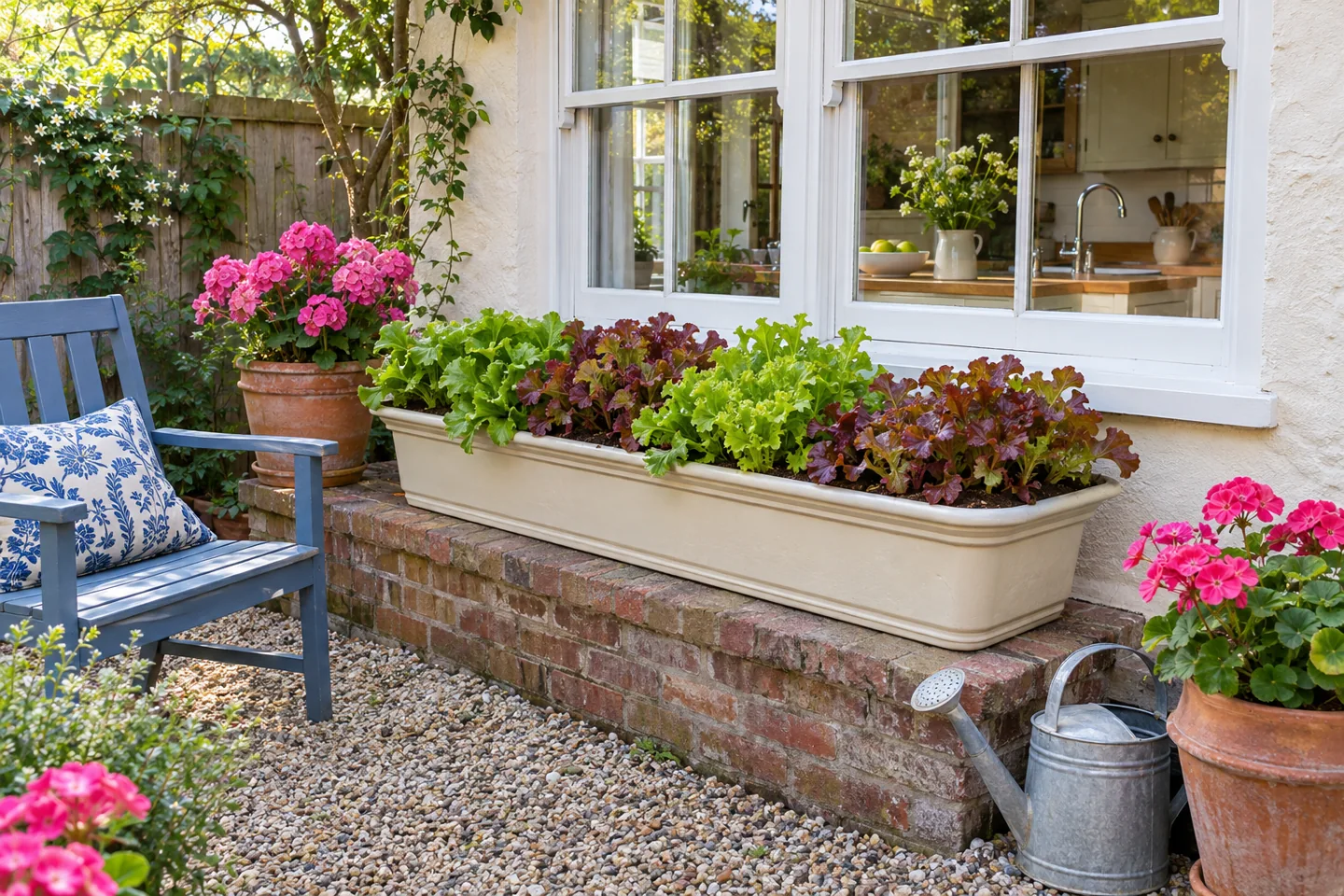
A window box can do more than hold summer flowers. Near the kitchen, a small planting of salad leaves gives you something useful to pick.
These ten greens suit an outdoor box when you harvest them young and match the crop to the season. Start with one or two favorites.
The layouts below show how to fit each crop into a complete little garden, with clear access, separate flower pots and room to keep sowing.
Expect small, seasonal pickings. A narrow box is not a full vegetable plot, and mature chard, kale or pak choi need more space than baby leaves.
Choose your window-box salad greens
- 1. Loose-leaf lettuce for a colorful kitchen-window box
- 2. Arugula for a small, peppery harvest station
- 3. Baby spinach in a cooler morning-light corner
- 4. Young chard as a bright-stemmed window garden
- 5. Baby kale in a simple, protected growing nook
- 6. Mizuna for a feathery, flower-framed box
- 7. Tatsoi as a low rosette planting
- 8. Red mustard for a small spicy accent crop
- 9. Baby pak choi beside a screened kitchen doorway
- 10. Mâche for a sheltered cool-season box
Check the box before choosing the crop
Use these checks to decide whether your existing box is suitable. A decorative window box may be too small or poorly supported for food growing.
Measure light at leaf level
Maryland Extension suggests 3–5 hours of direct sun for cool-season container crops. Growth depends on season and conditions; deep shade is a different problem.
In hot weather, consider morning sun and afternoon protection. Match the crop and variety to local temperatures, frost dates and day length.
Check actual growing room
Colorado State suggests a window box at least 18 inches across and 6–12 inches deep. Deeper containers dry more slowly.
For these young-leaf layouts, a broad box around 12 inches front-to-back and 8–12 inches deep is a practical planning choice, not a universal minimum.
Use a draining container mix
Choose a container with open drainage and a suitable vegetable potting mix. Garden soil alone can be unsuitable in a confined box.
Check whether the mix already contains fertilizer, then follow the product label for edible crops rather than adding a fixed weekly feed.
Plan support and runoff
A filled, wet planter is heavy. Use a stable, suitable support; check the support and fixings before using a mounted box.
The pictured ground-level arrangements avoid hanging boxes above people. Keep window operation, doors, walking routes and drainage paths clear.
For a narrow existing box, start with a small young-leaf crop. A deeper freestanding trough is often more practical than trying to fit mature vegetables onto a sill.
1. Loose-leaf lettuce for a colorful kitchen-window box
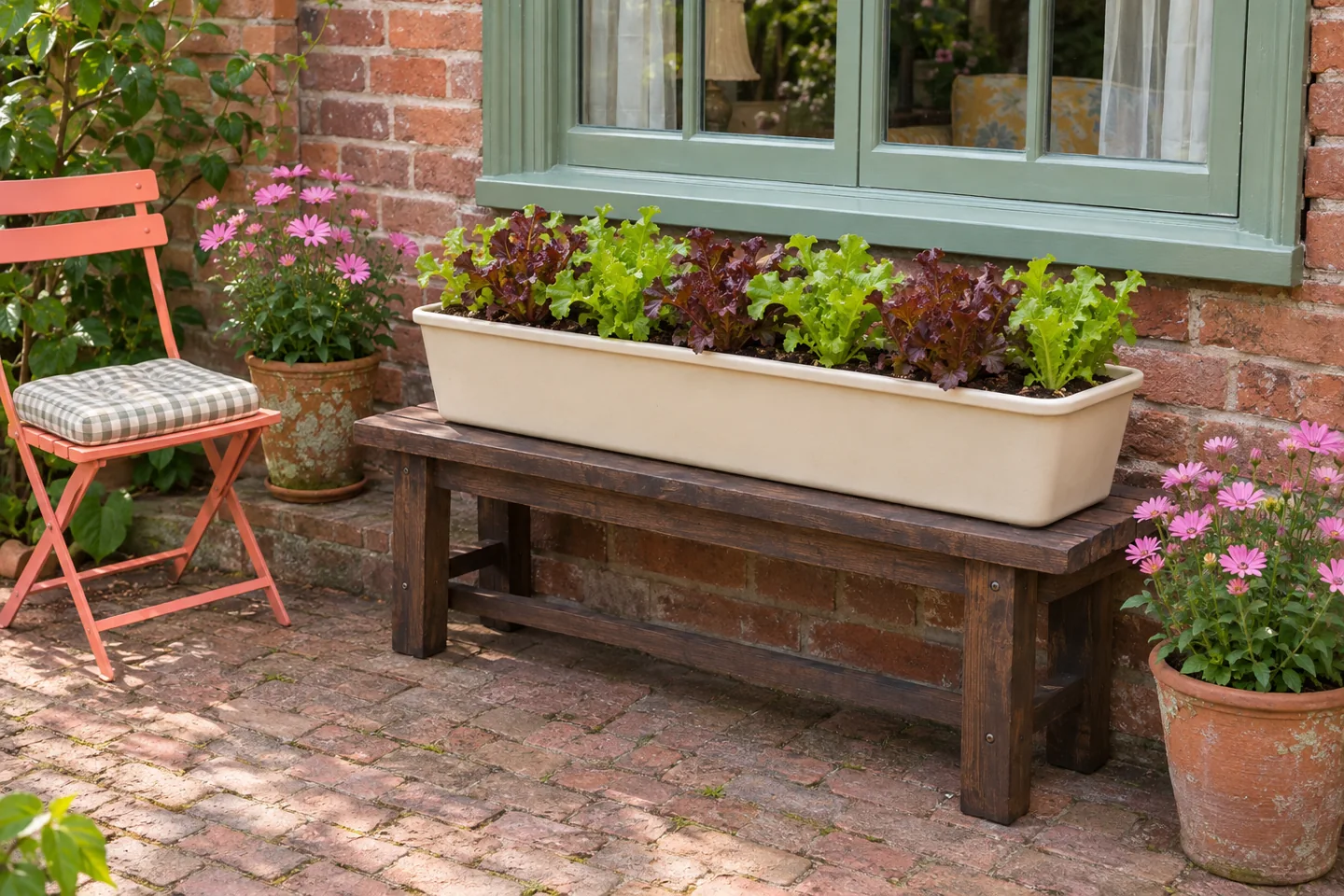
A cream trough filled with green and burgundy lettuce makes a useful little border beneath a kitchen window.
Keep it on a sturdy bench within easy reach.
A coral chair and separate pink flower pots finish the courtyard without taking soil space from the crop.
Choose loose-leaf seed rather than a large heading type, then follow the packet’s baby-leaf spacing and sowing depth.
Leave a small section unsown for the next batch. The planting looks softer when young leaves overlap without forming a packed, damp mat.
Pick a few outer leaves while leaving the growing center intact.
Maryland Extension notes that heat and longer days encourage bolting. Give this box a cooler seasonal window rather than promising summer-long leaves.
2. Arugula for a small, peppery harvest station

Arugula, also called rocket, suits a charcoal trough near the back door. Its loose green foliage looks crisp against pale paving and a simple cedar screen.
Place a mustard stool beside the working area, with a watering can tucked underneath. Keep purple flower pots beyond the approach.
The RHS recommends repeated small sowings of salad rocket because the crop is relatively short lived. Sow one labeled strip at a time, following the packet rather than emptying it across the whole box.
Pick young leaves for a gentler peppery flavor and check the mix before watering.
When flowering takes over, replace that strip. This is a flavorful addition to a salad bowl, not a large supply from one narrow planter.
3. Baby spinach in a cooler morning-light corner
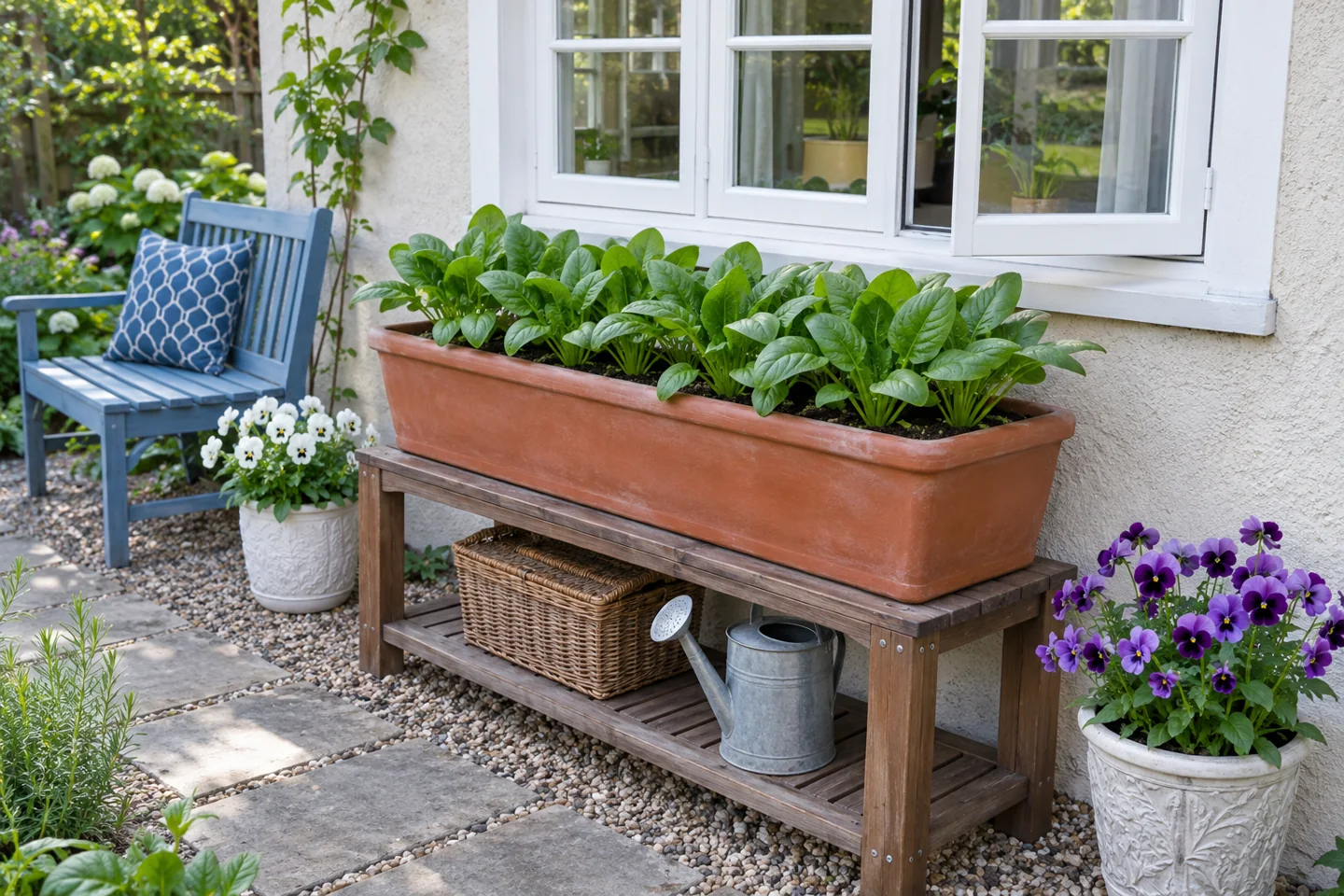
Use a terracotta-colored box beneath a pale wall, with a blue bench turned sideways so it leaves the harvest route open.
Spinach gives this quieter arrangement a low layer of soft green leaves.
Separate white and violet flower pots can brighten the ground below.
Sow true spinach directly into its container where possible, choosing a variety suited to your local cool season.
Keep the surface evenly moist during establishment, then thin according to the packet’s intended leaf size.
Harvest individual young leaves without stripping every plant.
Heat is only part of the limitation: increasing day length also encourages spinach to bolt. A shaded afternoon position cannot make every summer climate suitable, so plan a replacement crop before the box stalls.
Plan the harvest before filling every gap
Choose one main crop, then decide how much space to reserve for a later sowing. This keeps your box from maturing all at once.
| Growing goal | Approach | Check first |
|---|---|---|
| A mild first crop | Loose-leaf lettuce or young spinach | A suitable cool season; the actual light |
| More bite in a small harvest | A little arugula, mizuna or mustard | Flavor preference; avoid sowing the whole box |
| A low rosette display | Young tatsoi or mâche | Allow for spread; protect when locally needed |
| Leaves that can become large | Young chard, kale or pak choi | Choose baby leaves or a bigger container |
A worked potting-mix estimate
For a rectangular box with internal dimensions of 30 × 12 inches and an 8-inch intended fill depth:
30 × 12 × 8 ÷ 1,728 = 1.67 cubic feet, approximately 47 liters. This is an illustrative fill calculation, not a recommended planter weight.
Measure below the rim, allow for root balls and settling, and read the mix bag’s volume. Tapered boxes need their manufacturer’s capacity or a separate estimate.
Leave a renewal section
One simple plan is to sow half the usable area first and label the date. Keep the other half for a later sowing when local conditions still suit the crop.
Use the packet’s baby-leaf spacing; this is an area plan, not a plant-count formula. An 8-inch fill depth does not make a narrow box suitable for mature vegetables.
4. Young chard as a bright-stemmed window garden

Let young chard supply the color in a deep stone-colored trough. Red and yellow stems show beneath green leaves without needing a second crop in the box.
A yellow bench, patterned cushion and separate flower pots make the surrounding brick patio feel like a place to pause.
Keep the bench offset so you can reach the soil and inspect the lower leaves.
Chard’s young leaves can be harvested for salads. Sow for that stage and pick regularly rather than allowing every plant to become a large clump.
Thin crowded seedlings and reserve mature plants for a larger container elsewhere.
The display needs restraint: oversized leaves soon dominate a window box, shade smaller neighbors and make the planting harder to reach.
5. Baby kale in a simple, protected growing nook
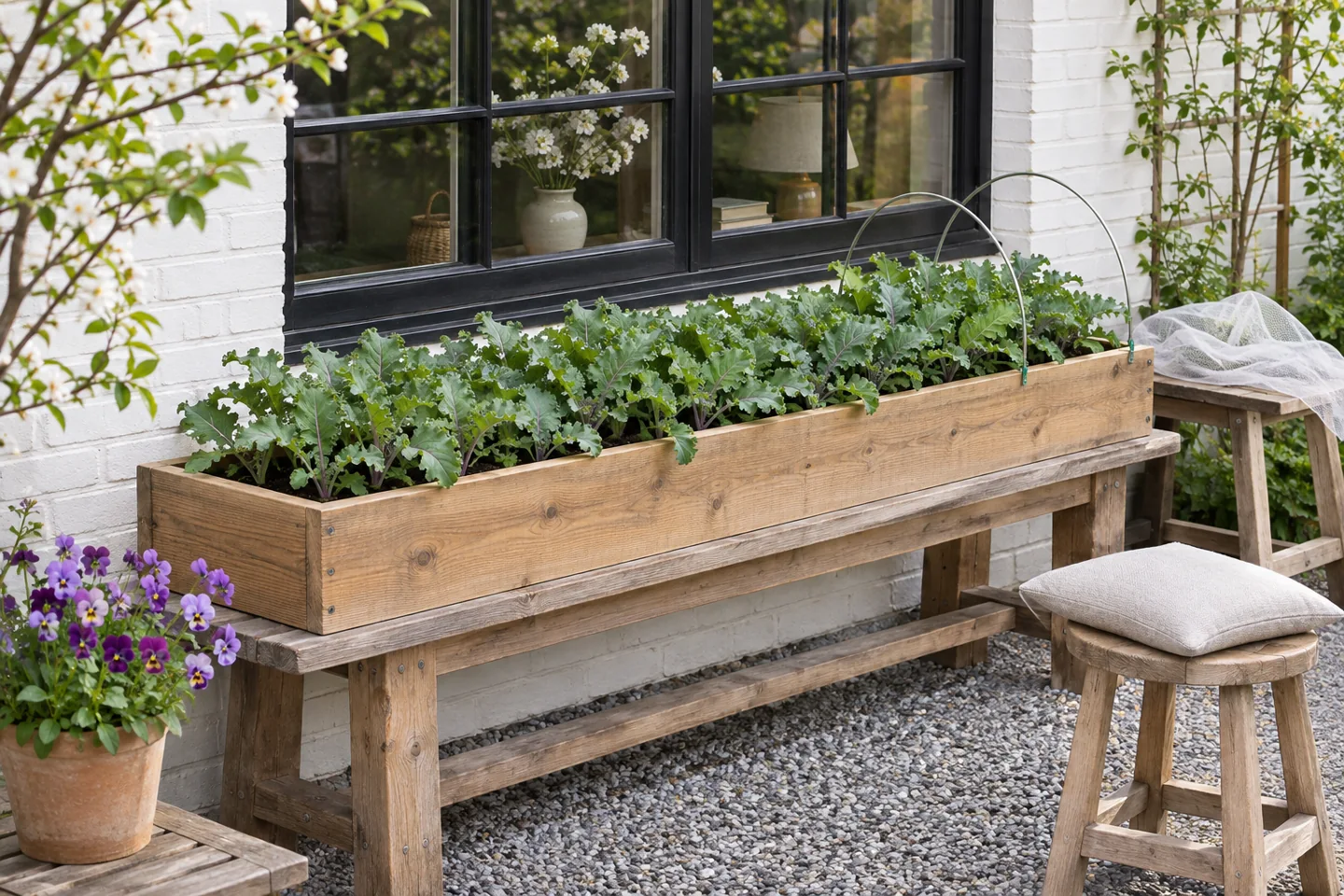
A broad wooden trough against white brick gives baby kale a calm setting. Small blue-green leaves work well with gravel, a plain stool and one pot of violas.
Keep the crop low and the window unobstructed; this plan is for young salad leaves, not a row of tall mature kales.
The RHS gives about 3 inches between baby-leaf kale plants. Use the variety’s guidance if it requires more space.
Fit removable hoops for suitable insect mesh, leaving room above the leaves and easy access for picking. Check underneath the covering rather than assuming protection has solved every pest problem.
Mature kale needs substantially more growing room. Move that ambition to a larger pot instead of letting this trough become crowded and top-heavy.
6. Mizuna for a feathery, flower-framed box

Mizuna brings a finer texture than broad lettuce leaves.
A wide teal trough beneath a cottage window makes its feathery growth easy to see.
I love how a dusty pink chair and floral cushion soften this practical corner.
Put the flowering pots beside the approach, outside the edible planting.
The RHS suggests 4–6 inches between plants for regular small-leaf pickings. Allow the tufts room rather than treating them as permanent bedding.
Sow small batches, keep the mix moist and pick a few outer leaves from each plant.
Avoid letting the chair block the watering route.
Hot, dry conditions can shorten the crop, so use locally suitable cool-season sowings and replace tired plants instead of expecting one box to keep producing indefinitely.
7. Tatsoi as a low rosette planting
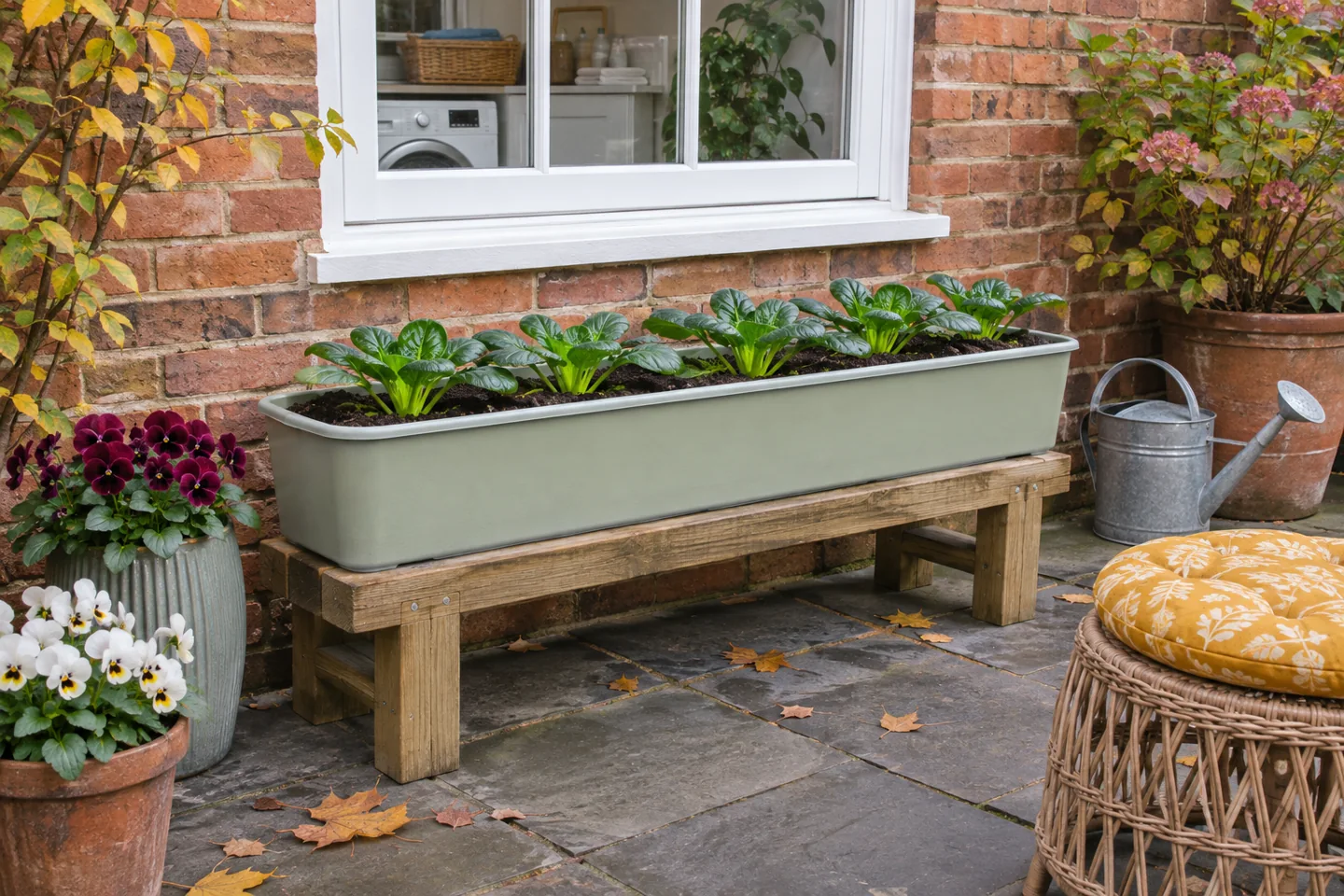
Tatsoi makes a tidy low layer in a pale green trough beneath a utility-room window.
Its rounded, spoon-shaped leaves give this small garden a different rhythm.
Use a broad support and keep the front edge reachable. A round stool, mustard cushion and separate plum-and-white flowers complete the slate-paved corner.
University of California gardeners describe tatsoi as a flat-rosette Asian green suited to their cool spring and fall conditions.
Sow labeled edible seed and follow its spacing for young leaves; crowded rosettes will eventually press against one another.
Pick modestly around each plant, keeping the center growing.
Adapt timing to your region. Cold tolerance does not guarantee that a small exposed box will keep growing or survive every winter freeze.
8. Red mustard for a small spicy accent crop
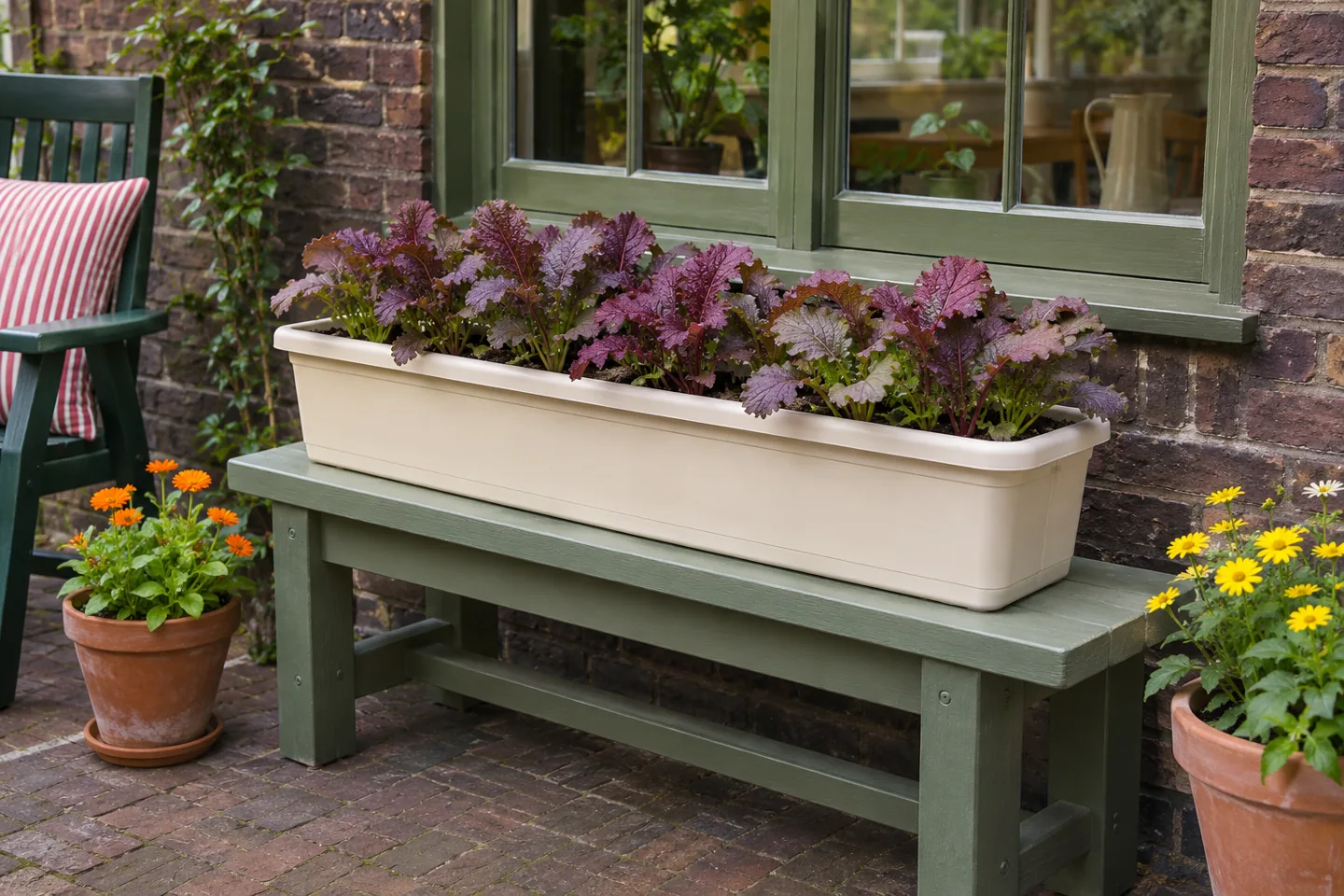
A cream trough of young burgundy mustard leaves can become the focal point beneath an olive-painted window. Pair it with a striped seat and separate orange flowers.
Leave the brick apron clear so you can inspect and pick the crop without leaning over furniture.
Choose an edible leaf-mustard seed packet, not an unlabeled ornamental plant.
Illinois Extension describes mustard as a cool-season salad green. Use its young leaves sparingly if you prefer a milder bowl.
Sow a small area first, thin to the packet’s spacing and keep growth moving with suitable moisture.
Inspect leaf undersides and growing tips regularly.
The strong flavor is the reason to grow it, but also a limit: devote less box space to mustard than to your mild salad base.
9. Baby pak choi beside a screened kitchen doorway
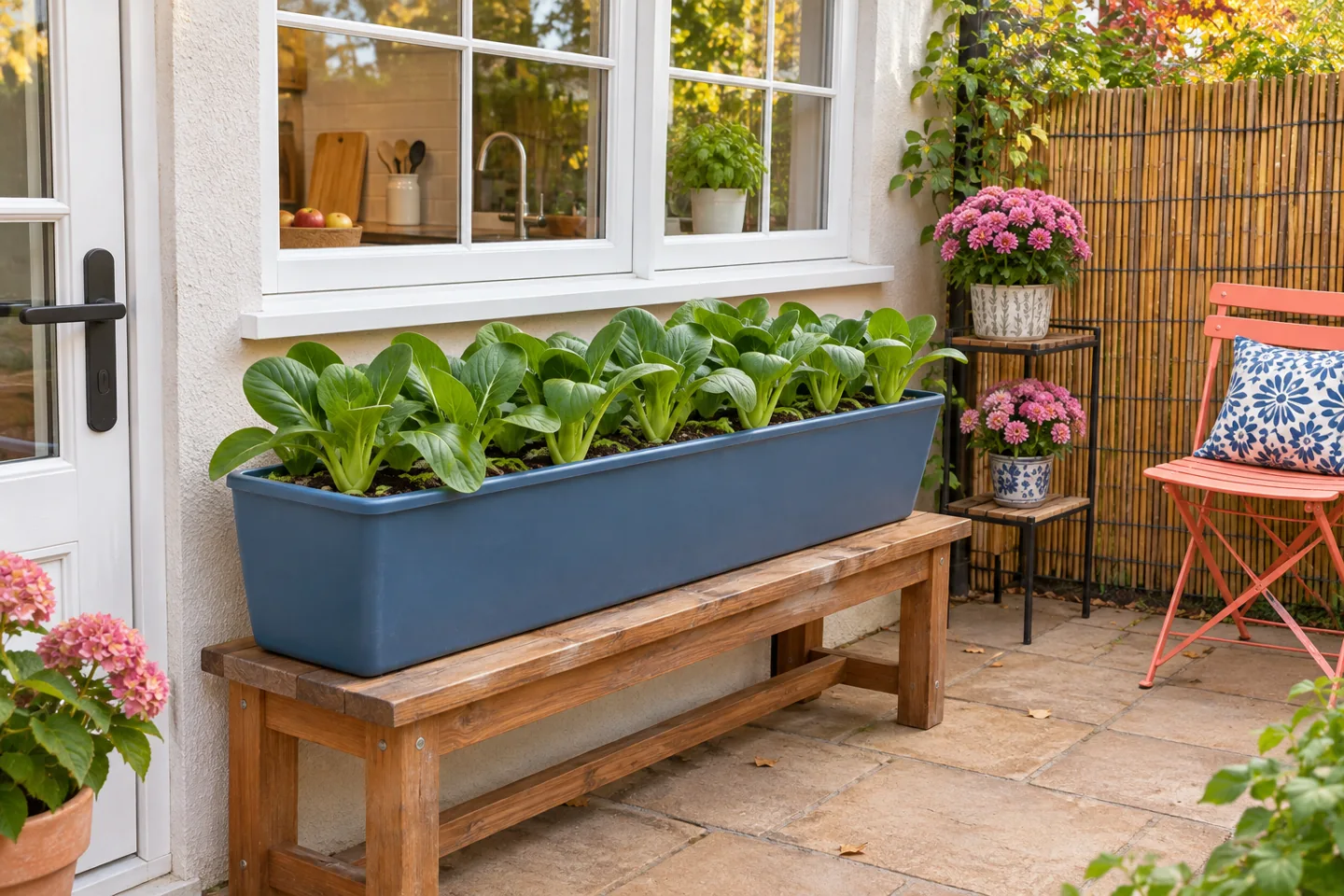
A broad blue trough gives young pak choi a defined place beside the kitchen door. Keep its smooth leaves separate from decorative pots on a nearby stand.
A bamboo screen, coral chair and patterned cushion make the wider patio welcoming while leaving the planter’s front edge open.
The RHS recommends roughly 3–4 inches between plants for baby leaves. Full-sized heads need much wider spacing, so decide your harvest stage before sowing.
Pick young outer leaves and leave the center undamaged.
Check moisture often enough that the mix does not repeatedly dry out.
Pak choi can flower prematurely after temperature or moisture stress. Use a locally suitable sowing period rather than assuming a sheltered doorway makes every season equally reliable.
10. Mâche for a sheltered cool-season box

Mâche, or corn salad, brings soft little rosettes to a stone-colored trough beneath timber shutters. Keep the planting low, with visible spaces between the clusters.
A folding chair with a rust cushion and separate pansy pots give this sheltered autumn corner a quiet finish.
The RHS describes late-summer or autumn sowing for winter salads under suitable conditions, with protection in harsh weather.
Follow locally appropriate timing and the seed packet; winter growth may be slow even when plants remain alive.
Keep removable cover supports nearby without allowing fabric to flatten the leaves.
Pick carefully, keeping gritty mix out of the harvest bowl.
This small planting is better treated as occasional tender additions than a promise of large daily winter salads.
A check-and-pick routine for a small box
Use this sequence when you visit the planter. It separates watering, crop renewal and food handling into decisions you can act on.
Check below the surface
If the mix is still moist, wait. If it is drying, water gently at the root zone until excess can drain.
Inspect blocked holes or standing runoff if the box stays wet. Wind, sun, box size and plant growth change how quickly it dries.
Look before picking
Inspect the undersides and centers for actual pests or damage. Remove faded leaves and thin crowding rather than treating a box automatically.
For a persistent problem, ask a local extension service with photographs of your actual plants. An attractive planting illustration cannot establish a diagnosis.
Keep a growing center
Use clean scissors or fingers to take a few outer young leaves without destroying the growing point. Leave enough foliage for recovery.
Replace declining or persistently flowering crops. Repeated picking is possible, but no single sowing is a permanent supply.
Handle the harvest cleanly
Use clean hands, tools and a clean bowl. FDA advises rinsing home-grown produce under running water before eating.
Do not use soap or detergent on leaves. Refrigerate perishable greens at 40°F (4°C) or below; washing reduces contamination but cannot eliminate it.
The RHS salad-leaf guide covers outer-leaf harvesting and crop replacement. Minnesota Extension explains how container moisture needs change.
Questions before your first sowing
Can I grow all ten in one box?
Not as a lasting, productive collection. Choose one or two crops for your actual dimensions and harvest stage; a mixed packet is an option for short-term baby leaves.
Will these work indoors on a windowsill?
This article plans outdoor boxes. Glass, reduced light and room temperatures change the setup; an indoor crop may need suitable grow lighting and a separate care plan.
Can the box stay planted through summer?
That depends on climate, exposure and the crop. Chard may handle warmth better than spinach, but hot walls and drying mix still need attention; pause or change crops when conditions stop suiting them.
How soon can I pick?
Use leaf size and healthy growth rather than one promised date. The seed packet, variety, temperature and light all affect timing; cold-season plants may grow much more slowly.
Start with the window you can reach
Measure the box, watch the light and choose one crop you actually enjoy eating. Keep the first sowing modest and leave yourself room to learn its rhythm.
What I like to do when planning is decide where the watering can will live before adding the chair. Easy access makes a small edible garden much more useful.