
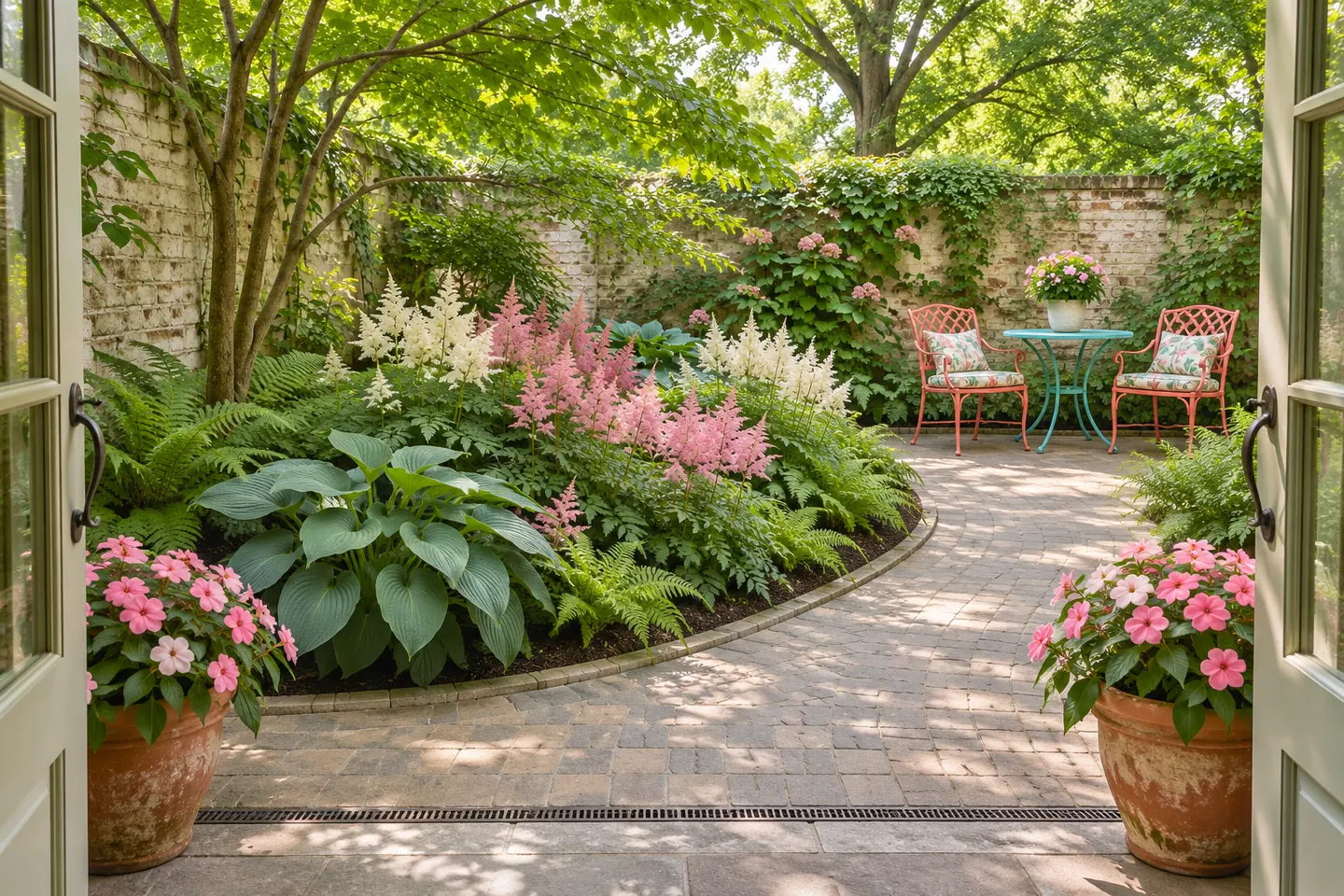
A shady garden can have plenty of flower color. The trick is choosing for the shade you actually have, rather than treating every sheltered corner alike.
For moist soil, consider astilbes, foamflowers, and primroses. For established dry shade, suitable epimediums offer a different starting point; containers can help where ground planting is difficult.
These fifteen shade garden ideas show complete layouts with paths, planting layers, and places to pause. Some shine in spring, others later in the year.
None promises flowers in darkness or every bloom at once. Match the plant, flowering season, mature size, and local growing conditions before copying a combination.
The RHS distinguishes several degrees of shade. Very dense shade, especially with dry soil, sharply limits the plants that will grow and flower well.
Before choosing plants: Check local hardiness, summer heat, drainage, mature size and invasive-plant guidance. These are ornamental designs, not edible-flower or pet-safe plant lists.
Explore the fifteen shade garden layouts
- 1. Sweep pink astilbes around a curved garden path
- 2. Build a sheltered courtyard around winter hellebores
- 3. Thread blue spring flowers through a woodland walk
- 4. Make a colorful begonia patio with room for tea
- 5. Frame a shaded porch with a low impatiens ribbon
- 6. Lift fuchsia baskets above a compact courtyard garden
- 7. Use hydrangeas as a flowering backdrop for a reading nook
- 8. Keep a dry-shade tree corner light and root-friendly
- 9. Soften a side passage with a foamflower border
- 10. Gather spring primroses around a courtyard birdbath
- 11. Run late-season anemones along an open-shade fence
- 12. Edge a shaded entrance with purple-flowered lilyturf
- 13. Layer coral bells into a colorful terrace border
- 14. Frame a cottage gate with spring bleeding hearts
- 15. Make a loose columbine island in dappled light
Make a shade-and-moisture record
Use one ordinary day as a starting observation, then revisit as the seasons change. A compass direction alone cannot describe the planting site.
Morning
Mark where direct sun reaches the ground and where nearby buildings block it. Note whether a proposed pot would receive the same light.
Middle of the day
Check whether the canopy creates shifting patches or continuous shade. Record the actual planting position, not the brightest point in the garden.
Later in the day
Look for hot western sun reaching beneath the canopy. A spot that feels cool in the morning may change substantially.
After rain and dry weather
Check the soil below the surface at the proposed site. Compare what happens near walls, beneath trees, and in the open.
The RHS shade guide explains why light, root competition and moisture must be considered together.
1. Sweep pink astilbes around a curved garden path
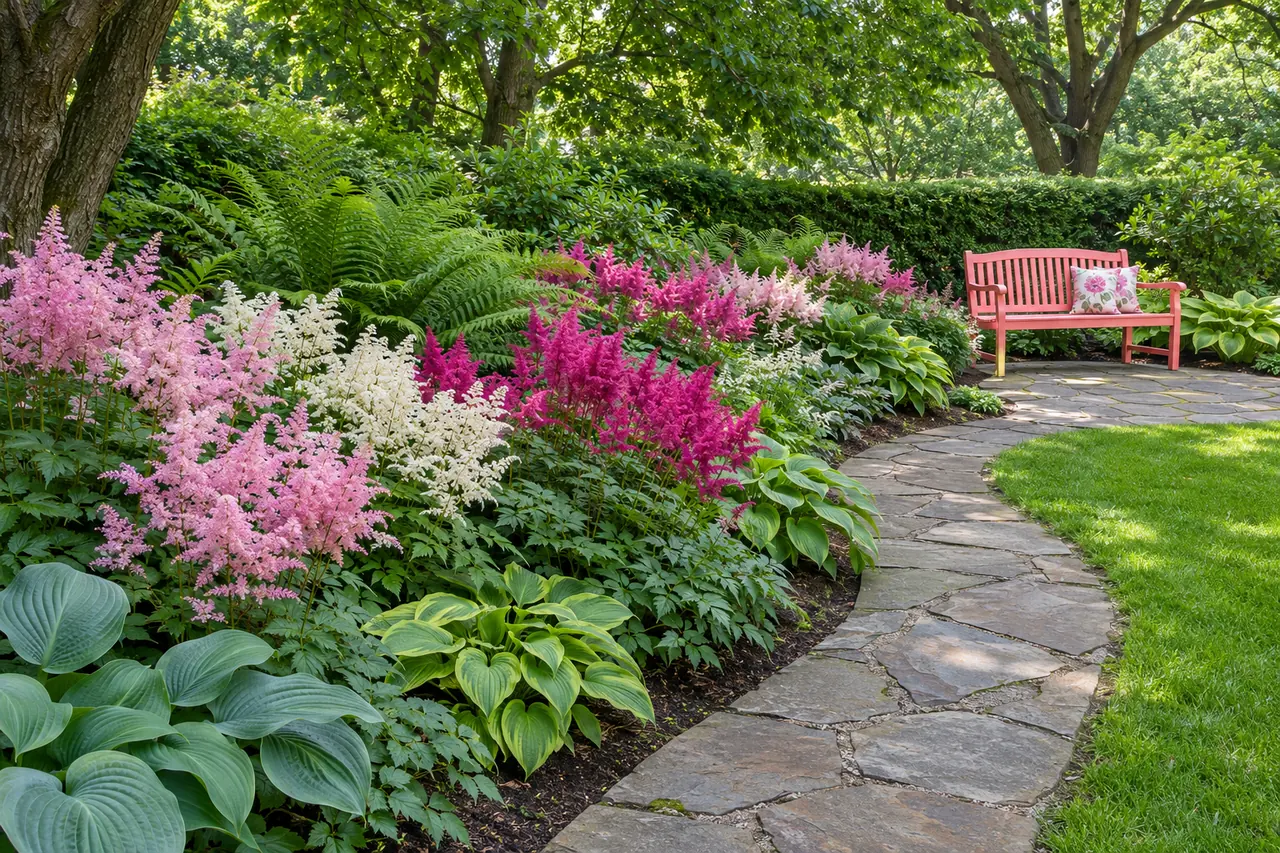
A curved path gives a broad shady border a clear shape before the flowers arrive.
Follow its outer edge with generous groups of pink astilbes.
Keep lower hosta foliage toward the path and taller ferns behind. A coral bench on a separate paved pocket makes the curve somewhere to stop.
Repeat white flower plumes through the pink rather than scattering many unrelated colors. The hedge behind them gives those airy heads definition.
Choose varieties for the space and their flowering periods, then check the soil during dry weather. Damp doesn’t mean permanently waterlogged.
Leave the path clear when the foliage reaches its mature spread.
2. Build a sheltered courtyard around winter hellebores
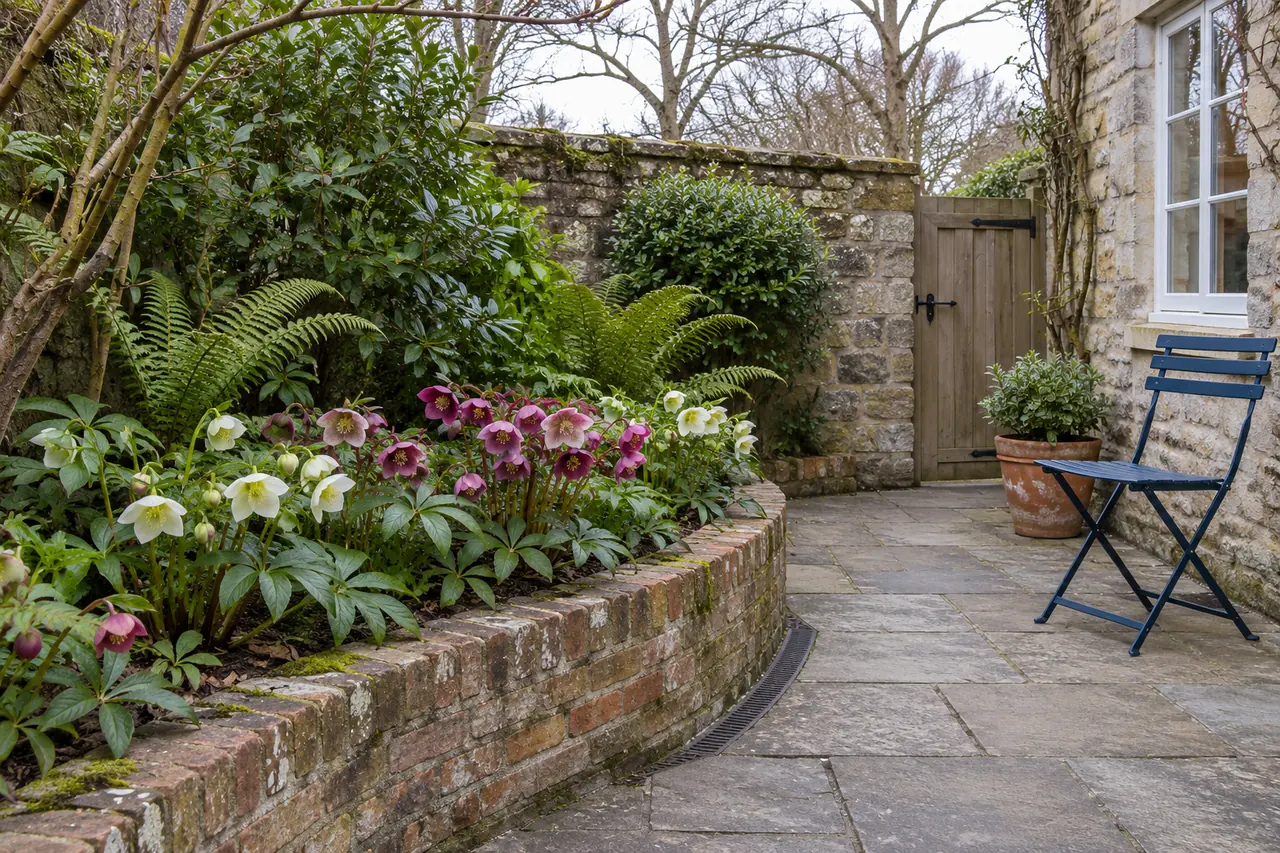
Winter flowers feel especially generous beside a chair you can reach without crossing wet soil. Use a low brick border to define that courtyard edge.
Plant white and plum-colored hellebores in front, with evergreen ferns and a suitable compact shrub behind. Their different leaf shapes keep the planting interesting.
A dark blue folding chair and plain terracotta pot complete the corner. Let the pale paving remain visible instead of covering every surface with containers.
Their main display belongs to late winter and early spring, depending on climate. The evergreen framework carries the space beyond flowering.
Keep the seating pocket outside the plants’ eventual leaf spread.
3. Thread blue spring flowers through a woodland walk
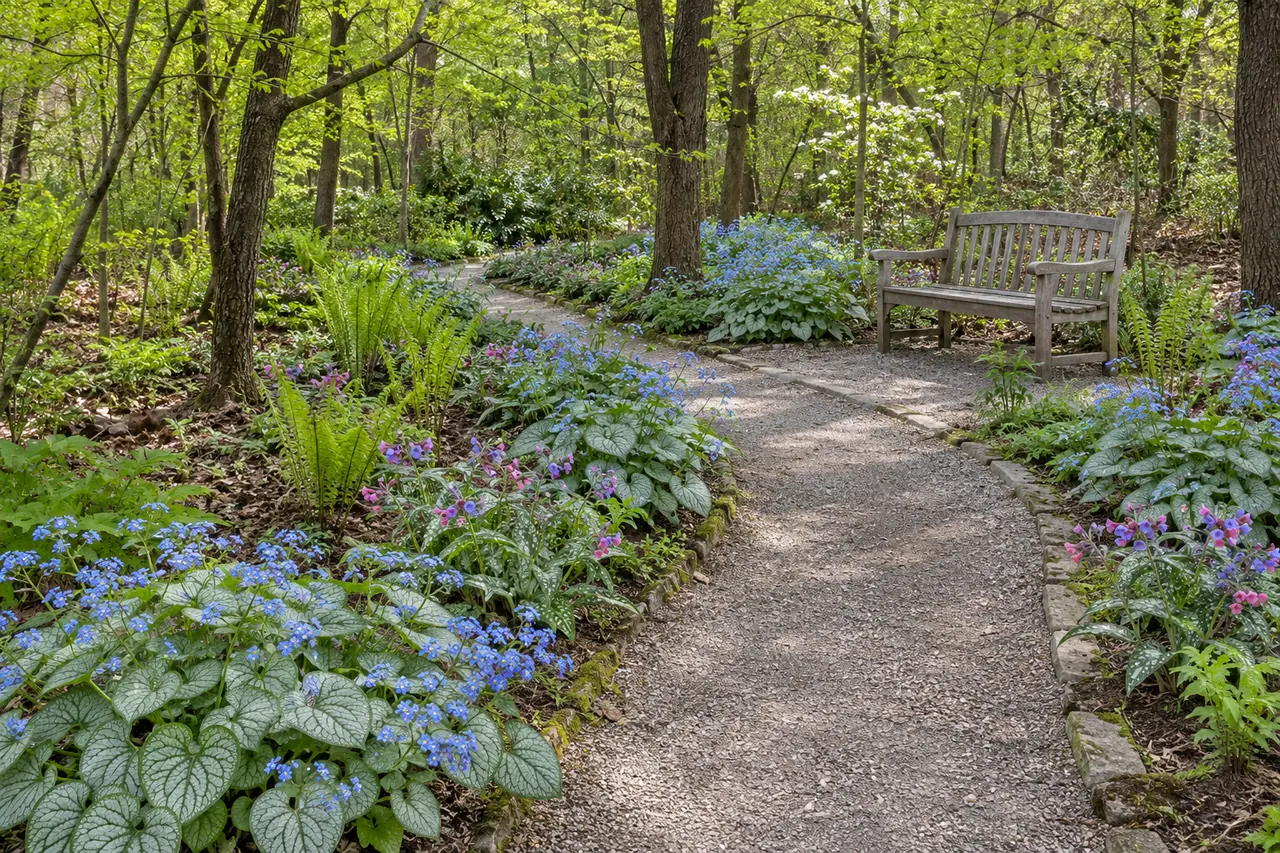
A modest woodland walk can feel rich without bright paving or elaborate furniture.
Let a narrow gravel path weave between repeated groups of blue-flowered brunnera.
Silver-marked leaves brighten the foreground, while spotted pulmonaria foliage and emerging ferns add another layer.
A weathered seat belongs in an existing clearing.
Keep the path’s curve gentle enough to use comfortably. You should be able to enjoy the planting without stepping into the bed.
Treat the blue flowers as a spring display, with the leaves providing later interest. Check local performance before buying enough plants for a whole drift.
Avoid digging through established tree roots to force the layout into place.
4. Make a colorful begonia patio with room for tea
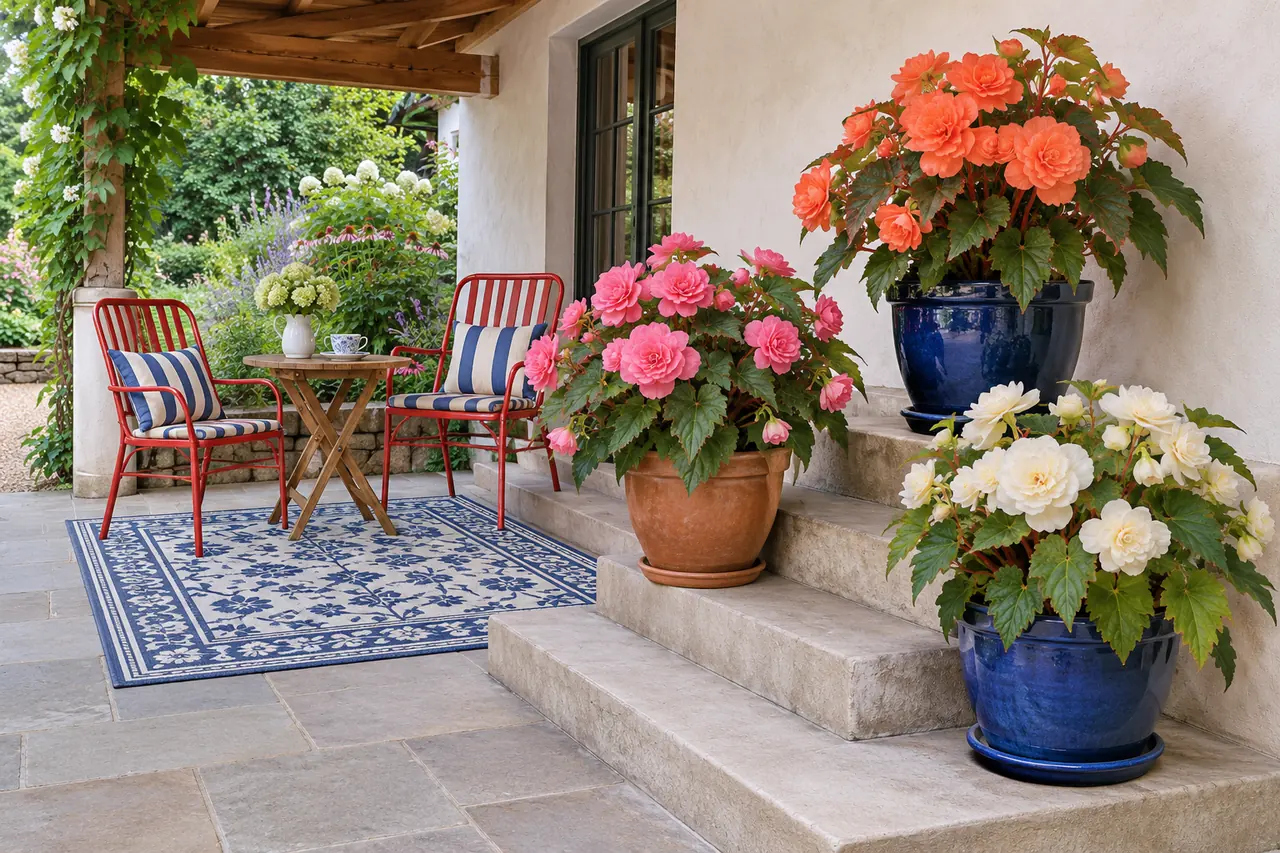
A roof-shaded patio can hold a cheerful flower garden when the sides still receive plenty of daylight.
Begin with the table and chairs, then position the pots.
Use substantial terracotta and blue containers of tuberous begonias in coral, rose, and cream. Place them at different stable heights beside the seating.
A patterned outdoor mat connects the red chairs to the pale wall. Keep its edges flat and the route to the door completely open.
Choose begonias for the actual light, using draining pots and suitable container mix. Water according to moisture, not simply because the patio looks sheltered.
I love how the flower colors make even simple furniture feel intentional.
5. Frame a shaded porch with a low impatiens ribbon
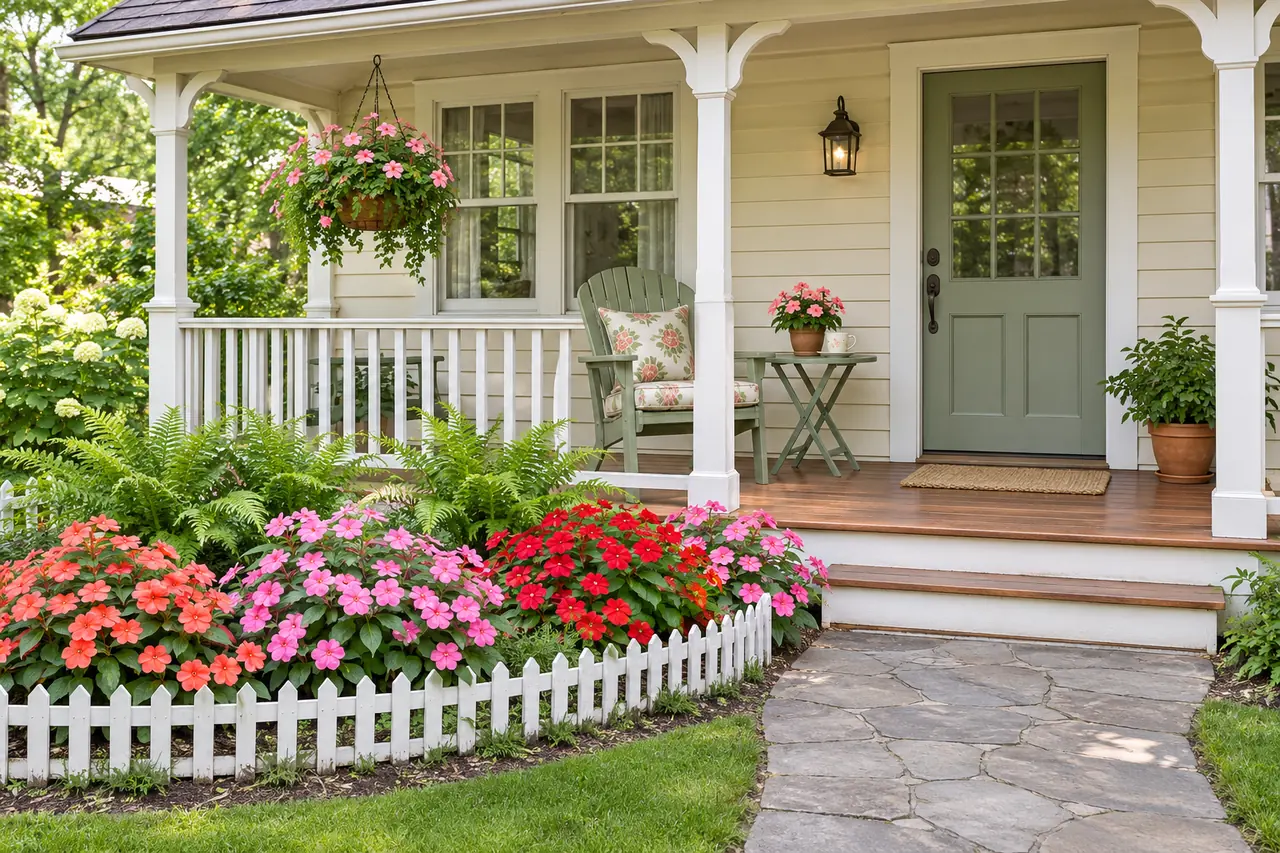
A low ribbon of impatiens can make a shaded porch feel connected to the garden. Keep the flowers outside the main approach to the steps.
Mix coral and pink mounds in front of green ferns, with a simple white picket edge defining the bed. Repeat coral in one chair cushion.
The porch itself needs little more than a sage chair and a small table. Leave the doorway and handrail easy to reach.
Ask for locally appropriate disease-resistant choices because downy mildew can be a problem. Don’t assume every impatiens sold has the same resistance.
In frosty climates, set these tender plants out only after frost risk has passed.
Estimate a planting quantity from the actual spacing
A simple rectangular grid example for plants whose nursery guidance specifies 60 cm spacing. These figures are not a recommendation for every shade plant.
Use the plantable dimensions
Example bed: 240 cm long × 120 cm wide, excluding the path, edging, obstacles and any protected tree-root space.
Count positions along the length
At 60 cm between centers, place four centers at 30, 90, 150 and 210 cm along the 240 cm length.
Count the rows
Two rows fit this example, with centers 30 and 90 cm across the width. 4 × 2 = 8 plants.
Test the plan on the ground
Mark positions temporarily before planting. Recalculate for different mature widths, irregular edges, access needs or plants that need more separation.
The 30 cm edge allowance is half this example’s spacing, not a rule for walls or paths. Allow more where mature growth would obstruct access.
6. Lift fuchsia baskets above a compact courtyard garden

When a courtyard has little ground space, a few fuchsia baskets can add another flowering layer.
Leave enough room beneath them for ordinary movement.
Choose a sheltered wall with bright, indirect daylight rather than a dark covered passage.
Position the baskets where you can reach them for watering.
Ferns in floor pots provide a quieter base. Pale green shutters, a lavender-blue chair, and one yellow patterned cushion bring the whole setting together.
Use suitable brackets and fixings for the weight of wet baskets. Keep runoff away from the seat and walking surface.
Let the hanging flowers provide the detail; the surrounding pots can stay plain.
7. Use hydrangeas as a flowering backdrop for a reading nook
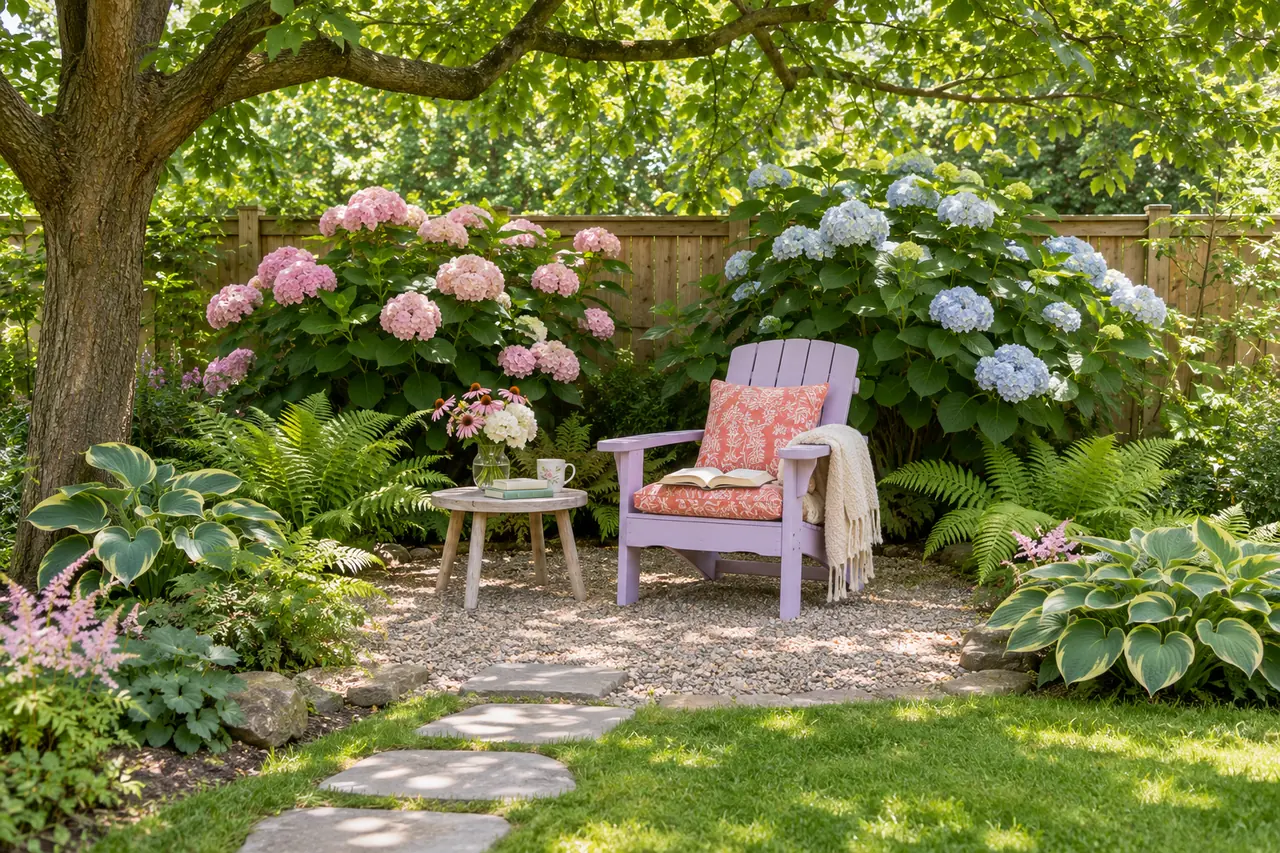
Hydrangeas can give a chair a sense of enclosure without surrounding it with hard screening.
Allow enough room for the shrubs to mature.
Put a pale lilac chair and table on a gravel pad. Keep lower ferns and hosta foliage between the seat and the shrub layer.
The large flower heads supply summer color, while a timber fence gives the planting a calm background. Leave an obvious approach through the garden.
Flowering depends on cultivar, climate, and pruning; deep shade isn’t a guarantee of abundant blooms. Soil and cultivar can also change flower color.
Choose the plant first, then coordinate the cushion with its likely flowers.
8. Keep a dry-shade tree corner light and root-friendly
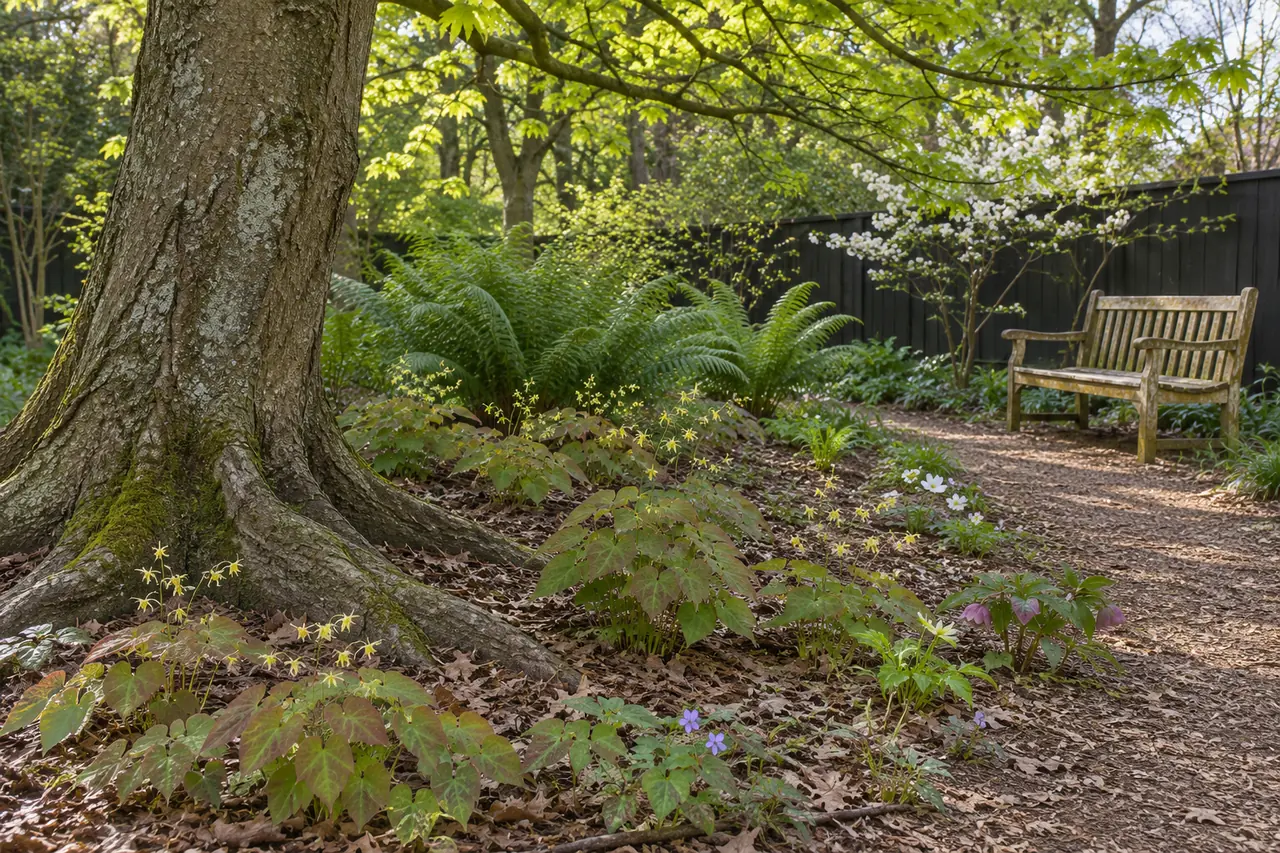
A tree corner doesn’t need a new raised bed to feel finished. Keep the trunk flare visible and work with the existing ground level.
Suitable epimediums bring low leaves and delicate spring flowers, with established shade-tolerant ferns adding texture behind. Leave natural gaps rather than forcing instant coverage.
Place an ochre bench on an existing path-side resting place, away from the trunk. Leaf litter and a dark fence make a quiet backdrop.
The effect should feel settled, not newly excavated.
9. Soften a side passage with a foamflower border
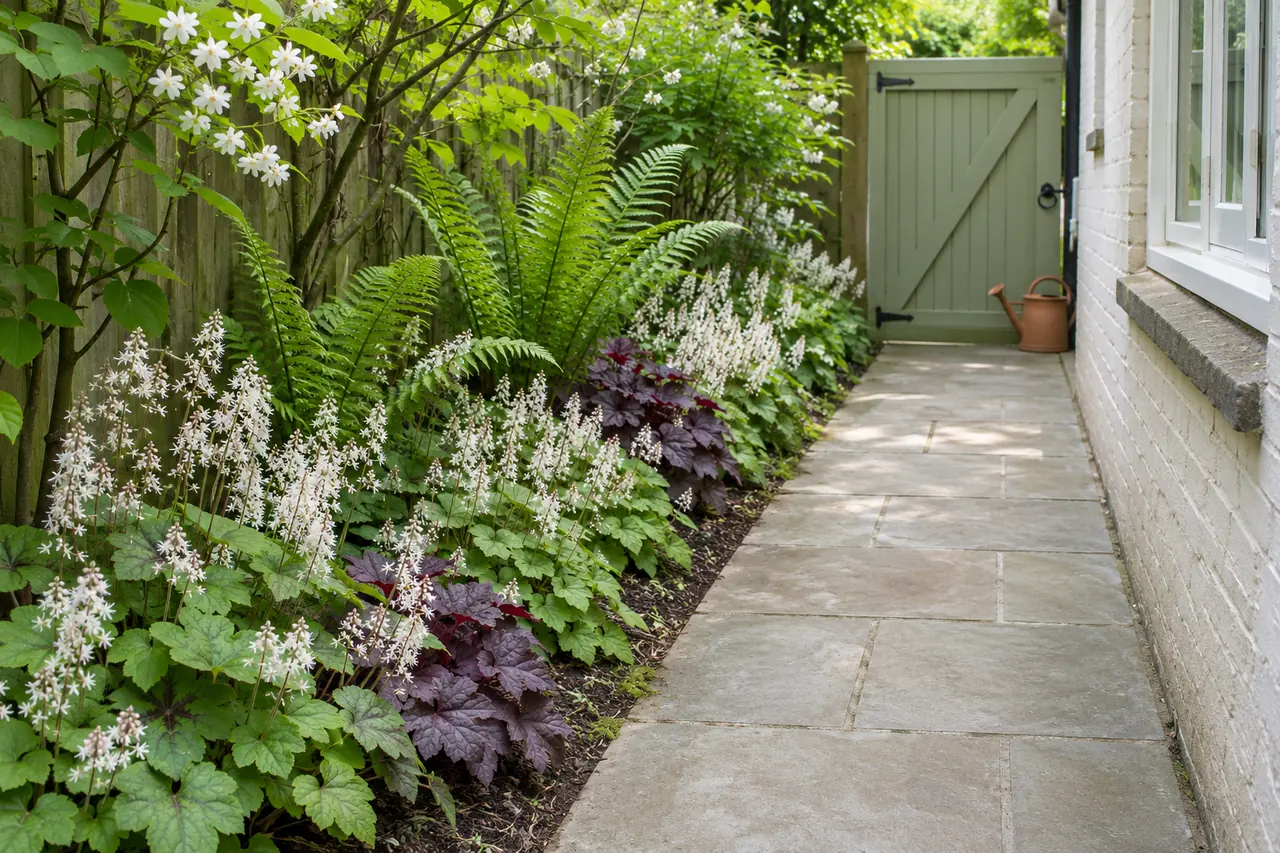
A side passage can become a small garden without losing its job as a route.
Keep the paving continuous and concentrate the planting along one edge.
Foamflower offers low foliage and airy white spring flower spikes, with upright ferns behind.
A few darker foliage accents stop the narrow border looking flat.
Use a pale green gate as the finishing point. There is no need to squeeze a chair into a passage that already has limited space.
Check where rainfall actually reaches before planting. Keep growth from spreading across the paving, especially where people carry bins or garden tools.
If the ground stays unsuitable, a different layout will serve the passage better.
10. Gather spring primroses around a courtyard birdbath
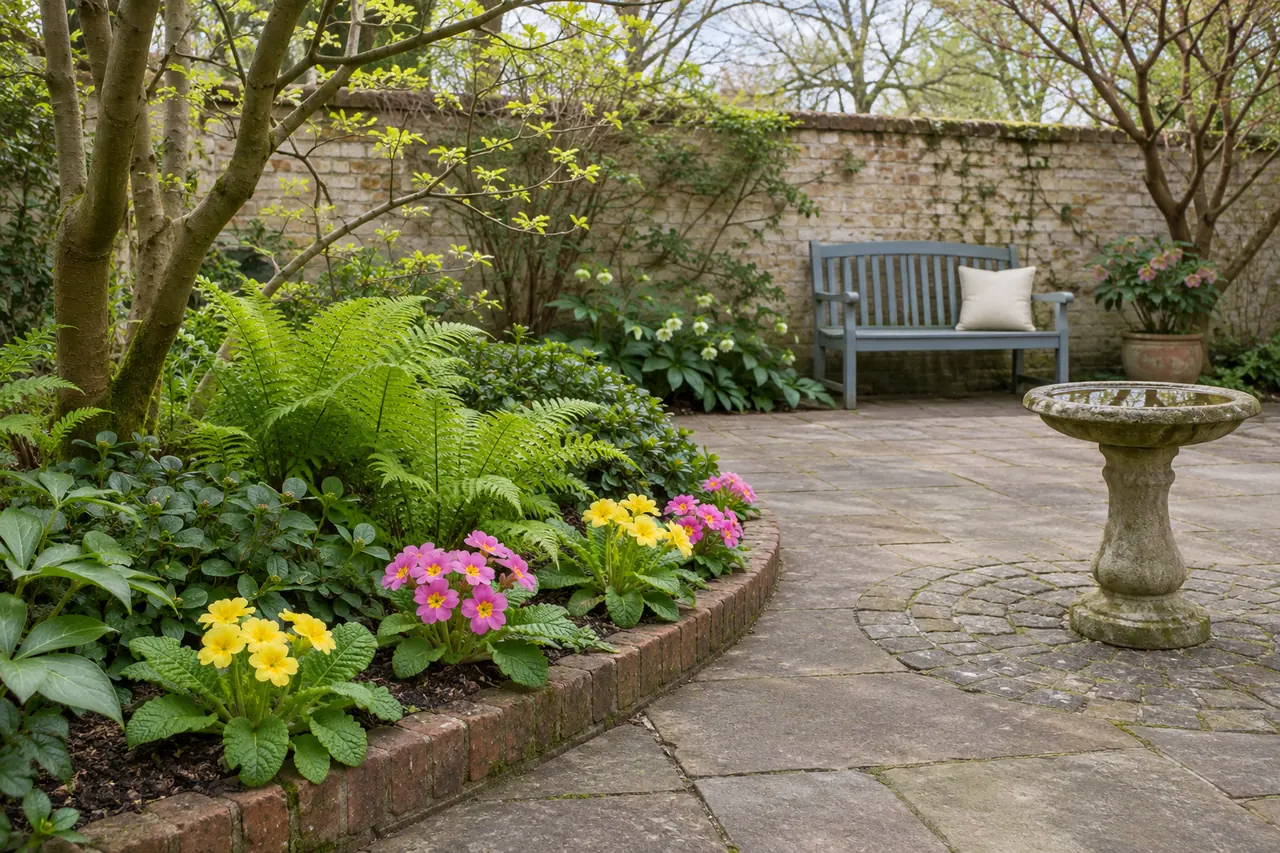
A small birdbath creates a focal point in a spring courtyard, but the planting should leave a clear way to reach and clean it.
Set the bowl on a firm paved circle, with yellow primroses and suitable pink garden hybrids in the adjacent border.
Fresh fern growth adds height behind.
Brick edging gives the low flowers definition. A muted blue bench on separate paving makes this a place to sit rather than just a display.
Choose garden plants suited to your climate, and don’t confuse temporary indoor florist displays with reliable outdoor planting.
Expect the strongest flower color in spring. The bench, stonework, and foliage keep the courtyard useful afterward.
Check the gaps in your flowering plan
A one-page calendar can stop a beautiful spring purchase becoming an unexpectedly empty summer border. Use local nursery information and your own observations.
Record the named plant
Write the exact species or cultivar and expected mature width. A general name such as “anemone” can cover very different plants.
Mark its likely flower window
Use a local seasonal range rather than copying a distant region’s month. Expect weather and establishment to shift the actual display.
Record what remains afterward
Note persistent leaves, summer dormancy, bare winter stems or useful seed heads. Choose which of those you want in the main view.
Keep replacement care realistic
List frost protection for tender pots and watering access for moisture-loving plants. A second flowering season is less useful if you cannot maintain it.
Choose complementary flowering periods for the conditions you have. You do not need every plant in this article to make one satisfying garden.
11. Run late-season anemones along an open-shade fence
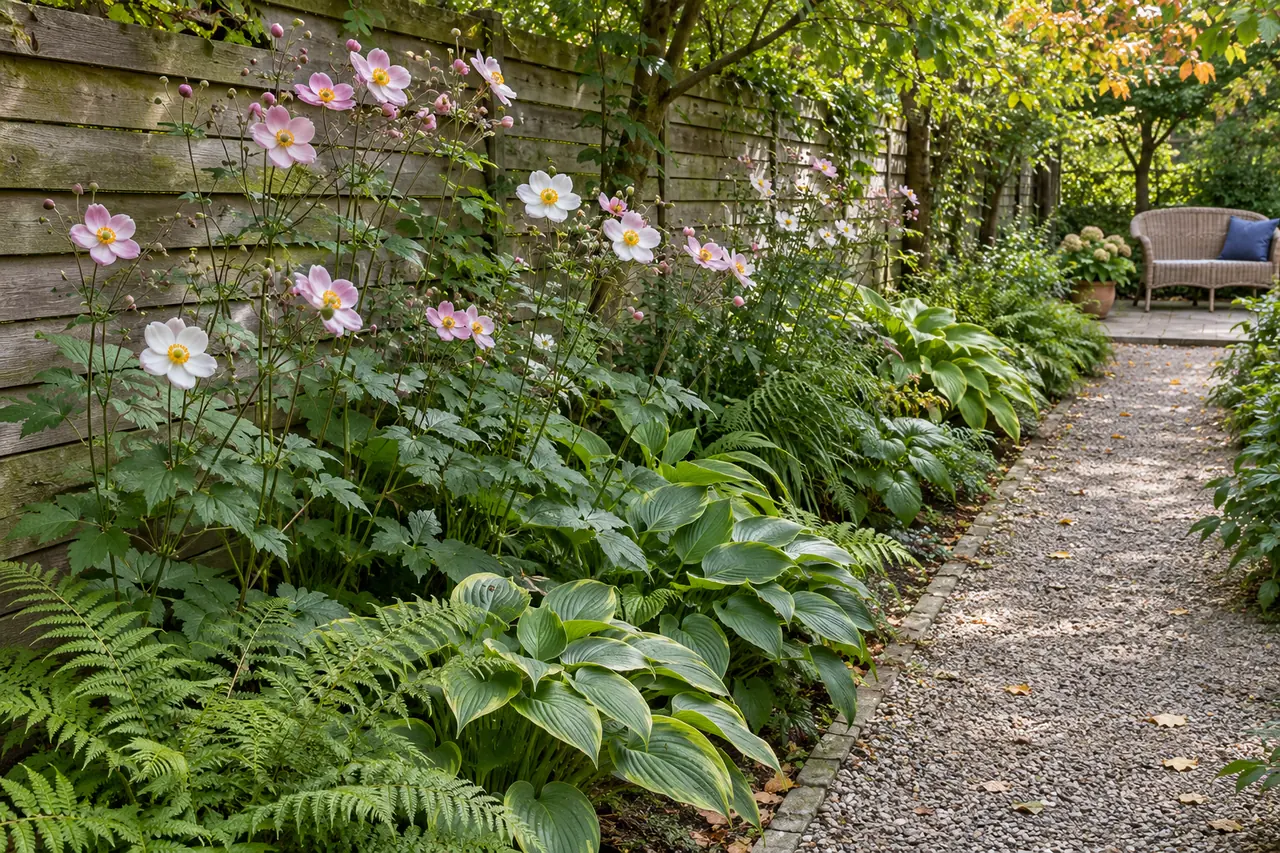
An open-shade fence border can hold its best flower display later in the season. Japanese anemones bring height without needing a solid wall of shrubs.
Plant them behind lower foliage, keeping the longest stems away from the path. White and pale pink flowers look clear against weathered timber.
A slim gravel route leads to a wicker bench on a small terrace. An indigo cushion adds color without competing with the airy flower stems.
Allow for spreading clumps and choose a place where you can manage their boundaries. A tiny mixed border may become crowded.
I like this as a late-summer view from a kitchen window or back door.
12. Edge a shaded entrance with purple-flowered lilyturf

A shaded entrance benefits from a planting shape that stays easy to read.
Repeat clumping lilyturf along one side of the approach rather than scattering pots everywhere.
Its arching leaves make a low ribbon, with short purple flower spikes adding late-season detail.
A taller evergreen layer gives the border depth.
Use gray stone edging and one cobalt fern pot beside the stoop. Keep the threshold and the walking route clear as the leaves expand.
Choose spacing from the plant’s mature width, not its nursery-pot size. Divide or edit crowded growth when needed.
The orderly outline is the main feature; flowers are a seasonal addition.
13. Layer coral bells into a colorful terrace border

A low planter can give a shaded terrace a garden edge while leaving the central floor open.
Choose plants for the planter’s drainage and light.
Use flowering coral bells with pink-red flower stems among leafy heuchera selections and soft ferns. Their leaf shapes make the layers readable.
A pale stone wall helps the small flowers show. Pair muted teal chairs with an ochre table and one purple floral cushion for the seating area.
Avoid a permanently wet root zone, and keep the crowns correctly positioned when planting. Follow the nursery’s spacing guidance.
Let foliage carry the composition outside the main flowering period.
14. Frame a cottage gate with spring bleeding hearts

A garden gate gives spring flowers a frame. Keep the approach simple, with arching bleeding hearts beside the fence and a clear brick path.
Emerging hostas and ferns make a lower layer that can develop after the main flowers. Place a cream bench in a gravel alcove.
A sage gate and blush floral cushion echo the soft pink flowers without turning the whole garden pink. The dark fence adds definition behind them.
Choose a suitable shaded site with moist, well-drained soil. Keep nearby plants from crowding the crown.
Mark its position before the foliage disappears so later gardening doesn’t disturb it.
15. Make a loose columbine island in dappled light
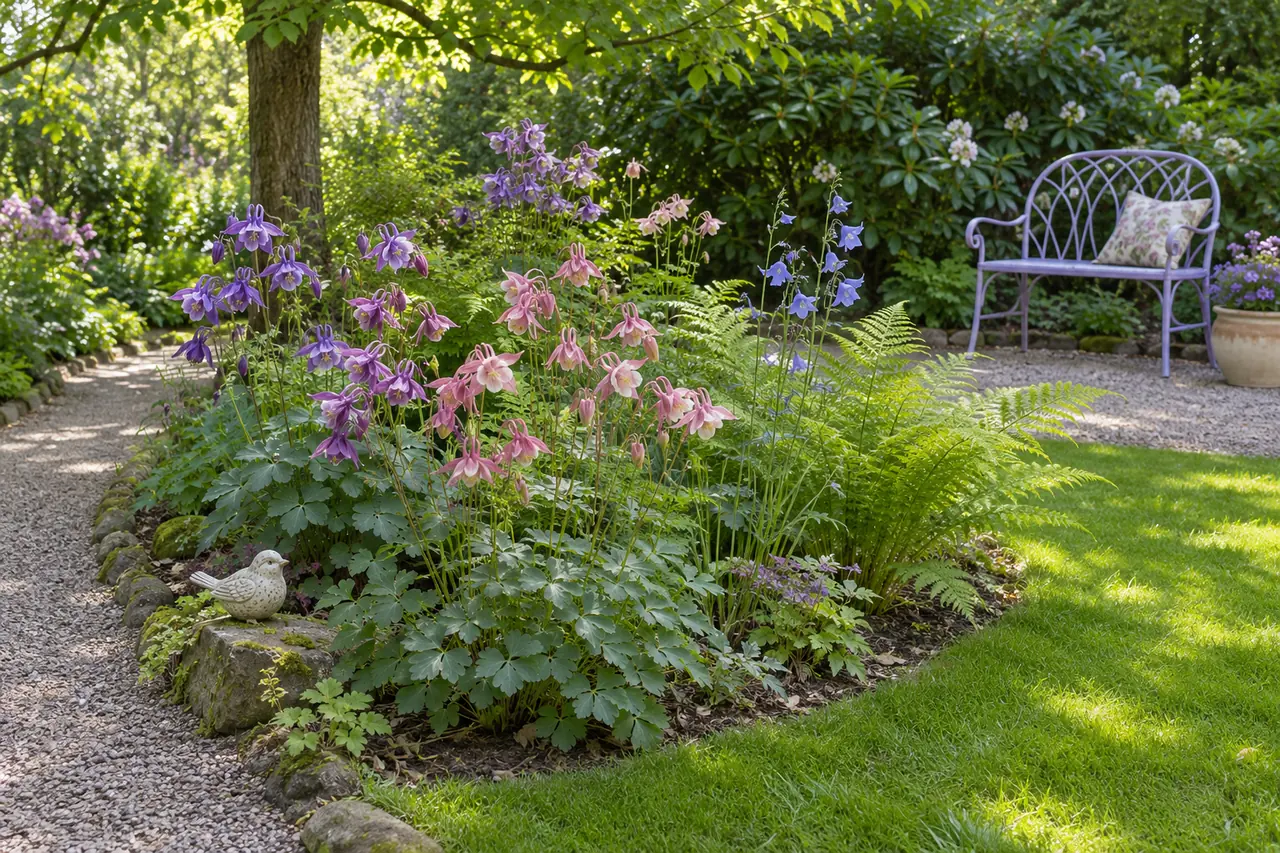
An island border works where a lawn edge receives shifting light from an open canopy.
Give it a loose outline and a clear path around one side.
Columbines provide spring flowers above divided foliage, with suitable bellflowers and ferns filling different heights.
Repeat a few colors rather than buying one of everything.
A pale lavender seat belongs on a separate widening of the path. One small ceramic ornament can finish the scene without becoming the focal point.
Many are short-lived and seed around. Decide whether you welcome that movement or will remove unwanted seedlings.
Keep the lawn edge reachable so maintaining the outline stays straightforward.
Questions before planting a shady corner
Can I get flowers under dense evergreen trees?
Sometimes, but the combination of heavy shade, dry soil and competing roots severely narrows your choices. Assess that site before buying a flowering collection.
The RHS guidance for planting beneath trees explains why the edge of a canopy can offer better growing conditions than the darkest area near the trunk.
Do shade gardens need watering?
Often, yes. A canopy can intercept rain and tree roots compete for moisture.
Containers also need their own moisture checks even when shaded.
Check the actual soil or potting mix and the plant’s requirements. Shade is not a substitute for adequate root-zone moisture.
Can I get continuous flowers from just one of these plants?
Do not plan on that. Flowering duration varies with the plant, cultivar, climate and growing conditions; many shade perennials have a clear seasonal peak.
Combine suitable plants with different flowering periods, and choose foliage you enjoy between those peaks. Keep the plan small enough to care for.
Should I put a raised bed over tree roots?
Avoid treating a raised bed as an automatic fix under an established tree. Added soil, excavation and construction can damage the root zone.
Work with the existing site, keep the trunk flare exposed and seek qualified advice before changes that could affect the tree.
Oklahoma State Extension explains the root-protection concerns.
Choose one scene your garden can support
Start with your light-and-moisture notes, then shortlist two layouts that fit. Mark the path and the mature planting space before ordering plants.
Choose the setting that will stay pleasant to use after the flowers fade. A comfortable route and thoughtful planting layers make the whole garden work.